Defining moments in the struggle to answer what it means to be human.
There is a coming tide –
It will consume the clouds and cover the sky
Dawning arrives as the sun sets and curtains are shut; beginning and end indistinguishable – It is time
Come away, do not be so close.
Abstract
The decolonisation project has always asserted as its end goal the creation of a new human face. This is arguably not only the greatest philosophical endeavour of our time, but a defining moment in history which will dramatically change the world and future generations. Perhaps more importantly, the application of fallism[1] within decolonial spaces and movements demands the imagining of the new human, how we can co-exist – if that’s even a probable likelihood – with a greater sense of urgency.
I’m tempted to use Pan-Africanism and Blackness as tools of analysis to forge this collective identity. For me, Pan-Africanism is an encompassing ideology of the liberation struggle. It emphasises unity and the need to have an “us” driven towards a common conclusion. This in turn then emphasises the need for collective identity because to some extent the “us” must be defined in some way. Blackness on the other hand further strengthens the idea of unity by calling on all things which are the antithesis of whiteness to unite in struggle against the system. The shortfall of Pan-Africanism though is found in how unity is formed on the basis of shared goals and values. Blackness mitigates this to an extent by appealing to a shared identity; which too inevitably is the result of common experiences so it is not exonerated from the above critique.
Introduction
This paper is contextualised around two events:
- The defence of Bill Cosby by the black community, particularly by black men, on charges of rape and sexual assault(Xaba, 2016)
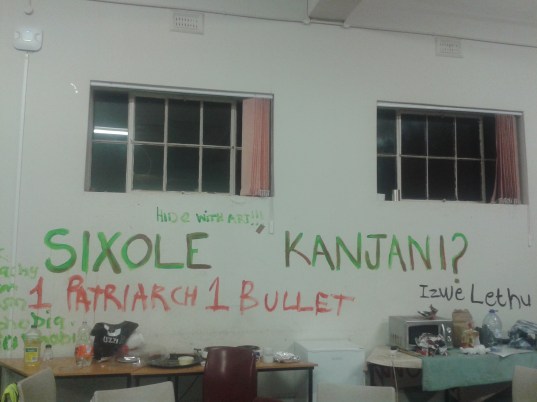
- The reclaiming of Azania House and #RhodesMustFall by womxn – trans*, non-gender binary and gender non-conforming identities, when the men of the movement were kicked out of Azania House during a meeting
Why identity is becoming a seemingly more appealing criteria for unity as opposed to common goals and values is a question not explored in great depth in this paper – suffice to say identity is enough of an incentive for people to be part of a movement which they feel they belong to, one which acknowledges, sees, and recognises their bodies. Therefore, as a way of finding collective identity, I’m going to turn to existing social constructs and constructivism in how they firstly shape a common identity, and from this attempt to navigate how these social constructs can lead to an understanding of a new human face and co-existence.
First and foremost we must acknowledge that in most cases we do not get to choose our identities, that role is fulfilled by our socialisation and upbringing. But even if we could, that these identities are often social constructs which are not “real” in a metaphysical sense, therefore even when consciously choosing your identity you are confronted with the cognitive dissonance of asking yourself what it means to identify with something which is a construct. The very concept of identity is also a construct. This is not to negate the fact that these construct have very real consequences in the world: race and gender are social constructs and they materially impact the level of meaningful self-actualisation and self-determination you have, how you interact with the world and how society responds. But for the sake of meaningful analysis, the use and adoption of social constructs can be used in the decolonisation project if we can meaningfully answer the following:
- Is the adoption of the concept justified?
- Does it privilege or negate other lived experiences in an illegitimate way?
- Will its adoption support or perpetuate structural and systemic violence?
From these three questions it is my hope there’ll be a level of clarity as to how collective identity as a result of constructivism can be an integral part of a broader liberatory framework unified in struggle as we attempt to usher in a new human face.
Is the adoption of the concept justified?
Before I go any further I must point out that my position as a male body and cis heterosexual man means interrogating this question is at the very least dubious. It is not my position as a person not experiencing a particular form of oppression to sit and judge whether the methods to a) highlight that oppression or b) dismantle that oppression, are acceptable or justified. That said, as opposed to this question being the platform to attempt to rationalise people’s pain and anger further marginalising very real lived experiences (despite that not being the intention), perhaps it is actually the opportunity for meaningful introspection.
As a starting point maybe it’s worth asking why the first response is to seek an explanation, and demand understanding for people’s actions. Unity is often seen as a sacred covenant which under no circumstance can be broken, and so much is done to protect this unity. At times without even questioning what conserving or protecting that unity means in terms of actually uplifting and protecting the black people this unity is there for. This reaction it seems is the result of a feeling of exclusion and expulsion out of a community and by extension the struggle towards a common conclusion. The outrage shown towards the willingness to break this unity without actively interrogating also how black men choose to be selective in this outrage, but more so not seem to want to question why that is how we respond, is one of the many shortfalls in attempting to find ways to reconcile collective identity and unity, but also impedes on the process of re-imagining and reframing existing ideologies into being more encompassing frameworks in the liberation struggle.
It never ceases to amaze though how people react in surprise and ask “how could they?” Logically, it’s the natural progression of any oppressed group involved in liberation struggle to be more radical, especially in the face of a blank stare which will only recognise their suffering on occasion. Therefore as a final act it should come as no surprise that the response is to band together as a way of gaining political capital. Consequently any resulting disunity is not only the obvious response, but “justified” in the sense of the word.
Crucially, as a question of what it then means to apply fallism to fallists (Matiwane, 2016) or as what Malcolm X summed up as “we can’t do to black people what we do to white people”, for me this is answered by what the decolonial project stands for and the aims it seeks to achieve, specifically by looking to the idea of what it means to be human. As a departing point I’m of the opinion that blacks should reach a point where we accept that we aren’t human, and that trying to reclaim that humanity amongst ourselves by appealing to existing constructs of what it currently means to be human is an exercise in futility. I’d even go as far as arguing that we should accept that we’re collectively far too damaged to be products or a part of the new Azania, and that what we’re working for will be for the next generation. That doesn’t mean that we should not fight injustices amongst ourselves, but rather, see them as ills which need to be admonished as they can’t be in what will be Azania. As such the idea then literally translates to: if you don’t embody what we’re trying to create you’ll be left behind because clearly we aren’t fighting for the same thing. With that understanding when fallism is applied to fallists, it is not then a matter of blacks imposing or finding their humanity amongst other blacks, but rather, actually a key part of the decolonisation project as it is literally the creation and reimagining of what it means to be human within our own spaces, clearing and forging the path towards a common, logical conclusion.
And those of us who refuse to learn and unlearn and do meaningful self-introspection, will be left behind as the lesser humans. Rightly so.
The tree looked and looked for its mother in what was becoming a feeble search
Its child clung on holding tight with thin tentacles
Feeling strangled the tree tried to find life elsewhere
Turning to its roots only to see that they too had grown to be the tree spread across its branches
Looking to find life the roots clung tighter
The tree had none to give and so spread its arms to the heavens
Maybe mother isn’t real, the tree finally thought.
Two worlds: one looking to find life, one looking to hold onto it
Does it privilege or negate other lived experiences in an illegitimate way?
At this point the length of this text is well over 1 200 words, and not once have I used the words “patriarchy, sexism, gender”. There’s often a reluctance which I’m also part and guilty of, to confront issues head on – in part because it speaks to the idea of introspection referred to earlier above. The dehumanisation of black people is undoubtedly deep, but far deeper for womxn. Black people have been reduced to property, colonial subjects and now mere means of production. For womxn this dehumanisation extends to patriarchy which effectively values womxn to the extent where they are objects for men. The failure to address the problem head on is a fear that comes with the implications of asking the old-age question: what does it mean to be human? If your entire lived experience and socialisation as a man has been under the assumption that womxn are meant to be owned and controlled by men, it is of course naturally threatening to concede the idea that womxn, non-binary, gender non-conformists and trans* people, are people. Because once you concede that they too are people and human (under the current construct or understanding of what it means to be human), you are then forced to ask yourself: if they are human, then what am I?
This level of interrogation is understandably intimidating and scary. Dealing with our demons it seems is not the most fashionable of tasks, even amongst those of us very familiar with the dungeons. But as with any trip into the dungeons, ultimately it’s a form of catharsis, healing and meaningful “transformation” in the sense of the word. If there’s anything to take from my slight digression into the intended subheading of this paper, is that actually moments like these are pivotal and give us a platform to better understand our identity and if these identity markers are actually valuable and are a reflection of true humanity.
But back to the point. It’s quite difficult reconciling a multi-faceted system of oppression to the reality of the seemingly singular struggle made against dismantling the system incognisant of the multiple oppressions exerted by the system. A common attempt to alter this phenomena can be seen in how the conversation around intersectionality is being had with increased frequency and is almost always a consideration before political action is taken. Albeit such dialogue is the result of a literal point of stasis and not an organic process. The fact that this conversation is in most cases a response to circumstance and something that becomes forced is quite telling.
Intersectionality as a political liberatory ideology or tool of analysis really is one of the nicest and most modest things in social movements. Not only has it suffered countless forms of appropriation deviating from its intended meaning and use, but its willingness and steadfastness to be an encompassing framework for social justice is all the more admirable as are its rightful proponents. True to Crenshaw’s words then: theory and practice that neglect to “accurately reflect the interaction of race and gender, because the intersectional experience is greater than the sum of racism and sexism”, does not seek to end systematic oppression in all its forms. Crenshaw argues that a key aspect of intersectionality lies in its recognition that multiple oppressions are not each suffered separately but rather as a single, synthesized experience (Crenshaw, 1989). This is useful in determining which experiences are accounted for in our social movements: when black womxn say they want it understood that sexism and patriarchy are forms of oppression that must be highlighted in the struggle, it is not an act of privileging some lived experience over others, but rightfully placing lived experience in its legitimate position.
More than that, intersectionality fits quite nicely in how collective identity is reconciled with unity in struggle. Apart from the political significance of adopting a collective identity and the unity therein, the concept of identifying with a collective speaks to the broader idea of finding common threads within a broader framework, further taking us closer towards establishing an understanding of humanity. Idealism dictates that I view collective identity as a yearning towards being part of something bigger than yourself, a macrocosm. Ultimately this transcends to a point where we’re all “one” able to identify with the suffering and experiences of all blacks (Nkopo, 2016). In pragmatic terms, this means a greater degree of fluidity. All the while understanding that the collective isn’t what makes the self, and that the individual experience is as meaningful as that of the collective.
Therefore in encompassing collective identity in a broader framework, the conclusion to draw is to view collective identity as what an imagined decolonised society would look like i.e. society after the revolution.
The little bird, weary and tired, came and sat on the branch
I will find cover under the great blue, it quipped
These waters are not of this land: fast approaching, angry, sad and high.
High oh so high no flight can save me
And so it was that the little bird looked up at the great blue once more only to see
The globe had stopped spinning
In that moment the universe understood what it was like to fly up alone, and for the first time
The cloud was carrying the sun
Will its adoption support or perpetuate structural and systemic violence/oppression?
The idea of violence as we know is a nuanced subject. For the sake of clarity it might be worth revisiting the understanding of what it means to reclaim something and how that relates to the politics of the movement and our understanding and conceptions of power. I must also say that the framing of this question may be completely wrong – indeed it may be that the set of three questions posited in the introduction and the analysis that followed are somewhat disjointed. Nonetheless the analysis still stands and people are welcome to then frame the issues differently.
The political act of womxn coming together as a collective and reclaiming the space has two interpretations:
- The consolidation of black feminism politics in the movement or
- Assuming control of the movement
There’s an argument that it’s actually one and the same thing, in that consolidating black feminism is in fact a way for the movement to be steered in a particular direction and gives certain individuals the opportunity to influence politics of the space. This is true, however I think it misses a meaningful distinction in understanding the scope of feminist politics thus casting different projections for what reclaiming of the space means.
It is entirely possible for #RhodesMustFall to be a wholly feminist movement centred on black radical feminism. At some point in order for the revolution to be complete I’d argue that it is not only necessary, but inevitable. What makes this possible is that black radical feminism as a liberatory ideology is actually one of the most encompassing framework in attacking a multi-faceted system of oppression for the most marginalised. The only inherent limitation in black feminism as far as decolonisation is concerned, is the question of what system will replace the old one. Therefore for the time being Pan-Africanism becomes useful in that regard in giving some direction.
To then speak to the question which is the heading of this section, I seek to provide clarity as to whether collective identity as a form of political capital, therefore power, can firstly cause violence, but more so if it is possible that it becomes structural in nature. The issue of violence and power are interrelated thus I’ll make my analysis from that lens. First is to get an understanding of what kind of power exists in collective identity and what then that means in the arena of politics. In general, power is the ability to control and influence. In its worst form it is the ability to dominate and oppress others (hooks, 1984). Following from that it would be disingenuous to lambast the accumulation of political capital/power for the purpose of being able to exert some level of control. bell hooks articulates it masterfully when she says that power shouldn’t be seen as something to shy away from because of the existing notions of power inherently linked to the oppression and domination of others. The power that lies in collective identity is in fact one that is yet to be seen in the form of control. On the contrary, its power is resistive – resistance to structural oppression and violence.
Further, collective idea as a form of power is ideally one which reconceptualises understandings of power and finds other methods of expressing that power (hooks, 1984). There’s a slight cognitive dissonance in the accumulation of political capital in the context of a bell hooks analytical lens, who explicitly said “before women [trans* and non-binary folk] can work to reconstruct society, we must reject the notion that obtaining power in existing social structure will necessarily advance feminist struggle to end sexist oppression”. Again, this is one of those moments where I’ll take a sit and not pass an opinion on what’s appropriate in waging struggle that doesn’t materially affect my being. What I will say though about collective identity in relation to the above quote and power, is that in keeping true to the role of collective identity in shaping society post-revolution, it will then place a different value on power. But more so, as a tool in struggle, it serves as a reminder to those vested in power to find other modes of power which advance struggle in a framework consistent with the principles of decolonisation.
Now whether this form of power can cause violence is admittedly too much of an abstract/metaphysical question. It’s simplistic in my opinion to say yes because that’s just working off of an existential possibility that can be easily likened to “anything is possible”. But it would also be disingenuous to not take into account earlier analysis of how collective identity is a fundamental process of decolonisation and an imagination of what a decolonised community would look like. Obviously ideally in a decolonised society structural violence won’t be a thing. But is it possible that post-revolution there may be new and other forms of systemic violence and oppression? Yes. Can collective identity have a part in that? I don’t know. Is it possible? Yes.
Clearly this question is too “futuristic” and doesn’t materially impact what’s justified currently. At this point a lot of things are uncertain and the answer to a lot of questions is “I don’t know”. Although it means there must be some level of caution exercised it certainly doesn’t mean things mustn’t happen.
What I can say with a level of certainty, and with a bit of clarity, is that the future uncertain as it may be, may yet have to question the very methodology which brought it to being, and perhaps more Meta, a new conception of existentialism.
Between the coming tide and the cloud that carried the sun
Which should weep for the world
And shed tears to water the tree
When the globe starts spinning once more, to what will the little bird look up to see
When the wind howls and the tree dances the sacred dance of life
What sway will give freedom from the deep firm underground?
Conclusion
This paper has sought to show how collective identity as a result of constructivism can be an integral part of a broader liberatory framework unified in struggle as we attempt to usher in a new human face. Indeed, the paper argued how collective identity should in fact be interpreted as a fundamental process of the decolonial project as it is the construction of something new, and provides slight glimmers into what a decolonised society would look like. Secondary to that, as part of a liberatory framework it provides the bases of connecting threads, providing useful identity markers of true humanity, helping clear a common path towards the logical conclusion.
Understanding the role social constructs materially impact the lives of individuals, they are difficult to completely ignore in passing judgement on what’s unjust. Therefore problematic as they are they must be used as tools in determining responsibility for people’s actions. However, as opposed to the reactionary response of addressing the effects of a flawed system and construct, this paper has also argued that for meaningful change collective identity must serve as a tool for the creation of new systems and constructs which are a reflection of true humanity, and thus in determining what is an ill in society, it does so for the purpose of advancing humanity and social justice. All the while in the hope that these new systems will not end up creating new forms of structural violence.
It is no doubt that there will be dark days ahead, but we must remain steadfast on our quest. We must remember that the Black existence is dire. It is this fact of bleakness that makes it so easy for black folk to wallow in frustration only to be perpetually trapped in an endless cycle of misery and meaninglessness. Revolutionary struggle is the only way out and without it the black face will never know the form of humanity.
Our hope lies in a shared dream of finding an expression of true humanity. If not for anything else, may this deep and intense yearning – to know what it means to be human – be the cord that keeps us together.
Dawning arrives as the sun sets; beginning and end indistinguishable
Between the coming tide and the cloud that carried the sun –
Lie two worlds that have grown to be one – holding onto and looking for life.
Death and eternity have always been in the middle
And unto them all judgement will be conferred
For death and eternity have never known the face of freedom
They are the children of life, descendants of existence
Slaves of creation
They did not come away at the beginning and close of time
Works Cited
Crenshaw, K., 1989. Demarginalising the Intersection of Race and Sex: A Black Feminist Critique of Antidiscrimination Doctrine, Feminist Theory, and Antiracist Politics. University of Chicago Legal Forum, pp. 139-167.
hooks, b., 1984. Feminist Theory: From Margin To Center. 1984 ed. Boston: Boston, MA : South End Press.
Matiwane, M., 2016. Kopano dining hall conversations during deferred exams [Interview] (January 2016).
Nkopo, A.-N. E., 2016. Facebook. [Online]
Available at: <script>(function(d, s, id) { var js, fjs = d.getElementsByTagName(s)[0]; if (d.getElementById(id)) return; js = d.createElement(s); js.id = id; js.src = “//connect.facebook.net/en_US/sdk.js#xfbml=1&version=v2.3”; fjs.parentNo
[Accessed 3 January 2016].
Xaba, W., 2016. Facebook. [Online]
Available at: https://www.facebook.com/permalink.php?story_fbid=1560194844300193&id=100009290783076
[Accessed 4 January 2016].
[1] Not a fixed definition – in essence demanding the fall of a system that is anti-black which negatively impacts your existence, with the aim of replacing it with something new.
Discover more from Simon Rakei
Subscribe to get the latest posts sent to your email.
 Simon Rakei
Pingback: Untitled | simonrakei