I wonder, is this the fate of our Nation?
I wonder what is wrong with us? Why do we blame creation?
How could a god that only creates be the source of devastation?
– Akala: The Search, Chapter 1: Knowledge Seeker
Balance is a curse to those called by dual extremes. It is standing on a knife edge, living life walking a tight rope – a two edged sword of great heights or powerful lows. Balance is holding life and destruction in one hand. And yet, the middle way, a single mindfulness, is but a way to say you could not wholly belong to a side. So, the path of the middle way risks being but a half-answered call, a half measure; empty. Balance is a curse to those called by dual extremes.
It’s difficult to imagine now that at a point in my life, roughly 3-4 years ago, I was ready and willing to become a monk. It was a time when to some degree I felt the fire that drives life deep in my heart – a roaring passion – and I had a gentle taste of the deliciously sweet, soft water which contained meaning and love I can’t quite put in words. As of late I now feel only an emptiness which burns away at rotted ash, I feel like a sacrifice left broken and battered upon an altar. The tragic irony of it all is I endeavoured to know the cause, core, root and source of that fire I felt. A quest to uncover the hidden – a search for truth – led to an emptiness which has again left me to wonder if it was worth it, or meaningful.
There are multiple possible reasons to explain this void and it is not my intention to detail through the majority of these – indeed some of them are quite plain and simple to see. Rather, I’d like to particularly focus on and attempt something of a study, on what some would call a natural disposition, or inclination, towards the divine. To examine this rich fervour towards the religious, spiritual and esoteric from my own experiences and what that has led to, and if from that we can begin to ground our experiences, aspirations, and practices in a way that is meaningful. As I’ve stated in my previous posts, what I consider meaningful within the context I find myself in is something linked to resistance of the imperialist white-supremacist capitalist patriarchal super structure, and, that which leads to the pursuit of social justice. Therein perhaps will lie the answers to the search we have for the meaning and purpose of our lives, and maybe, an experience of the divine.
This is also probably one of the most complex, difficult and challenging pieces of writing I’ve ever undertaken, and so it will be imperfect in many ways.
A better articulation of this natural inclination I speak of, and which I wish to examine in closer detail can be found in an extract of Du Bois’ The Souls of Black Folk where he says:
“The Negro has already been pointed out many times as a religious animal,–a being of that deep emotional nature which turns instinctively toward the supernatural. Endowed with a rich tropical imagination and a keen, delicate appreciation of Nature, the transplanted African lived in a world animate with gods and devils, elves and witches; full of strange influences,–of Good to be implored, of Evil to be propitiated.”
The above has problematic undertones of anti-black racism but we’ll forgive Du Bois, further, I think the essence of the point being conveyed remains undiluted.
I was having a conversation with someone who at a point said Black People Will Never Stop Believing in God. As soon as I heard the phrase it struck me and I vowed to write something on it for further exploration. In fact, it was the original title of this post, but I’ve since changed the title to what it is now.
I changed the title to simply ‘Decolonising God’ from the previous title ‘Black People Will Never Stop Believing in God’: upon second thought the former makes the characterisation of the natural inclination or disposition towards the divine/God/supernatural which is the subject of study in this piece, less(?) offensive or insulting as the previous title may have insinuated – which wasn’t the intention and I apologise for that.
The idea of ‘Decolonising God’ makes this inclination appear in a positive light (which in any case is the conclusion reached in locating how it was instrumentalised in the Haitian revolution and slave rebellion, and the bulk of this piece actually intends to push people to that conclusion towards a more ‘meaningful’ practice of their faiths), as it allows for the opportunity to redefine our relationship with God, and instead of appearing like an inherent disadvantage it becomes an ally. On a stylistic note or in terms of framing I don’t know why that didn’t appear to me sooner as to what should have initially been the title of this piece.
As for ‘Black People Will Never Stop Believing in God’, the phrase is almost self-evident in its claim and is a truism of sorts: you only need to look at the amount of religious zeal black people emanate in our everyday lives. Whether it is a nigh unimaginable and unfathomable scenario involving Doom being sprayed on congregations’ faces, and recently drinking Dettol, to the somewhat more ‘conservative’, moderate and widely accepted eating and drinking of The Body and Blood of Christ made manifest in bread and wine (which upon reflection I think is equally sad, more so as condemnations of the aforementioned example of Doom became more ludicrous if not hypocritical coming from Christian sects with logically questionable rites), it seems to me both these examples and practices, and particularly why, how and for what reason people buy into these practices, is underpinned by a common driver. And it is that I wish to understand and explore.
Consequently, I will not necessarily or directly argue to show the truth purported by what I originally intended to be title of this piece as I submit that the status quo offers numerous examples which at the very least make the claim reasonably true. Besides, if I were to argue directly for the affirmative it would only yield in a basic discussion which at best will peak in questioning the existence of god, or even the nature and conceptions of god, and the nature of belief. Instead of taking that route, we can confront the fact that the majority of black people hold some sort of belief(s) in relation to explaining and understanding the forces which drive this world and our lives. For me, this is a question which is fundamental in nature.
Whatever the religious or spiritual inclinations are, I think the root of the issue has to do with fundamentally exploring the idea that Black People simply have a kind of natural gravitation towards understanding the mysteries of this world, a kind of intuitive knowing, and believing that there is something more to existence beyond the physical world, a natural inclination towards believing in something ‘divine’ and a connection to that realm.
To help ground this piece before it floats away I will primarily rely on three texts for reference and as a centre for which to hold this piece together. I use W.E.B Du Bois’ The Souls of Black Folk first to explore this idea of a natural gravitation and ground it in lived political, social, economic and spiritual realities of black people following the abolition of slavery in the United States of America. I choose this book because I think our spiritual malaise, search for meaning, purpose and paths of resistance is akin to a kind of enslavement, and thus drawing experiences from that era might prove to be insightful. I’d also recommend reading Ayi Kwei Armah’s Two Thousand Seasons. There are general truths which don’t necessarily rely on text and can be seen in our everyday lives: religion, in general, provides a source of certainty, strength and hope to many. It’s a source of comfort and assurance, providing answers to life’s hardships and challenges. In particular for Black People who lead lives of endless toil, suffering, misery and struggle, religion and or spirituality serve as forms of momentary rest and respite. And from my own experience, being told for instance that the purpose of life is to “know and love God” made my existential woes less burdensome as I could direct all my energies to that one goal, and as I’ve said ironically now put me in this position leading to this deeper study of that drive. That said, conditions such as slavery and the hardships of living on the plantation make all the above general explanations for this natural gravitation even more potent.
The next book I use is C.L.R. James’ The Black Jacobins. This book is a historical account of the Haitian Revolution – the only successful slave revolt in history. I use this book to form a dialectic with the first such that the two experiences speak to each other, I hope it provides from those experiences possible vehicles and paths of resistance to draw from. And it is my personal ambition that through drawing from the spiritual strivings of Black Folk in Du Bois’ work to a successful slave revolt in The Black Jacobins, a search for meaning is merged with purpose, thus splitting the false dichotomy that exists in modern spiritual strivings of black folks divorced from following the path of resistance and social justice in favour of rampant consumerism, materialism and neo-liberalism perpetuating legacies of imperialist white-supremacist capitalist patriarchy and modern day slavery. Whilst The Black Jacobins isn’t necessarily relevant to the subject of this essay I think, or at least for me personally, it offers much needed catharsis which I believe many of us are searching for.
From the above dialectic I finally hope to arrive at some kind of resolve in my own existential woes and questions of what I’m doing with my life – here I use Ngũgĩ wa Thiong’o’s The Devil on the Cross to attempt to chart a new path, particularly linked to resistance, following the result of the merging of meaning and purpose. That is simply to say I get closer to something spiritually fulfilling, or at the very least I come to some resolutions to soothe these woes (for instance I could arrive at a resolution saying that my inclinations towards believing in the idea of purpose, even meaning, are flawed). Perhaps I’ll even clarify if I believe in anything. And out of that I make some commitment as to how to move from here as I find paths to walk with a more focussed single mindfulness – or at least one devoid of half-measures.
In locating the above three works in this piece, I draw from my own experiences focussing on my years growing up Catholic. I begin this meditation by exploring my journey through the Catholic Catechism which culminated in my exposure to works of various Catholic monks such as St. Francis of Assisi, St. Dominic, and St. Thomas Aquinas in answering some of my earlier existential questions growing up, and attempting to understand meaning and purpose in general, the nature of God, and suffering as purported by the Church. In particular, I attempted to read the Summa Theologica in high school, which is essentially the founding document of the Catechism and doctrine of the Church as authored by St. Thomas Aquinas, and I didn’t get too far (the book is over 6 000 pages long). Next I detail my journey into discovering the epistemology of the Church – believe it or not it began with a Dan Brown novel so I went through that phase around grade 10 – and in unravelling the origins, epistemology, and foundations of the Church and by extension all of Christianity, I was exposed to other beliefs and forced to confront them. This then leads lastly to the Esoteric part of this piece – as I slowly moved away from the Religious aspect from Christianity to Hinduism and Ancestral Veneration and ‘African Spirituality’ to ultimately the more ‘metaphysical’ interpretations of Eastern and African philosophical texts. The last phase is perhaps better explained by Buddhism which technically isn’t a religion and doesn’t ascribe to a belief in a deity or God (in any form/conception).
In following the above structure which will loosely form under three sections in this piece, I’ll then integrate relevant text from the books I’ve mentioned where applicable in speaking to certain issues. Further, because the above structure is broadly descriptive in nature the connection may not be immediately evident with the works I’ll be citing, that said the experiences do provide some context and grounding for the conclusions I wish to arrive at. By recounting my own experiences I wish to make the conclusions follow from the premises in a way that is intuitive. Therefore even though the conclusions in part will be drawn from the works of Du Bois, C.L.R. James and Ngũgĩ, ultimately they will be grounded in the framing I’ll set up of my own lived experiences.
I primarily hope this piece strikes with people who identify as being Christian and particularly those exploring some of the contradictions raised by the resurgence of decolonisation; what that means for various belief systems and faiths, or for those trying to locate the role of their beliefs in relation to the unfolding currents of our time. There is a rich history and practice of spiritual strivings linked to a culture of resistance and rebellion which in part I hope this piece sheds light on. Whilst my political inclinations with respect to some of the issues remain somewhat at bay in this piece, I hope that by shedding light on what I think is a kind of natural inclination towards the spiritual, a more meaningful spiritual practice and pursuit is undertaken. A practice and pursuit linked to purpose, resistance and importantly, land.
Dear disciple of truth. Wisdom is the fruit
You can only know what’s true if you examine the root
Peace and happiness visit the home built from the bricks of justice
And the throne that is built from the same, is never ever rusted
So rise above your senses young one it’s a must (Akala, 2014)
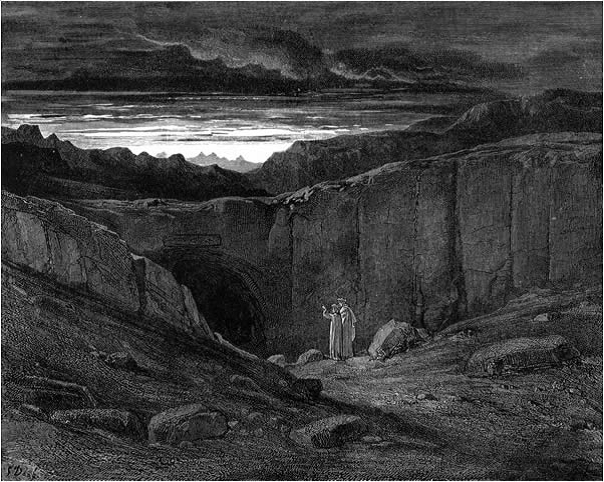
“All hope abandon, ye who enter in!” Canto 3 of Dante’s Inferno in the Divine Comedy
Early Years – Introduction to the Church, and The Beginning of The Search
Most of my childhood was spent in an old colonial town that was divided into 4 sections, and like many similar places in the 2000s, particularly after the land grabs and whites were leaving in droves, black people moved to these areas and the informal settlements that existed prior to the 2000s ceased to exist. Or perhaps said differently, I never saw a shack growing up and I’d like to think I traversed a significant part of my city given its size. The townships remained both tangibly and symbolically as many markers of township life were exported to the suburbs, for instance, it wasn’t long before there were spaza shops, street kids, children playing soccer or hopscotch in the streets, corners to use prepaid phones, buy airtime, snacks or even roasted mealies and peanuts. It made the place feel strangely homely so I never felt out of place. Anyway my mom at the time who was completing her teaching training was earning enough to begin renting in these now vacant suburban houses which had found new owners and landlords in the aspirant black bourgeoisie.
In a typical 3 or 4 bedroom house, there’d be at least two, and sometimes three families sharing and co-living in that house. Sometimes the cottage house, or ‘boys’ cot’, was often let to smaller families or couples. I found it to be a normal if not lovely way of living – it was a way to form some kind of close knit bond with others – almost like having two families, but more importantly, it brought the idea of collective ownership and principles of sharing to life in a practical way.
It was a kind of utopia and an optimal lifestyle which prioritised the collective good, welfare and benefit of others (for instance it’s literally impossible to ignore the fact that someone else doesn’t have food when you both use the same stove, store food in the same cupboards), we shared struggles and helped each other. It was all good and well until of course you were reminded that you actually don’t own the place and had to pay the rent at the end of the month. The rental business was really profitable. By the time I was ten years old we had moved at least 6 times to different houses due to the increasing rent. There’s a particular feeling I couldn’t articulate then, of dispossession, displacement, shame and insecurity, which one feels about not wholly having a permanent place you know you can go to. The radius of this town was no more than two kilometres, it was a small town and so there were very few places to move to. It became annoying when as I child I had to explain to my peers and friends why we had moved houses, or that bluntly we didn’t own a house to call our own.
Anyway, the above bit doesn’t really have anything to do with this piece: I just felt like writing briefly about this part of my childhood and will expand on it another time.
This piece however and my search for ‘God’, or trying to know god, does begin in this town, and in my childhood.
I was seven.
It was around the month of August and we were walking back home after the weekly Wednesday meeting we had with church goers who lived in our vicinity.
Every Wednesday evening, almost without fail, we would congregate at someone’s home for prayer and primarily, a meditation on the rosary. These Wednesday nights were opportunities to connect with neighbours and strengthen the existing catholic community, and there’d be the subtle household contestations which I assume are typical. For instance, who would make the best scones, or muffins for tea that would be served after the rosary was completed, or whose home had the best crochets adorned on sofas. Inevitable class antagonisms arose but on the whole, it was somewhat lovely, also because there’d be niceties to eat afterward; except when it was our turn to host visitors because there’d be a mountain of tea cups to wash and tedious cleaning before-hand. But it was worth it because there’d be guaranteed biscuits and scones which we didn’t have often.
On one such night, as we were walking back home, my mother started reflecting on the recent meditation. I don’t remember exactly what I had said or asked, or how we got to that point in the conversation, but the only way I can make sense of what she then told me is to assume that this happened in the month of August. The subject of the conversation came to the Virgin Mary, who is a central figure both in the church but particularly when it comes to the rosary. Maybe I had asked something which was fundamental to why people pray the rosary (or to Mary – but that’s for later in the piece). As we were moving along discussing the Virgin Mary and her role of interceding on our behalf, she said, that once every while there are sightings, the official term being apparitions, which for all intents and purposes are a supernatural appearance by the Blessed Virgin Mary. And why I say it must have been August, is because that is the month in the liturgical year of the church dedicated to the Immaculate Heart of Mary and when people pray the rosary and novenas most intensively. And specifically to what she then said, August is also the month with many reported apparitions.
My mother told me, especially in the case of children, that it was common for the Virgin Mary to appear or show herself to those who devoted themselves to meditating on the rosary. She even cited a recently reported apparition somewhere in Europe.
This simple claim came to define a large part of my life from that day until now. It stirred a deep yearning and unrelenting desire, which has at some point drove me to consider becoming a monk. I’ve since come to define that yearning from wanting to ‘know God’ to what I can loosely now say is a search for meaning, or purpose, having since parted ways with the rigid conception of God the church espouses, and contradictions therein. Today I now wonder whether if my mom had replaced the Virgin Mary with an alien or space ship in the sky, if I would have responded with the same intensity in finding and discovering such occurrences.
I don’t know why but my response to that claim compelled me to seek out this divine encounter, such that at a point I even came to define it as the single purpose of my life, and in that moment, I’d come to find meaning in that encounter. Maybe it was also a form of discipline or trying to get me hooked into the faith. Whichever it was it worked because I’ve devotedly recited the rosary from that day well into my late teenage years.
Wednesdays from this time in my life were one of my favourite weekdays growing up, with Thursdays and Sundays coming second: Wednesday is the day dedicated to meditating the Glorious Mysteries of the Holy Rosary. As the name suggests, the glorious mysteries are celebratory in nature (they are The Glorious Resurrection of Our Lord (John 20:1-29), The Ascension of Our Lord (Luke 24:36-53), The Descent of the Holy Spirit at Pentecost (Acts 2:1-41), The Assumption of Mary into Heaven, and The Coronation of Mary as Queen of Heaven). I enjoyed meditating on these mysteries, and later I came to enjoy meditating on the luminous mysteries, or the mysteries of Light which Thursday is dedicated to. The Luminous mysteries are a more recent addition as traditionally there were only three mysteries (glorious, joyful and sorrowful) until the church decided to make this addition. They are: The Baptism of Our Lord in the River Jordan (Matthew 3:13-16), The Wedding at Cana, when Christ manifested Himself (Jn 2:1-11), The Proclamation of the Kingdom of God (Mark 1:14-15), The Transfiguration of Our Lord (Matthew 17:1-8) and The Last Supper, when Our Lord gave us the Holy Eucharist (Mt 26). I learnt many things as I spent almost 45 minutes daily contemplating the various mysteries, and gained a lot too.
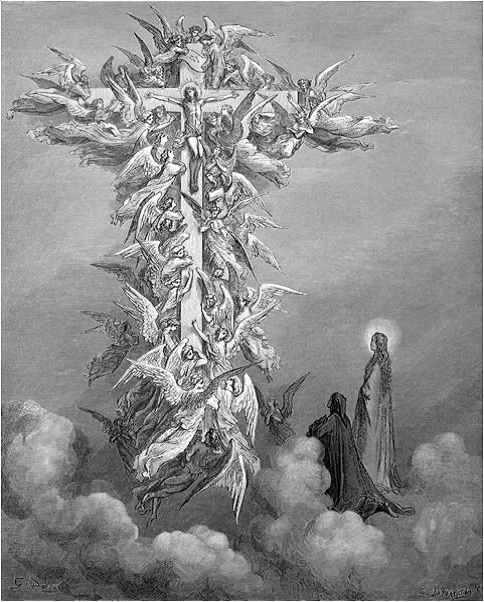
“On that cross as levin gleamed forth Christ” Canto 14 Dante’s Paradiso in the Divine Comedy
Catechism
I started going to Sunday school after I turned 6. I went to a crèche that was run and administered by that same local church and was brought up in what can be considered a relatively orthodox Catholic household in the particular context of where I grew up. My introduction to the church, the catechism and scripture was rigorous and thorough. In primary school, there was a subject called Religious and Moral Education (RME), which amongst other things was geared towards studying the different precepts of the major religions and cultivating a sense of moral conscience and moral obligation. It also involved reading the Bible and drawing lessons from the stories therein (Moses, Samson, Noah, Joseph were favourites). So with a Christian grounding from home further enforced in school, ensuring a strict discipline arguably wasn’t too difficult.
Despite this, I actually only got baptised when I was 10 or in grade 5. In all my years of going to this church before I turned 10 there wasn’t a single baptism ceremony, in fact it was only after this particular priest left the parish that sacraments such as Baptism and the Eucharist/First Holy Communion (Holy Communion is the ritual of eating the Body and Blood of Christ in the form of Bread and Wine) were administered. The official reason, we were told, was that the priest felt we did not understand the catechism – that, we only regurgitated prayers, memorised and crammed the 10 commandments, seven deadly sins, seven acts of mercy and such. So he wouldn’t baptise anyone.
Ordinarily, you receive the sacrament of Baptism whilst still an infant and only go to Sunday school for some sort of ratification, particularly for subsequent sacraments such as the First Holy Communion or the sacrament of Confirmation. But if for some reason you are not baptised in the first few months/years of birth you then have to go to Sunday school for a year.
As I look back I have reason to believe that this priest didn’t baptise any children for those 6-7 years simply because he was racist. But I didn’t know that then. So despite acing all my assessments in order to be baptised (including oral examinations conducted by the same priest) we ostensibly still did not understand the fundamental concepts and principles of the Church doctrine. Inadvertently these yearly rejections drove me to rigorously invest my time in studying scripture, the catechism and doctrine of the Church. There were also many other cool things you couldn’t do in the church without being baptised (for instance, being an altar server). So participation in the church – which bear in mind is an extension of community – was limited to being in the choir and I used to enjoy playing the drums though I wasn’t particularly the best at it, or a preferred/favourite choice for this rite.
I eventually got baptised in my 5th grade – after my mom and grandmother decided it was time to move to a different church on account of the priest’s refusal to baptise anyone. I got baptised and received my First Holy Communion within months of moving to the new parish. I also became an altar server within the same period.
After First Holy Communion the next major sacrament out of the seven is Confirmation which you can only receive after you’ve turned 15. It’s one of the more important sacraments as it distinctly separates you from generically being Christian (for instance baptism generally is a mandatory requirement for being Christian as a sign of accepting Jesus Christ as your lord and saviour, in its various permutations, and the Methodist and Anglican Churches both offer First Holy Communion), the sacrament of Confirmation as the name suggests, is an official acceptance and initiation into the Church and Catholicism more specifically. Crucially it’s meant to serve as an official receiving of the gift of the Holy Spirit (much like how the disciples received the Holy Spirit after Jesus’s ascension into heaven). And so the requirements are far more stringent.
Thereafter it was relatively sweet sailing as I was now preparing for Confirmation, which gave me time to move beyond a study of the catechism to understanding the doctrine of the church.
Church Doctrine
If it is true that only truth is revolutionary, it may be added that only rapprochement brought about on a basis of truth can endure. The cause of human progress is not well served by casting a veil over the facts (Diop, 1981). These are the concluding words of Cheikh Anta Diop’s section of work in a book commissioned by the UNESCO International Scientific Committee for the Drafting of a General History of Africa.
Consistent with any other practice of whiteness first erasing and distorting Black peoples’ historical contributions either through blatant theft and violent colonisation or appropriation of those ideas, modern day Christianity is a very good example of white washing history. I’d recommend reading a book published by The United Nations Organization for Education, Science and Culture (UNESCO) titled GENERAL HISTORY OF AFRICA II: Ancient Civilizations of Africa. In fact, if you have ever wanted to understand how whiteness works, or imperialism, or what is meant by whiteness appropriating and erasing narratives and presenting them as its own, look no further than the story of Jesus Christ, the evolution of Christianity and the formulation of the Church doctrine. It’s absolutely amazing. But I promised to keep politics at bay so for now I’ll just recount how I navigated the doctrine and came to realise its epistemology.
A fundamental premise in Christian belief is that we are all souls and that after the corporeal body is dead there is ‘life’ after death – eternal life. I understood this early on so around grade 9 I wanted to get answers particularly around the soul so I had a few basic questions and wanted to know answers to the questions such as: what is the soul, when is it created (i.e. during birth, at conception or does it already exist prior to conception.), where does it come from and what happens to it after death. To be honest there are very satisfactory answers to those questions which stilled my thirst at that time,
One of the greatest advantages of the church in how it formulated its doctrine is that a large part of it was, in fact, philosophical in nature following from the tradition of the likes of Aristotle, Plato, and Socrates who famously contributed to stoicism (stolen from the East – India and Hinduism specifically). In fact, many of the founding church fathers like Thomas Aquinas, St. Augustine and St. Francis where philosophers following some of the aforementioned schools of thought and wrote numerous treaties concerning the vast philosophical inquiries. Therefore in St. Thomas Aquinas’ Summa Theologica for instance, he makes an argument for the existence of God using premises which in some case don’t rely on scripture. There are other cool topics explored: the idea of knowledge and the nature of thought: where do thoughts come from and whether or not they are divinely received or inspired or if we make or create new thoughts etc. I’m actually just a fan of Thomas Aquinas, I, in fact, chose him as one of my patron saints – one of the candidate’s tasks for confirmation is to identify traditional catholic saints whose lives were dedicated to service, and whom they would like to emulate. For me that was St. Thomas Aquinas.
The Summa Theologica helped me understand the church’s positions on numerous topics: the nature of faith, belief, suffering (why people suffer) and to simpler things like why there is evil and why God allowed for evil to exist if he is perfect. Or even why God doesn’t intervene, and the contradictions between an all knowing god (past, present and future) and notions of predestination/fate Vis a Vis choice and free will. Honestly, there are some satisfactory, assuring and comforting answers to some of the questions.
Onward I went as I added further depth to my understanding of the doctrine – which is also another essential requirement that a candidate for confirmation must fulfil. In addition to St. Thomas Aquinas, I was also greatly impressed by St. Augustine and St. Francis of Assisi who were also among the early Church fathers. I did however particularly find St. Dominic interesting, who is credited for having developed the modern day rosary (apparently he had an apparition wherein the Blessed Virgin Mary told him the prayers to include, hence the infamous Hail Mary prayer).
I read Dan Brown’s the Da Vinci Code in grade 10. I was completely spell bound and it was like my new bible. I found solace in the search the book undertook, and journeyed in the quest to uncover the hidden. Like any other instance of confirmation bias, I actually didn’t find the book to be sacrilegious or blasphemous as it has been labelled. Instead, to me, it only served to prove and confirm certain things, that for instance Jesus did in fact exist, performed miracles etc. Despite the fact that the Christian faith as it exists today would be completely shattered if it was proved that Jesus didn’t die on the cross, or that he got married and had children, to me such feeble beliefs were immaterial to the essence of the Christian faith, but more so surely the largest religion and following in the world cannot be destroyed by such a thing, so I thought.
And thus I found that at its core the church doctrine is meant to be infallible. Whilst I’m personally of the opinion that a faith is more than the character(s) who present it and can continue to exist outside that e.g. if it was proved that Jesus didn’t die on the cross, surely those serious about the faith will recognise that it is his teachings and how he lived his life which they should adhere to and try to emulate in their everyday lives, and whether or not he is the son of god should be immaterial to that. Alas at its core Christianity as it is has a weak foundation. But the church doctrine guards against that and cements the foundations of the church outside scripture. Catholicism has a particularly smart and nifty way of centring Jesus Christ in its faith (because what is Christianity if not centred on Christ), whilst not necessarily centring Christ in its faith. You only need to attend a single Catholic Church service/mass to see this for yourself.
So I remained steadfast in my beliefs.
But more discoveries kept pouring in challenging what I held to be true. Again, confirmation bias. So I would hear “but look at the evidence: the Buddha for instance who existed at least 600 years before the birth of Christ and whose story follows a similar trajectory: born by a virgin, the three wise men came to pay their respects, adorned by gifts at birth, left home and wondered in the desert before returning to teach”. Or another example, Krishna, born 3112 BCE, also by a virgin conception (in fact in Hinduism there are multiple virgin conceptions of deities). I would respond – yes, surely if the same story exists in multiple places of the world across different religions and time periods, then surely it must be true. In Ancient Egypt, there is a similar story almost 6 000 years old.
I had this dance for a good and long period until more historical facts came to the fore as the conjectures faded away. But again this was more evidence to reinforce my own beliefs. It didn’t matter if Jesus was black or white. What mattered is what he stood for and taught.
This was until of course I began to appreciate and associate more with ‘rebels’ and I came to meet people who understand and locate Jesus in a tradition and culture linked to rebellion, defiance, and resistance. As a ‘non-violent’ revolutionary, I use non-violent in quotation marks because there are some stories of a violent Jesus who killed people: the Gospel according to Thomas – yes there are more than four gospels including one by Mary Magdalene, another by Barnabas, and they weren’t left out of the Bible by accident either – tells the story of a young and angry Christ. But I don’t intend to stir too many pots today. Regardless, you only need to examine for yourself how Jesus rebelled against the existing social order of his time. Whether as Chinua Achebe once noted in Things Fall Apart saying: “Our Lord used the whip only once in his life – to drive the crowd away from His Church” in response to the crowd selling sheep, oxen, and pigeons at the temple. His next action is to send the money on the tables scattering by turning them over. Of course, it’s open to interpretation but Jesus’ lifestyle showed he was deeply opposed to rampant consumerism and materialism. The natural conclusion of avarice and a consumption culture as we will later take note of when we look at Du Bois work is that even places of worship and what we consider sacrosanct and holy can easily be turned into markets or commodities, with ourselves being the proverbial sacrificial lambs to be taken for the slaughter.
With all this information overload I was left feeling confused and directionless, in many ways I still am. But ultimately I accepted many things about the church’s founding, its history regarding the purge of so-called heretics and the millions killed, but very crucially it’s simple theft of other people’s histories, cultures and knowledge systems and presenting them as its own. In essence, I came to accept and look at Christianity and any religious system for that matter, as primarily a political project with vested economic interests. That is to say, if you trace the genealogy of any religious system be it Christianity or Hinduism, at its heart, it also serves as a tool for governance over people; to influence how people think and act, and what they believe in and hold to be true. Specifically for Christianity, its genesis was spurred by a growing Roman empire needing to consolidate itself and secure its political and economic interest, and thus the Roman Catholic Church was conceived.
Religions though offer immense wealth, resources, and practices for those looking to deepen their spirituality in ways which are systematic. It’s no surprise that the majority of monasteries house Catholic, Jesuit, Buddhist or Hindu monks. I considered being a Carmelite or Jesuit monk around grade 11/12, but I was too repulsed by the history of the church and I couldn’t reconcile the dissonances I had. Also important to note about almost becoming a monk is that I really wanted to run away so to speak, far away from the world and an existence which didn’t make sense to me, one drudged in everyday misery and suffering.
Being a monk in a Roman Catholic religious order would also have meant the possibility of becoming a priest. If I’m not mistaken and my memory serves me correct in some monasteries it is a prerequisite to become a Reverend especially as the demand for priests grows. And to be honest I kind of liked – and I still do – the idea of leading people or a congregation towards spiritual fulfilment and healing. In fact, one of my friends briefly joked that if I became a priest I could become a Bishop then Cardinal and here is the punchline: I could even become the Pope. The first Black Pope in history.
It was a charming idea and I briefly flirted with the thought of how progressive the church could be, or instrumentalised as a tool for social justice with a Black Pope. But I’ve since come to have disdain for almost anything linked to being the “first Black” anything, because more often than not it’s tokenising, and an acceptance by a system and status quo which its very existence was meant to exploit and steal from you, oppress your kind and has historically spat on Black People. It’s also very elitist and reproduces class antagonisms. The Vatican empire is not excluded from this history in relation to Black People.
Then I considered being a monk in a Hindu or Buddhist monastery. This meant travelling to the Asian continent and that wasn’t possible. I was finally left with one choice if I was serious about being a monk, and that meant being an ascetic monk. Loosely speaking ascetics don’t necessarily belong in any order and in some instances they are ‘wondering’ monks who live off alms; begging for food, clothing, and donations from people in the streets. I need to write later about why I didn’t take this route so that explanation will come another time once I myself am closer to understanding why.
In addition to unravelling the Church doctrine and my disillusionment in it, I also began to search for answers in the places from which it was constructed from. I thus turned to the east, and I surprisingly found ideas and concepts which intuitively were very compelling and made sense. Having had my fair share in experiencing the expression ‘once-bitten twice shy’, I was not too quick in believing anything. And so I’ve remained something of a sceptic as I haven’t wholly embraced some of the concepts fully, except as things which make sense and to look to when trying to understand the world and ease my turmoil. But even though I did not embrace these concepts, I sought to know for myself.
At some point, I decided that I was going to stop searching for more stories or explanations to answer my questions, unless if they came in the form of empirical evidence which could be objectively proven. And so for a while around grade 11 I started turning towards subjects like archaeology, anthropology, astronomy and astrophysics to find objective truths. I intended to further these studies in university. Of the three I found astrophysics to be best suited for my quest and so I’d later apply to study astrophysics. I declined my acceptance offer to study astrophysics and I’ve written briefly about that decision.
Left with nothing so to speak, it has been a difficult time for me these last few years to find and hold onto things which would existentially explain the world and currents around me. Whilst I know and feel at my core that there is some faith or something I believe in still yearning to be found, it has been difficult establishing an independent, disciplined and rigorous practice which will lead to the kind of ‘enlightenment’ and meaningful fulfilment I seek to find.
And so in that great pit of utter nothingness I scrounge for fulfilment
desperate to escape the turmoil wreaking havoc in this emptiness within
My soul cries in that bleakness
as I begin to make that slow sinking inevitable descent
For what use is it to know of an impending doom
If you are to walk right into it
What curse is this gift of foresight
If we are fated to fall


The Souls of Black Folk
In recounting all the above, I wish to establish that I’m no stranger to belief, devotion, and faith. That said it’s time I now start incorporating the selected texts I said I would use in this piece, and consequently, begin looking at paths of resistance. I hope the first part of this essay so far has made some headway in exploring this natural gravitation towards the divine.
For starters, I think that the enthusiasm I showed in my early years, how I poured myself into the faith, and constantly sought to deepen the faith serves as an example of a certain kind of religious fervour amongst Black People which manifests in different ways. As one example of one of the ways this devotion manifests, it is Christmas day as I’m writing this and in the block of flats opposite to the one I live in, one of the tenants has converted their/her/his home into a church. The majority of the attendees are West African folk who are part of the growing class of people moving to Johannesburg in a search for better lives and opportunities for their children and families. Almost every night there is blaring music and singing, songs of praise and worship. I’m annoyed less because it’s really loud but more so because the songs have lyrics which of late have come to characterise people’s relationship with/to God in the Christian understanding.
I can understand the reasoning though: people have been through multiple hardships and have come out of them stronger, in part because of their steadfast beliefs. Sometimes they sing songs to celebrate their success: the new car in the parking lot, securing a bond to the new house, engagement or wedding, and attribute all this to God and as thanks dedicate all this to him. Personally, I feel very uneasy about relinquishing my sense of autonomy and agency. I cannot stand feeling helpless and powerless, and that is the relationship characterised by dominant materialistic Christian understanding with god. Using another example, the ‘Decolonised’ National Anthem – which I’m not necessarily a fan of because of the lyrics, plays up to this narrative of having gone through (and still going through) numerous hardships, struggles, and suffering, and asks for strength and power to resist and fight this metaphorical devil. Maybe I’m just really egotistical and bitter and I’m willing to admit to both, but I still feel uneasy about not being able to meaningfully self-actualise and self-determine.
Anyway, what do poor black people who invest copious amount of energy and time into this devotion get out of it? To be clear, I don’t think the devotion in itself is bad, but we must ask why poor people and not necessarily wealthier classes are found literally, religiously attending church, and ultimately what that then says about how much value is placed on religious systems and as a consequence spirituality.
Du Bois’ tells us: “In the Black World, the Preacher and Teacher embodied once the ideals of this people–the strife for another and a juster world, the vague dream of righteousness, the mystery of knowing; but to-day the danger is that these ideals, with their simple beauty and weird inspiration, will suddenly sink to a question of cash and a lust for gold.” Where do these preachers exist today in Black communities? They live in mansions and come every Sunday to leech off from our pockets their riches. The haunting accuracy of Du Bois’ prophecy as ideals of social justice and righteousness, the quest for knowledge, meaning and purpose, have but all been stifled for money leaves a lingering bleakness. And in some instances, those ideas are suffocated by the very same people who historically were once custodians of those struggles. It certainly is cause for an amount of bleakness.
Personally, I find that the loss of truly righteous churchgoers concerned about the wellbeing of others within their locales is far more detrimental, as I would argue, that is actually at the core of any meaningful devotion to ‘God’, which by extension, is a devotion to goodness and justice. Whilst I have my own gripes with religion, it certainly at a point wasn’t divorced from pertinent socio-economic issues. Indeed churches used to be places used as key points to mobilise, offer refuge and act as safe houses. There’s a need to reimagine what the church’s role is today. As it stands millions of Rands are siphoned off from the hands of poor people into the pockets of church ministries.
The Souls of Black Folk was written at a time when slavery was abolished in the United States, approximately 20 years after the Emancipation Proclamation by Abraham Lincoln, and the book journeys through the lives of ordinary Black Americans who were ex-slaves, and were trying to make something out of their lives. This is important because I think there are striking parallels as South Africa has now entered into its 20s as a ‘Democratic’ state post-1994, and the world Du Bois paints could easily be what we are living in today. Du Bois narrates his experiences as he travels through various towns which used to house numerous and large plantations which formed the backbone of USA’s economy and observes people’s struggles and attempts to develop themselves and their communities.
From building schools and making sure their children learn to read and write, to the expectations of young Black university graduates who were now able to go to colleges and universities to build and develop their communities, it tells the story of simple lives struggling to make ends meet in the backdrop of racist America. Also at the heart of these simple material struggles, is a search for meaning and purpose, a search to lead full and meaningful lives.
Reading the book is quite an experience: it opens with the chapter titled Of Our Spiritual Strivings – locating black people in a metaphysical framework and thus establishing the concept of The Veil and Double Consciousness. And as the book moves along, like many other black writers and their works, in particular, to note Fanon’s Black Skin White Masks and Steve Biko’s I write what I like, it takes a little time before Du Bois reaches the tireless existential question: what does it mean to be human?
If you examine the above three works closely you’ll see a clear common thread connecting them: all three have to do with the psychology of Black People and to some extent all three struggle to find an effective remedy to the problem. For Fanon the physician and psychiatrist his solution is clinical, for Biko who was a medical student his somewhat psychological with a particular focus on the mental approach is similar to Fanon. But Du Bois’ approach ironically whilst simple still grapples I think more fundamentally at the root, by diagnosing the slave-master relationship and locating that in the need for spiritual and metaphysical catharsis.
Du Bois quickly discovers that after the abolishment of slavery the chains were swopped for new ones, as the Black citizenry was forced to acquire obscene amounts of debt to endeavour on developing its communities. Debt was the currency of life whether for those who used to work on the farms to those newly owning the now unproductive pieces of land. Debt was the new kind of enslavement and there was no escaping it.
Further, he noted that the dependence on the same system – political, economic and social, which was responsible for their enslavement – ultimately meant that they were beginning a race that started 200 years ago already on the back foot. Or as Kwame Nkrumah once said, “What other countries have taken three hundred years or more to achieve, a once dependent territory must try to accomplish in a generation if it is to survive. Unless it is, as it were jet propelled it will lag behind and thus risk everything for which it has fought.” It would be wishful thinking to imagine that reparations which are long overdue will come anytime soon – they certainly would go a long way towards that development. The ex-slaves were in a position where they needed a jump start, and there was none.
The dilemma to secure the hard ‘won’ fruits of decades of struggle and sacrifice is no stranger to our context. In many ways, the issue of development is central, because at the end of the day regardless of what conception of freedom, liberation or justice you may have, people simply want better lives for themselves and their children. And in a state of hunger, the quickest route to that life is taken. Understanding the ANC’s choice to adopt a neoliberal framework, for example, explains this. It is, in fact, a direct appeasement of capital.
To link Du Bois words to our present reality, in this extract he says: “For every social ill the panacea of Wealth has been urged,–wealth to overthrow the remains of the slave feudalism; wealth to raise the “cracker” Third Estate; wealth to employ the black serfs, and the prospect of wealth to keep them working; wealth as the end and aim of politics, and as the legal tender for law and order; and, finally, instead of Truth, Beauty, and Goodness, wealth as the ideal of the Public School.”
I’d be lying if I said I could complete the link better than the below extract of this essay by Liepello Lebogang Pheko in 100 years of Liberation Struggle – ANC, PAC and AZAPO – Between Liberation and Neoliberal Policies. She connects the experience of ex-slaves to Black South Africans presently needing to make something of their lives and seeking development and needing something of a jumpstart. This will complete the point I wanted to draw in this section of the piece, which simply is to establish a kind of enslavement that continues. Pheko says:
The structural crisis and stagnation of a monopolised apartheid capitalism necessitated a process of economic restructuring that provided an opportunity for reconstruction and development on the terms of the oppressed majority rather than capital. Ironically, even the World Bank in the early 1990s in its interventions on South African macro-economic policy accepted the need for a redistributive approach, given the historical legacies of racialised deprivation and exclusion.
Despite this, the ANC-led liberation movement chose not just reconciliation but arguably appeasement. This meant that white monopoly capital was not called upon to take responsibility for its complicity under apartheid and to commit to a serious transformative program, even though the conditions existed for this. Instead it was given what it wanted in terms of neoliberal reforms and ‘economic stability’. Corporate social responsibility, tax payments and black economic empowerment to engender a new black bourgeoisie were considered sufficient and a normalising quid pro quo. Even this strategy has not worked with many monopoly firms moving offshore.
Instead of pursuing the dream of a transformed and non-racial South Africa, the ANC-led national liberation movement relied on neoliberal reforms with an African voice to bring a ‘better life for all’. The presumption was that South Africa would manage home-grown neoliberalisation as a short term expedient in a different way from the rest of Africa and, indeed, the world. Thus, post-apartheid South Africa moved in a straight historical line from apartheid into a market-led development model, sometimes referred to as ‘Afro-neoliberalism’. (Pheko, 2012)
Evidently, South African exceptionalism has proved to fail again, Pheko’s essay was written in 2012 and it couldn’t be truer today. The idea of creating more wealth, as the panacea for all our social ills, has rippled through in every aspect of our lives. And the spiritual/religious aspect has not been spared. In what Du Bois refers to as the consequent deification of bread as the ideal of freedom is transformed into the hard reality of bread-winning, it’s no wonder that churches have become places that people go to not necessarily to advance their spiritual growth – as I’d imagine is one of the primary functions and purposes of any faith, but rather it is to make prayers and offerings for that job, food on the table, strength and perseverance for the long days ahead.
The Pope’s Christmas message this year to the world was as usual one of peace, and an emphasis on love and embrace to refugees fleeing economic instability caused by what he called the “idolatry of money”. This Pope is trying shame – maybe he will come out soon and denounce capitalism as he grows in popularity in his progressiveness. This despite the fact that historically the Church has consistently denounced the left. A recent article in the Jacobins magazine notes: In 1949, the office of Pope Pius XII issued a decree that forbid Catholics from participating in, supporting, or even reading the literature of communist organizations. When liberation theology gained prominence a few decades later — personified by figures like Oscar Romero, the archbishop of San Salvador — the Vatican inveighed against the left doctrine. Liberation theology, Pope John Paul II asserted in 1979, “does not tally with the Church’s catechism.” (Ravisankar, 2016)
I therefore submit without necessarily launching an attack on Christianity or religion more generally, that we are in a spiritual malaise where our practices are devoid of any meaningful substance. The panacea as I stated earlier I believe lies in following the path of resistance set before us by our predecessors, who understood and knew more than we do about the nature and the way of life, and how to lead and live full, meaningful, and purposeful lives.
We owe it to those who did what they could to get us to this point, especially for those in who are still alive and are in their final and dying days, who I’d imagine would appreciate a glimmer of hope before they pass from this world.
As the 11th chapter of The Souls of Black Folk eloquently draws to end: surely there shall yet dawn some mighty morning to lift the Veil and set the prisoned free. Not for me,–I shall die in my bonds,–but for fresh young souls who have not known the night (Du Bois, 1903:130-131).
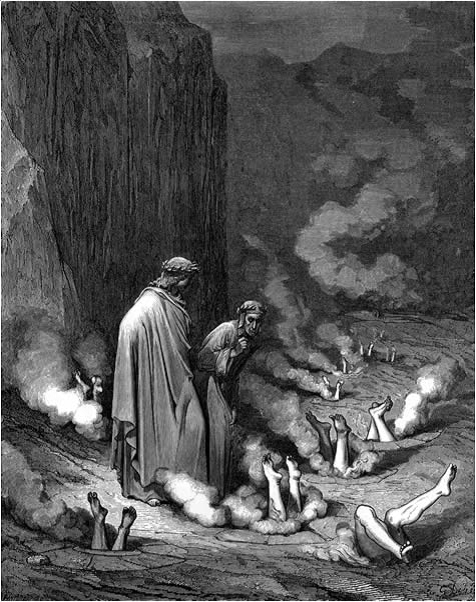
Ye have made yourselves a god of gold and silver – Canto 19 of Inferno
A Slave Revolt – The Haitian Revolution, and The Devil on the Cross
There Boukman [a priest] gave the last instructions and, after Voodoo incantations ad the sucking of the blood of a stuck pig, he stimulated his followers by a prayer spoken in creole, which, like so much spoken on such occasions, has remained. “The god who created the sun which gives us light, who rouses the waves and rules the storm, though hidden in the clouds. He watches us. He sees all that the white man does. The god of the white man inspires him with crime, but our god calls upon us to do good works. Our god who is good to us orders us to revenge our wrongs. He will direct our arms and aid us. Throw away the symbol of the god of the whites who has so often caused us to weep, and listen to the voice of liberty, which speaks in the hearts of us all.”
The symbol of the god of the whites was the cross which, as Catholics, they wore round their necks. The slaves destroyed tirelessly. Like the peasants in the Jacquerie or the Luddite wreckers, they were seeking their salvation in the most obvious way, the destruction of what they knew was the cause of their sufferings; and if they destroyed much it was because they had suffered much. They knew that as long as these plantations stood their lot would be to labour on them until they dropped.
The only thing was to destroy them.
– C. L.R. James: The Black Jacobins
When one thinks of Haiti today, images of destruction and devastation quickly come to the fore. It is the poorest country in the Western Hemisphere, has an unemployment rate of 40%, and plagued by cholera outbreaks and one that the United Nations recently acknowledged its own involvement in.
Perhaps after that picture, you wouldn’t be surprised to know that Haiti was the first country to gain independence from colonial rule, and the first to abolish slavery. Haiti gained its independence in 1804 following a successful slave revolution which started in 1791. The price of freedom is steep: having suffered two invasions from the United States of America and a U.S. military occupation lasting 15 years, the story of Haiti is a lesson to those who dare to defy imperialism and tear down the systems that are the cause and root of their suffering.
The story of Haiti represents a kind of catharsis that I think black people in general, or at least myself specifically and all those other ‘radicals’ going on about the land and black liberation need and are searching for. Granted, it will be short-lived, but a single momentary moment of healing and transformation of centuries of intergenerational pain may well be worth it. Besides, like any uprising and social outburst, the key is in making sure that the energies generated can be channelled and morphed into positive, regenerative gains. And that is the opportunity that catharsis brings, giving a chance that hasn’t been generously granted to reimagine ourselves into existence and the creation of a new human face.
If we understand the status quo in the framework posited in The Souls of Black folk of post-slavery slavery, as a consequence and by the natural conclusion the next step would be to study a text like The Black Jacobins in beginning to conceptualise paths of resistance.
The path of resistance leads towards revolution (Thiong’o, 1980). Whilst somewhere far in a part of me I can begin to accept that perhaps things won’t be as glorious as I’d like to imagine – after all, the word revolution means many different things to different people at different times – we can still hope and dream and work towards that. And we can even begin reimagining and rethinking revolution and what revolution is.
This final section of the essay we’ll probably be the least coherent and cogent, largely because I’m not particularly well versed in it and I’m still trying to understand many things, but also because trying to conceptualise forms of resistance in a way that doesn’t lend itself to extremes, but crucially because going against the grain in such a way that you ensure your own survival whilst actually making meaningful progress, is a difficult task indeed. It’s easy to say fuck survival because what are we really living for and surviving. Which I won’t dispute, but if my willingness to become a monk is anything to go by I care very little about surviving this world or living in it. Rather it’s simply trying to figure out which forms and kinds of participation are optimal and can yield towards tangible gains, whilst not negating fundamental and core principles essential to this.
And so our approach must and will always be revolutionary even though pending factors which to some degree are not in our control will often result in a different outcome than what we intended, our task is to make sure that those gains always push us towards resistance, towards revolution, and that we remain steadfast in the guiding principles of our struggle. I’ve said previously that I’d be bleak if at an older point in my life we haven’t done anything to at least significantly dent and destabilise the system. Recently I was introduced to the other side of the coin: it is one thing to mobilise counter system violence, and quite another to have a program – economic and otherwise, to build upon. Thus our efforts must not only be aimed at the destruction of that which oppresses us, but we must in also beginning the work of reimagining alternatives
As I try to strike a balance recognising the necessity of both experiences and that the occurrences of each event in its fullness and depth must happen, trying to think through what that looks like tangibly is difficult. Consequently, this leads me to a subject I haven’t touched on so far which is in the title of this piece – that other part of spirituality called esotericism.
To be clear I’m not even certain what spirituality is or if it can even be divorced from the human experience, therefore in exploring esotericism I look towards a model that finds a balance between the human, supernatural and metaphysical, that I think is ‘African Spirituality’.
There are two main threads to pick out from African Spirituality from wherever you are looking at it from in the continent – and I use the term African Spirituality with hesitation because it implies a certain kind of homogeneity and generalisation, but for a lack of a better or a more informed term, I apologise for that. The two main ideas in any Afrocentric spiritual system is first the belief in ancestors and Ancestral Veneration, and the second is a belief in the sacredness of land and the Earth. Land and the Ancestors are at the centre of African Spirituality. There are some generic principles which ground these ideas, for instance, the “oneness” of all things, a natural egalitarian understanding, the idea of community commonly popularised as Ubuntu and collective self-reliance and many other concepts too many to list here. This field of knowledge especially when it comes to esotericism is vast and unfortunately also dubious because the sources and validity of information sometimes are unknown and not easily accessible. And with the advent of YouTube some things you come across are said by some guy living in a single bedroom with the video shot whilst lying on his bed and the background of a generally untidy, unkempt room whilst simultaneously chewing on peanuts and chips, so at the very least it comes across as dodge. Also in all honesty I could have easily, and can still easily, be that guy living in his mother’s two roomed apartment making YouTube videos about Ancient Egypt, John Henry Clarke, Credo Mutwa and Black Magik whilst lying on a bed chewing on some “organic” (and if lucky maybe even home-grown) food.
In all my searches for answers spirituality and esotericism broadly speaking are the ones easiest to get lost in and the ones most difficult to get direction from – there are no guiding principles and sometimes you’ll find yourself drowning in a pool of ‘knowledge’ and information. But it’s still fascinating and I’m honestly drawn to it. I’m convinced my earlier searches were somehow directing me to this point. More fundamentally this is an inherently dubious field because the subject has a “dark” feel to it, mysterious hidden and words like occult easily connote things which must remain secret, and of course, those who venture into these parts are generally more than just weird. And so I’m working on the back foot of an already existing stigma, or if not for anything else simply because many of the claims do sound ludicrous (or perhaps they are) and unbelievable in the first few instances. That said it is also a field I’ve found to intuitively make sense to me as I search for tools to help conceptualise and understand my life, life, and events around me.
It took a while to get to this point because I was waiting to have this discussion in the framing and context provided for by The Black Jacobins, and whilst this final section is somewhat in the air, I’ll still try to maintain a level of grounding.
You’ll notice from the extract that opens this section, that the role of the priest in preparing the masses for war – it is not the passive prayer but a direct incitement and ritual to action. The book is filled with many such stories of how the leaders of the revolution were thought to be gifted with supernatural powers, such that in some instances armed with just sticks and pans they would go to meet cannons and bullets armed only with their faith and beliefs. At the centre of the revolution, as it is with any meaningful revolution, was the question of land, and if my understanding of African Spirituality holds, it means that by the extension it was a quest for spiritual regeneration as the link between land and spirituality was brought to the fore with the reliance of ‘supernatural’ powers, which from an African spiritual system is the result of the ancestors interceding. This astounding faith and belief if you have been following so far, is strikingly similar to the fervour and devotion examined earlier in this piece. The only difference is in what that belief, faith, and that natural inclination towards the divine is used for. And indeed at this point, I’d even add, a natural prowess in the subject.
In exploring the catharsis and opportunity to birth a new future the slave rebellion provided to the Haitians it would be useful to take a closer, honest look at the immediate actions which the slaves took in seeking. Visceral to say the least, C.L.R. James narrates the actions thus:
“Vengeancel Vengeancet” was their war-cry, and one of them carried a white child on a pike as a standard. And yet they were surprisingly moderate, then and afterwards, far more humane than their masters had been or would ever be to them. They did not maintain this revengeful spirit for long. The cruelties of property and privilege are always more ferocious than the revenges of poverty and oppression. For the one aims at perpetuating resented injustice, the other is merely a momentary passion soon appeased. As the revolution gained territory they spared many of the men, women, and children whom they surprised on plantations. To prisoners of war alone they remained merciless. They tore out their Besh with red-hot pincers, they roasted them on slow fires, they sawed a carpenter between two of his boards. Yet in all the records of that time there is no Single instance of such fiendish tortures as burying white men up to the neck and smearing the holes in their faces to attract insects, or blowing them up with gun-powder, or any of the thousand and one bestialities to which they had been subjected. Compared with what their masters had done to them in cold blood, what they did was negligible, and they were spurred on by the ferocity with which the whites in Le Cap treated all slave prisoners who fell into their hands.
From their masters they had known rape, torture, degradation, and: at the slightest provocation, death. They returned in kind. For two centuries the higher civilisation had shown them that power was used for wreaking your will on those whom you controlled. Now that they held power they did as they had been taught. In the frenzy of the first encounters they killed all. Yet they spared the priests whom they feared and the surgeons who had been kind to them.”
I’ve always wondered why people who historically have oppressed others, white people specifically as an example, have always feared the liberation of those they exploited and plundered from. The answer is provided for above – fear of retribution. White people are guilty of and have committed the worst forms of atrocities imaginable upon black people, be it in the form of slavery or their colonial conquests on the continent. Bear in mind the Haitian revolution happened in the later part of the eighteenth century, right at the peak of slavery and Europe’s exploration of Africa, these stories would have surely reached the mother colonies of Britain, France and America, and it only makes sense that they resolved to ensure that they too wouldn’t ever face the brunt of “vengeance”. A vital part of that is making sure history is framed and presented in a particular way.
I’m not going to comment on the actions of the slaves or more bluntly pass any moral comment or judgement on the issue, you can do that for yourself. There are two things I want to single out from that quote: and the first is with respect to how they did not maintain this revengeful spirit for long. The cruelties of property and privilege are always more ferocious than the revenges of poverty and oppression. For the one aims at perpetuating resented injustice, the other is merely a momentary passion soon appeased (JAMES, 1963). Obviously I cannot comment on what it was they achieved as I don’t know, but I can certainly imagine the link between retribution and justice becoming more identifiable from their understanding.
Whilst it’s certainly not a model to espouse, it’s an interesting study nonetheless of moments of violent catharsis, and I don’t think we could condone some of the actions simply because it not only would be morally unjustifiable – rape as the one instance which stands out and is wrong in any context, but also because it lacks any discipline and ultimately the other side of the coin when mobilising counter system violence is to begin planning for an alternative. And as far as possible our actions in getting to that place must resemble that which we wish to bring forth without necessarily sacrificing justice. It all sounds lofty as I write it now and will probably play out differently in reality, which is fine as long as I can prepare for that.
As a whole the rebellions didn’t last long, but they were wonderfully planned.
Moving from Haiti momentarily there is this fascinating phrase that has been said by Jomo Kenyatta and since has been popularised: when the Missionaries arrived, the Africans had the Land and the Missionaries had the Bible. They taught us how to pray with our eyes closed. When we opened them, they had the land and we had the Bible. These words of Jomo Kenyatta, also sometimes incorrectly attributed to Desmond Tutu as its source (the archbishop has in fact admitted to using it on occasion – so that’s some irony considering there has been a fair bit of implicit religious bashing in this post), paradoxically portray the relationship between land and spirituality with spirituality symbolically represented as the Bible.
The question then becomes how do we go back to centring land as the source of spirituality and as our metaphorical Bible? Ngũgĩ is of assistance in The Devil on the Cross where he portrays people trying to lead simple lives and survive, and who have been forced to engage in a battle for space and time out of circumstance, a battle for their very souls.
I’m beginning to develop a seriously bad habit when I’m writing essays, and that is, failing to provide a meaningful conclusion to a piece which right now is just a hundred words shy of 12 000 words. It’s really difficult less so because of the technicalities, but because genuinely trying to answer the “where to from here” question from an existential stand point is quite a difficult task. If you read any of the books I referenced you’ll find that answers don’t exactly jump up in your face too, though they certainly are clearer and in that respect, I’d encourage you to try determining or drawing those conclusions for yourself. So without necessarily offering hollow words about continuing moving forward just yet, perhaps it will be sufficient to conclude this section by reaffirming our nature as beings – human, spiritual or otherwise, in a vast universe we are yet to understand fully if at all. Maybe that’s fine, but for now, the search continues.
The weak of heart given the power of will
Fail and fall in the pit of predestination
Given the mighty pen to author their own futures –
A terrible weight
A terrible feeling of guilt, to not turn away from despair
When given the opportunity to do so
A foreknowledge of impending grief, loss, pity
And so it is that to hold life in your hands
Is necessarily carrying death
Trapping souls
A sweet release – pleasure
Followed by a swift capture
What power. such power
Of creation and destruction – out of nothing to trap souls
Trapped unto others, to themselves, and ultimately to that nothingness
Conclusion
First, I have sought to examine and understand the natural inclination Black People have towards the divine: why, the root of it and what drives it. I have attempted to do this by locating the experiences of black people in three time periods and framed these experiences against the backdrop of my own search for meaning, purpose, and paths of resistance and the various explanations and answers found from those searches. In attempting to understand this inclination I conclude that a necessary first step is to retrace our understandings and conceptions of life and existence to that of those before us and what can emerge from there, more so because that understanding is largely unpolluted (to a degree obviously). This idea is further grounded as I look more towards African Spirituality and esotericism in explaining interpersonal occurrences and the more macro manifestations. Had my understanding of the practice been deeper I could have compounded on this extensively but alas it is not.
Secondly, in attempting to find paths of resistance I also offer for those who like the traditional route characterised by The Black Jacobins an opportunity for a merging dialectic as I recount similar experiences of African Spirituality which were instrumentalised in the rebellion.
Lastly and most importantly, I hope for and to my Christian friends, bourgeoning middle class black kids, would be entrepreneurs who I wish success as I’m no stranger to adopting tactics of capitalist enterprising, I hope that this piece has provided for you moments of reflection and introspection. And as always, I hope that without disregarding your beliefs, you come to appreciate alternative understandings and radical practices in a tradition of resistance and rebellion, thus taking up your part of the mantle as we all try to make something meaningful out of our existence.
As for me, I end with these words of depicting the final scene of a wonderful character in The Devil on the Cross:
“Warĩĩnga walked on, without once looking back. But she knew with all her heart that the hardest struggles of her life’s journey lay ahead.”
And remember to be kind on yourself
-remember the open green fields
-remember to be vigilant
for the moon comes stealthily in the night stirring deep troubles and misery, and
quietly slips away vanishing from the sky
References
Akala, 2014. AKALA Home to the blog of UK Hip Hop artist Akala. [Online]
Available at: http://illastate.posthaven.com/
[Accessed 19 December 2016].
Diop, C. A., 1981. Origin of the ancient Egyptians. In: G. MOKHTAR, ed. GENERAL HISTORY OF AFRICA II: Ancient Civillisations of Africa. Paris: United Nations Educational, Scientific and Cultural Organisation (UNESCO), pp. 27-84.
Du Bois, W. E. B., 1903. The Souls of Black Folk. 1st ed. Oxford: Oxford University Press.
JAMES, C., 1963. The Black Jacobins: TOUSSAINT L’OUVERTURE AND THE SAN DOMINGO REVOLUTION. 2nd ed. United States: Vintage Books.
Pheko, L. L., 2012. 100 years of Liberation Struggle – ANC, PAC and AZAPO –, Johannesburg: Kirchliche Arbeitsstelle Südliches Afrika KASA.
Ravisankar, R., 2016. The Hammer and Cross: Examining the fraught relationship between Christianity and Marxism.. [Online]
Available at: https://www.jacobinmag.com/2016/12/hammer-cross-left-christian-revolutionary-andrew-collier/
[Accessed Sunday December 2016].
Thiong’o, N. w., 1980. The Devil on the Cross. 1 ed. London: Heinemann.
Discover more from Simon Rakei
Subscribe to get the latest posts sent to your email.
 Simon Rakei