Authenticity, naming and cultural identities in Khoisan historiography for epistemic justice
Submitted in response to the essay question:
Critically discuss the various discourses on the ‘precolonial’ within southern Africa, with KhoiSan Historiography as a case study. What are the implications for epistemological transformation in southern Africa?
AXL5202F Problematising the Study of Africa, Centre for African Studies, University of Cape Town
Abstract
The Khoisan revivalist movement has its roots in rejecting the term Coloured as an oppressive colonialist and apartheid imposition. As illustrated by Verbuyst and Bam, it is a movement of claiming identity and belonging. In this respect, the essay establishes the operative discursive framework of Khoisan historiography. Part 1 illustrates how the history which the Khoisan revival movement seeks to connect to – to affirm and demarginalize its cultural identity in contemporary South Africa – has been severely sullied by racism and its antecedent in the form of the temporal discourse of anthropology. The essay thus hopes to unpack the trappings for Khoisan historiography ordered by the temporal discourse of anthropology: this might mean not only an erasure of history, but a broader estrangement from the history the Khoisan revival movement seeks out in Southern Africa and Africa more broadly. The second part of the essay borrows from William Elis’s tracing of genealogies and narratives of San authenticities, to attempt to envision what an epistemically just Khoisan historiography in relation to Southern Africa might look like. The essay concludes by drawing on what these connections might mean not only for Khoisan historiography and the archives it could draw from, but for the Khoisan revival movement itself.
Introduction
I had the privilege of attending at least three class seminars scheduled in the Problematising the Study of Africa course with activist Bradley Van Sitters – a member of the Khoi Revivalist Movement – who does work on preserving and restoring the heritage, culture and language of the Khoi Khoi and San. There were moments of organic learning, deep insights and understanding which I will not try to capture in this essay. However, this essay draws from some of the class discussions, particularly revolving around some of the trappings Khoi revivalism might find itself in.
The central aim of the essay is twofold. First, to establish the discursive space within which Khoisan historiography operates. Here the essay primarily turns to Fabian (1983) Time and the Other: How Anthropology Makes its Object. Part one of the essay will thus establish the problematic of precolonial discourse and its operation in Southern African history (Tisani, 2018).
As it relates to anthropology: the aim is to show how anthropology establishes a temporal discourse to construct the Khoisan primitive (Asad, 1973) using time (Fabian, 1983:1). The essay specifically hopes to demonstrate how the secularisation of time leads to a universal and universalising history resulting in the formation of epochs (Fabian, 1983: 3), such as pre-colonial – whereby the primitive is still in a backward state of development whose periods are irrelevant and consigned out of history (Hamilton, 2018:98) all leading towards modernity. In conjunction, typological time as reflective of quality of states (Fabian: 1983: 22) is used to explain the insistence of Khoisan historiography to maintain a discourse of “primitive mentality”. The essay will go on to illustrate how the power structure within which the discipline takes shape proceeds to determine the description and analysis carried out by historians to preserve such conceptions and ideas (Wright, 1992). Because of the colonial encounter, the essay proceeds to demonstrate how a European cosmological outlook was imposed onto pre-colonial African history (Tisani, 2018:22) The Western worldviews forced onto pre-colonial history and African cosmology according to Tisani (2018) are: binaries, linear notions of time, Absolute otherness.
The second aim of the essay is to discuss through authenticity of identity and culture in Khoisan historiography. The bulk of Khoisan activists consider the present-day Coloured population to be the indigenous people of South Africa (Verbuyst, 2016:85). This is based on genetic ancestry (Bam, 2014: 123) to the San who have had the longest habitation in the Southern region of the African, dating more than 20 000 years back (Ellis, 2012: 9). This ‘pure’ ‘genetic’ based form of identification readily lends itself to essentialism thus distorting the very history Koisan historiography seeks to unearth (Abu-Lughod, 1991). Archaeological study of precolonial Southern Africa classified both foraging and pastoralist communities under the term Bushman, (what Vollenhoven in the subtitle of her book “ancestral longing and belonging”, a boesmankind). This other practice of anthropology – creating temporary distancing as a way of creating the object of the Bushman, has the effect of flattening, undermining and erasing the history of the KhoiKhoi and San. Part 2 will explore how this naming, flattening and erasure of cultural differences between the hunter-gathering San communities and the Khoi Khoi cattle herders potentially affects the identity claims of the Khoisan revivalist movement and notions of authenticity.
The essay will draw on the insights on revivalist movements and cultural identity which Abu-Lughod (1991) draws in Writing Against Culture. This reflects on the tendency towards essentialism as outlined above. The concluding comment draws from the doctoral thesis by William Elis (2012) on Genealogies and narratives of San authenticities which complicates the narratives around authenticity through the various naming of the Khoisan over the ages. Referred to as the Abathwa by the isiXhosa speaking people, Baswara by the Tswana, the essay offers this complication and locates naming both as a form of decolonial historiography and an entry way to other archives, by locating and situating Khoisan historiography within an African frame of reference, language, and by extension, epistemology.
The essay will be split in two parts and structured around the aims as outlined above.
Part I. The Temporal Discourse of Anthropology
Conquest, Domination and Classification: Settlerist and Nativist Narratives in Southern African Historiography
The colonial expansion through Southern Africa began in 1652 when the Dutch East India Company came on the shores of Table Bay (Adhikar, 2010:23). This invasion in the Cape introduced a group of farmers, the trekboers, adding to the already existing Khoikhoi pastoralist and the hunter-gatherer San community.
Historically, the influence of Western racist thinking dehumanised the hunter gatherer way of life as “an utterly debased form of life, merely inhabiting the land – much as animals do – rather than making productive use of it” (Adhikar, 2010). This framing of the native as someone deeply connected to the land, nomadic and with no intelligible language, living in a feral state not far removed from animals (Mudimbe, 1988), immediately located the San at the opposite of the Dutch settlers ideal of humanity. We see the work of anthropology in constructing a narrative by Europeans for a European audience analysing and explaining the domination of non-European societies dominated by European power (Asad, 1973: 14). Moreover, this colonial encounter gave the Dutch access to cultural and historical information about the Khoi Khoi and San society it was dominating (Asad, 1973). Khoisan historiography thereby emerges under two further dehumansing schema which classify and establish hierarchies between the Khoi Khoi and San.
The foragers, being closest to animals, are accorded the lowest rung on the social hierarchy. However, as expounded in part 2, though the term San is pejorative, it is a term originating from the Khoi Khoi denoting a thief, and someone of social inferiority more generally (Adhikar, 2010:23). This, however, cannot be said of the term Khoi Khoi itself, whose origin derives from what the early settlers initially termed Hottentots in referring to the Khoi. Yet as if this was not enough, Dutch settlers used the term Bushman to classify both the Khoi Khoi and the San, effectively flattening and erasing differences between the two. It got to the point where it became ambiguous and uncertain for the dutch to tell them apart or to draw any distinctions between the two (Adhikar, 2010: 37), and this would be consequential in the portrayal of what became Khoisan historiography, fundamentally rendering it inaccurate and hence ahistorical.
Thus, the settler and nativist discourses are not only inseparably created through this matrix of conquest and domination, but the power of conquest also generates a certain universal ahistorical understanding of the native and a conception of the human whilst simultaneously enforcing the inequality between the European and non-European worlds (Asad, 1973:16). In the contemporary, this white-supremacist and racist conception can even be internalised by those who are othered by European colonialism.
Classified as ‘mixed’ on her birth certificate – only to be later brought closer to blackness and labelled ‘other coloured’ on her green identity card as a young adult in the 1970s, Sylvia Vollenhoven in her book The Keeper of the Kumm: Ancestral Longing and Belonging of a Boesmankind, describes how she always felt guilty about the inherent racism in the community that she grew up in (Vollenhoven, 2017:85). This detail, minor as it is, is important as she reflects on how whilst in most Khoisan families, only the names and details of white forebears are “handed down for endless repetition” (Vollenhoven, 2017:82); in her family they could not present any white ancestry to rescue their status by establishing relation to whiteness.
Immediately evident is a twofold significance for the purpose of Khoisan historiography: first, we observe the archival limits which Khoisan historiography draws from. A celebration of white Khoisan ancestry at the negation of African indigenous knowledge is at odds with the concept of uMakhulu – the grandmother – as an institution of indigenous knowledge in isiXhosa worldlview and ontology (Magoqwana, 2018:76). Secondly, this is particularly important because the names of white forebears are handed down for recital and repetition – a common technique used throughout “precolonial” Africa to ensure those tasked with carrying and embodying the history would not fail to remember (Armah, 2002). Given the significance of the oral tradition as an alternative to the hegemonic concept of the archive, which tends to only validating history and knowledge as that which can be written and enfolded in time (Hamilton, 2018:100), this practice thereby constitutes a form of oral history, and also, due to its white supremacy tendencies – sullies both the history and potentially discredits the reliability of the ‘archive’.
Based on the above, it would seem that those who claim the Khoisan identity run the risk of turning away and shunning the African connection upon which their claims to indigeniety and belonging rest. Upon the the realisation that “Khoisan people and the descendants of slaves walk an identity tightrope strung across a minefield of inconsistencies” Vollenhoven (2017) is left with two unanswered questions. Having experienced being at the bottom of what she calls pigmentocracy in her youth growing up in the Coloured community, Vollenhoven (2017:82) asks:
- When did it start, this affinity for whiteness and disdain for other Africans? And why does it continue to this day?
Periodisation
Armed with this narrative of the savage needing civilisation and a universalising history (Fabian, 1983), the temporal discourse found itself in fruition in Khoisan historiography; the San particularly were regarded as primitive, savage – beyond civilisation thus necessitating extermination. But more than that, for the purpose of anthropological discourse, this distance between the civilised and the savage, what Fabian (1983: 30) refers to as temporal distancing, gives rise to the mechanism which determine whether a body of knowledge is validated or invalidated by temporal categorisations. Thus, time is used as a means to classify Khoisan historiography under its appropriate place in “natural history” as the discursive formation would have it.
It is thus not surprising, that after 1994, most people thought that the Khoisan were extinct (Vuuren, 2015), locked away in their primitive world from which they were unable to evolve into the modern world of civilisation (Fabian, 1983:13). Indeed the narrative of Khoisan historiography is narrated in the past tense, as if the do not exist in the present. This is the function of temporal discourse
Since informed by Western racist attitudes, pre-colonial Africa had no history before the presence of Europeans in Africa (Hamilton, 2018): the history of Southern Africa before the arrival of Europeans was thus to quote Hamilton (2018: 98), “consigned out of history”, because:
- It followed from long held stereotypes about most of the continent having no history worth discussing.
The term pre-colonial as an extension of the temporal discursive formation outlined above – and analogous to how the Dutch collapsed the Khoi Khoi and San into one category of Bushman – collapses together the eras and time before European colonisation into a single period. To put it in perspective, the San had been in the Southern region of Africa for close to 20 000 years (Ellis, 2012), and European colonisation was but a 350 odd years old – merely a fraction of that larger history (Tisani, 2018). Thus, the term pre-colonial at once becomes imperial as it provides a periodisation centred on the domination and conquest of African societies by European power (Hamilton, 2018). The phrase pre-colonial therefore effectively makes the dominated a people without a history unless it is in reference to colonialism.
Khoisan activists alligned to the revival movement will readily relate to this and this formulation may be applicable to the ‘discourse’ around “Coloured” identity as imposed by colonialism and defined in relation to whiteness, outside of which the person with that label has no other history unless it is in reference to it (Adhikar, 2010). From this vantage point, we can begin to develop a more sophisticated account which explains why for example Khoisan families as observed by Vollenhaven, only recite the white ancestral line and not the African ancestry to their children. This contradiction embodied by the Khoisan, of: on the one hand rejecting the Coloured identity whilst willing to operate within its discursive order – in this instance, history negating African in favour of white ancestry – and simultaneously appealing for African indigeniety, is a tension not necessarily to be condemned, but used rather as an entryway to mapping out a decolonial turn.
Part II. Decolonising Khoisan Historiography: Identity and Indigeneity
On Naming and Claiming
In one of our seminars (Centre for African Studies, 2019), Van Sitters made a timely intervention which set both my and his thinking across different points of significance which would later come to converge. Paraphrasing, Bradley invoked a well-known adage: the strength of a culture is in the strength of its language. In this respect, Van Sitters teaches the Khoekhoegowab language in which he is trained. We converged at two points asking:
First on language and names: why does the revivalist movement still cling onto the sullied term Khoi Khoi in denoting the relevance of Khoisan historiography given the well-known fact of its racist connotation? But more importantly, what does it mean for a revivalist movement claiming indigeneity and first nation status in South and Southern Africa, to do so under the construct which has been widely acknowledged (Adhikar, 2010) as colonial and Eurocentric in origin, the term Khoisan? This question, as Elis (2012), (Ncapayi & Mayongo, 2018) illustrate, becomes even more pronounced given that before European colonisation, various groups in the Southern African region, to flag the Setswana and isiXhosa speaking groups as examples (Ncapayi & Mayongo, 2018:132), already had names and terms with which they referred to the Khoisan.
For Khoisan historiography and a decolonial turn towards epistemological justice, this fact is crucial.
First, it means that people who lived in the region had a way of knowing, of thinking about and understanding, the Khoisan, without referring to or relying on often racist and Eurocentric discourses on Africans. This fact provides a minefield for Khoisan historiography and for the revivalist movement who seek an authentic cultural identity and values and beliefs within African cosmology (Tisani, 2018:18). But more than that, and secondly, it potentially transcends the orders of how we academically think about history, a process of ‘academic healing or “ukuhlambulula” (Tisani, 2018). You might have noticed the phrasing “that people who lived in the region had a way of knowing…” This presupposes a historical understanding of time as static, of one way of life, living, or thinking, as solely belonging or associated to a distinct period. We thus find an opportunity to connect to a cosmological worldview beyond the linear notions of time (Tisani, 2018) and drawing continuities.
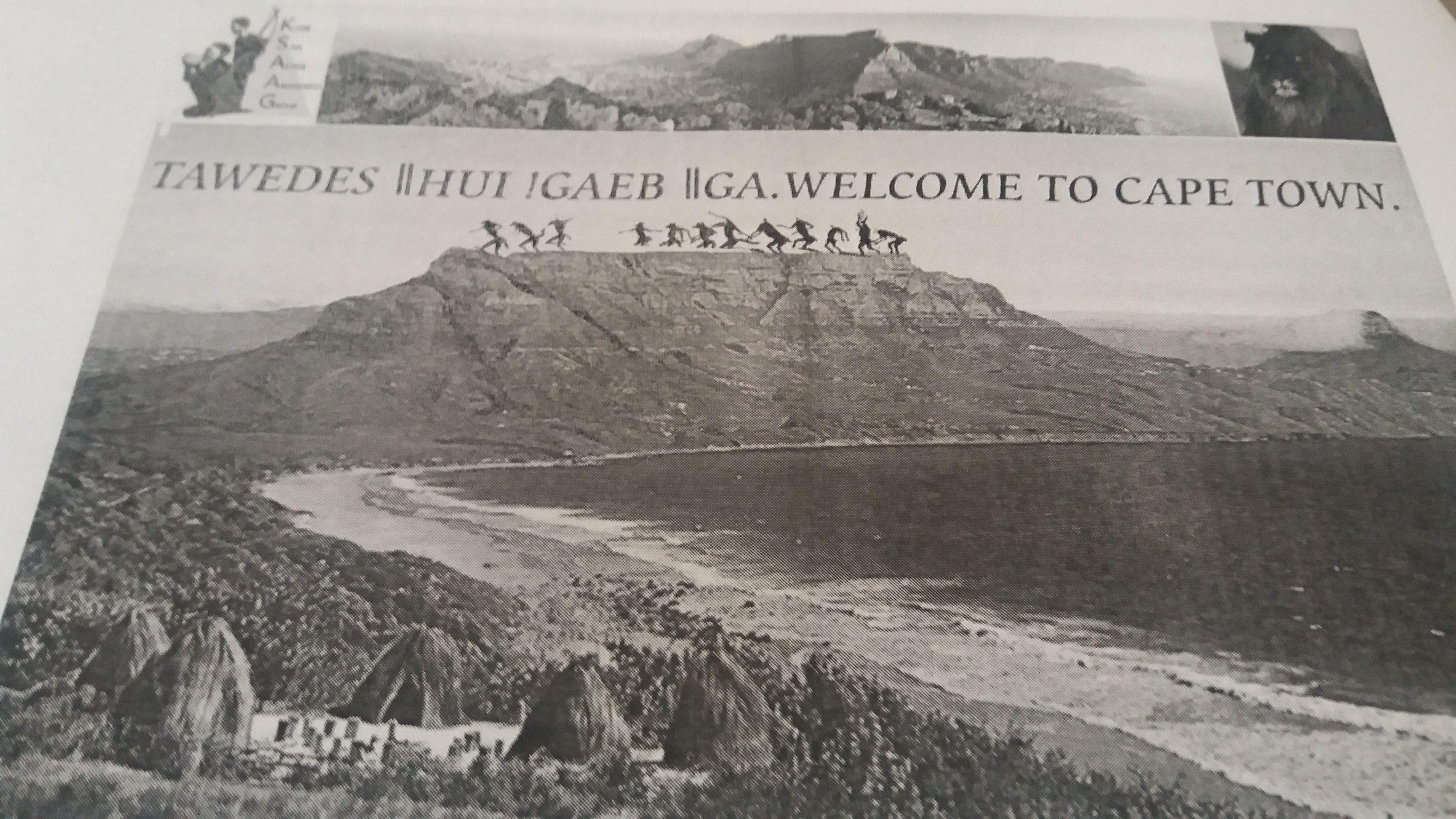
In this respect existing Khoisan historiography perhaps does not need much help. As Bradley illustrated numerously, people living on the Cape Flats continually adopt mannerisms, language and thought forms from Khoi and San ontology, for example, in how they greet, folk tales about the city and the symbolism attached to it. A more concrete example was the practices of people going up the mountains in search of fynbos, a medicinal plant, directly correlating to the hunter-gatherer form of life of the Khoisan thus establishing a continuity and illustrating that “time does not belong to a period” (Van Sitters, 2019).
Secondly, it supports and bolsters the Khoisan claim to indigeneity when the term is located and rooted within African epistemology, with language being one such carrier of thought, knowing and being (Maseko, 2018). Of course, the Khoisan did not choose the term Khoisan. In fact, studies (Adhikar, 2010) show they prefer the term Bushman since it captures the fact that they would rather be seen and thought of as people who live with nature despite the negative connotation of the term. However, this is about self-naming and claiming. The opportunity before the Khoisan revival moment is to decide whether it positions itself within a European gaze or African frame of reference.
But more importantly, this positioning is not for the obvious political significance. Rather, I argue that the act of naming in relation to an African epistemology may potentially act to mitigate against the essentialist tendencies of such a movement, which the essay turns to shortly. By locating Khoisan historiography firmly within an Africa epistemological and cosmological outlook, the earlier trappings of temporal anthropological discourse might be lessened. This is because, once embraced within an African epistemology, conceptions and framing of the other are changed and no longer necessarily ordered by colonial constructs.
However, due to the nature of a discourse and history as a subject and academic discipline, one you are in the discursive formation – in this case of history you cannot escape it – as you use its methods to critique it (Said, 1978). A search for cultural identity within this formation will thus inevitably have the imprint of the colonial encounter.
Yet, Khoisan historiography beyond the academy has a much richer potential. If we take the invocation of uMakhulu as an institution of knowledge, we also get a different form of archive (Hamilton, 2018).
Authenticity and Cultural Identity
Quoting one Khoisan activist directly, Verbuyst (2016:86) observes how the revivalist movement is willing to model their cultural practices as ‘pure’ and unique. This is done to receive recognition and acknowledgement as indigenous. In approaching this, I take direction from Worden’s (2010) argument in After race and class: Recent trends in the historiography of early colonial society. Given the new-found centrality of identity in historiography, it (identity) is to be found in the performative (Worden, 2010:53):
- The performative, that is the ways in which people defend or promote their identities, becomes a central concern of the historian
Following this train of thought, one observes the trap of being ahistorical. The danger lies in how the notions of authenticity are once again ordered by a discourse which trap and erase history (Abu-Lughod, 1991:45). The Khoisan revival movement for instance at times is willing to “downplay the differences between vastly diverse groupings that fall under the “Khoisan” label to create a homogenous identity as indigenous people” (Verbuyst, 2016:86). This reverts back to the colonial historiography which flattens and collapses differences thus erasing history. Moreover, this may then also lead to essentialist readings of identity as demanded by discourses of authenticity in order for Koisan indegenity to fit into constructs shaped by anthropology in how it defines the self and other (Abu-Lughod, 1991:45).
It might then seem that in search for authenticity, it may be lost. Or, on the other end of the scale, drawing from post-colonial theory, one might find that the Khoisan revivalist history might then simply find itself mimicking the dominant culture, acting at its dictates, accepting its strategies and discourses but replacing them with its own tropes and characters (Ekeh, 1997). Yet, this would only once again conform to the anthropological trapping of the discourse on authenticity and its narrow conception.
Upon reflection, a richer historiography might actually seek to understand and analyse this performance of identity as a method of seeking cultural preservation. Indeed, several cultures across the continent have since had to morph and redefine their identities and practices as a result of the colonial encounter in order to preserve and maintain them. The fact that they are not practiced in the manner prior to the colonial encounter does not seem to undermine their authenticity, since what is authentic is acknowledged as the expression of that cultural group.
Conclusion
The first aim of the essay was to centrally establish the discursive space within which Khoisan historiography operates. As it relates to anthropology: the aim was to show how anthropology establishes a temporal discourse to construct the Khoisan primitive (Asad, 1973) using time (Fabian, 1983). Part 1 concluded by demonstrating how the temporal discourse of anthropology extends to periodisation (Hamilton, 2018), and how its accompanying settler/native narratives are used to form the discursive space within which the history of non-Europeans dominated by Europeans is created for a European narrative (Asad, 1973). Using the experience of Vollenhoven observing Khoisan families growing up, part 1 concludes recommending that the contradiction made possible by periodisation be taken as a signal towards a decolonial turn. The second aim of the essay was to discuss through authenticity of identity and culture in Khoisan historiography. It highlighted how the performance of identity (Worden, 2010) potentially leads to a discursive trap whereby to seek the validation of indigeneity the revivalist movement must live up to colonial conceptions of ‘authentic’ Khoisan (Abu-Lughod, 1991), they potentially losing authenticity and in fact even erasing history (Adhikar, 2010). The power of naming (Ncapayi & Mayongo, 2018) and claiming was suggested as a means by which to shift Khoisan historiography from a Eurocentric gaze and locating it within an African epistemological frame
References
Abu-Lughod, L. (1991). Writing Against Culture. In Recapturing Antrhopology: Working in the Present (pp. 137-162). School of American Research Press.
Adhikar, M. (2010). A total extinction confidently hoped for: The Destruction of Cape San society under Dutch colonial rule, 1700-1795. Journal of genocide research, I-II(12), 19-44.
Armah, A. K. (2002). KMT : in the house of life : an epistemic novel (1st ed.). Popenguine, Senegal: Per Ankh.
Asad, T. (1973). Anthropology and the Colonial Encounter (1st ed.). London and Ithaca: Cornell University Press.
Bam, J. (2014). Contemporary Khoisan Heritage Issues in South Africa: A Brief Historical Overview. In L. Ntsebeza, & C. Saunders (Eds.), Papers from the Pre-Colonial Catalytic Project. Volume 1 (pp. 123-136). Cape Town: Centre for African Studies.
Ekeh, P. (1997). European Imperialism and the Ibadan School of History. In P. Ekeh, Problematising History and Agency: From Nation to Subalternity (pp. 401-422). Buffalo: State University of New York.
Ellis, W. (2012). Genealogies and narratives of San authenticities: The ≠Khomani San land claim in the southern Kalahari. Ph.D. Thesis. University of the Western Cape.
Fabian, J. (1983). Time and the Other: How Anthropology Makes its Object (1st ed.). New York: Columbia University PRess.
Hamilton, C. (2018). The long southern African past: Enfolded time and the challenge of the archive. In J. Bam, L. Ntsebeza, & A. Zinn (Eds.), Whose History Counts? Decolonising African Pre-Colonial Historiography (pp. 91-116). Cape Town: African Sun Media.
Magoqwana, B. (2018). Repositioning uMakhulu as an Insitution of Knowledge: Beyond ‘Biologism’ towards uMakhulu as the body of Indigenous Knowledge. In J. Bam, L. Ntsebeza, & A. Zinn (Eds.), Whose History Counts? Decolonising African Pre-Colonial Historiography (pp. 74-91). Cape Town: African Sun Media.
Maseko, P. (2018). Language as a Source of Revitalisation and Reclamation of Indigenous Epistemologies: Contesting Assumptions and Re-imagining Women Identities in(Arican) Xhosa Society. In J. Bam, L. Ntsebeza, & A. Zinn, Whose History Counts? Decolonising African Pre-colonial Historiography (pp. 35-57). Cape Town: Africa Sun Media.
Mudimbe, V. (1988). The Power of Speech. In J. Currey, The Invention of Africa (pp. 44-97). London: Indiana University Press.
Ncapayi, F., & Mayongo, M. (2018). The study of earlier African societies before colonial contact in the Xhalanga magisterial district, Eastern Cape. In J. Bam, L. Ntsebeza, & A. Zinn, Whose History Counts? Decolonising African Pre-colonial Historiography (pp. 119-139). Cape Town: African Sun Media.
Said, E. (1978). Orientalism. London: Peregrine Books.
Tisani, N. C. (2018). Of Definitions and Naming: I am the earth itself. God made me a chief on the very first day of creation. In J. Bam, & A. Z. Lungisile Ntsebeza (Eds.), Whose History Counts? Decolonising African Pre-colonial Historiography (pp. 15-35). Cape Town: African Sun Media.
Verbuyst, R. (2016). Claiming Cape Town: towards a symbolic interpretation of Khoisan activism and land claims. Anthropology Southern Africa, 39(2), 83-96.
Vollenhoven, S. (2017). The Keeper of the Kumm: Ancestral Longing and Belonging of a Boesmankind (1st ed.). Tafelberg: NB Publishers.
Vuuren, H. v. (2015). Approaching an extinct indigenous culture: The /Xam colonial archive. Research Gate, 96-110.
Worden, N. (2010). After race and class: Recent trends in the historiography of early colonial society. South African Historical Journal, III(62), 589-602.
Wright, J. (1992). Working with Southern Africa’s past 1500-1880. In Dirs (Ed.), Papers from the Pre-collonial Catalytic Project” (pp. 1-10). Cape Town: Centre for African studies.
Discover more from Simon Rakei
Subscribe to get the latest posts sent to your email.
 Simon Rakei