Food security and displacement in the age of Monsanto and climate change
Submitted as an essay in response to:
Sarah Ives’ book, Steeped in Heritage, is not just about rooibos tea but also about how people claim belonging in relation to uncertain political, economic, and ecological futures. By exploring the ironies and surprises that surround the plant/commodity, the book examines how people envision themselves as attached to places and how those attachments play out in fierce contestations over nature, race, and heritage in a land where climate change shifts are pushing indigenous ecosystems south. Write an essay wherein reflect on the aforementioned, paying particular intention to how residents in the book grapple with their precarious identities and how they articulate their own concepts of what it means to be indigenous when their uncertain claims to belonging and place merge with the uncertainty and the rootedness of place itself
SOC5059F Module 2, Theorising Justice from the South, Sociology Department, University of Cape Town
Abstract
Within six months from the January 2010 earthquake in Haiti, 10 000 rural farmers were marching against the “deadly gift” of hybrid seeds to the Haitian government from the world’s largest seed company. Defending a development model based on food and seed sovereignty instead of industrial agribusiness, the farmers were fighting to protect their native seeds; asserting that Monsanto’s genetically modified and hybrid seeds violate peasant agriculture. The essay adopts Sarah Ives’s articulation of a theory of the Bush and of precarious landscapes to illustrate how ecological factors – seeds – become socially, culturally and politically active in the wake of globalisation as modelled by Monsanto. Part 1 locates seed imperialism and the threat to food security, tracing from the 2001 moment when Monsanto donated seeds in the wake of flooding in the central provinces of Mozambique. The essay draws from responses and coping strategies of farmers in Ethiopia and Mozambique, to illustrate how people navigate adaption to shifting ecosystems because of climate change.
Part 2 extends, to briefly illustrate the impact of globalisation and the simultaneous need to conserve ecosystems on notions of indigeneity and belonging. Using the recent enclosed protection for patented seeds law in Tanzania forcing indigenous farmers to stop a tradition of seed exchange between themselves, the essay discusses how agribusiness threatens biodiversity and undermines attempts to preserve ecosystems, and by extension food security. With farmers who persist traditional seed exchange practises risking a prison sentence of at least 12 years or a fine of over €205 300, the essay illustrates how the interweaving of globalisation and changing ecosystems, and their connections to food, are a component part to ideas of indigeneity and belonging.
Introduction
In the Cederberg region of South Africa where rooibos is grown, Ives (2017) narrates how there has yet to be any human intervention over the seeds from which the plant is grown, thus retaining its indigenous marker as a wild plant (Ives, 2017:84). Afrikaners and Coloured people who do not fit into neat categories of “native” made claims to indigeneity through their relationship with an indigenous plant (Ives, 2017:69). This essay adopts the broad canvas on which the resultant contestation between these two groups over indigeneity and belonging occurs (Ives, 2017:1); broadly typecast by white Afrikaner farmers representing industrial and established agribusiness and large scale commercial farming interests (Ives, 2017:167), with Coloured farmers reflecting the rural poor, low wage farm workers and rural subsistence farmers (Ives, 2017:177), to illustrate how vulnerable communities negotiate uncertain landscapes in “places of imperiled ecosystems” in the face of climate change (Ives, 2017:xii) which causes displacement and food insecurity. The essay particularly adopts this framework in light of when the contestation over preserving ecosystems is typified by scientific knowledge through genetically modified and hybrid seeds, or through local and indigenous knowledge and conservation systems such as seed farming and exchanges (Ives, 2017; Taylor, Castro, & Brokensha, 2012; Ensor, Boyd, Juhda, & Broto, 2015).
The essay has two central aims. Part 1 aims to establish the operative discursive framework within which Ives’ theory of the bush is articulated, to illustrate how ecological factors – seeds primarily – become socially, culturally and politically active (Ives, 2017:24) in the wake of globalisation (de Sousa Santos, 2014; Amin, 1997:33). This part of the essay will further aim to show the different vulnerabilities that emerge through the interweaving of seeds and plants as commodities in relation to the language of globalisation (Ives, 2017:25), and how vulnerable communities adapt, cope and respond to these uncertainties.
To fulfil the above, the essay draws from chapter 2, Farming the Bush in Ives (2017) Steeped in Heritage read together with chapter 4 Rumor, Conspiracy and the Politics of Narration, to situate Monsanto and its hegemonic globalisation viz seed imperialism by drawing to “emotive ideas of ecological belonging and the changing persistent structure of inequality” as made evident in Haiti (Campesina, 2011) and Mozambique, where Monsanto has donated seeds in the wake of globalisation[1] and natural disasters reminiscent of Naomi Klein (2007) concept of disaster capitalism. In this respect, the essay mostly draws from second hand sources: newspaper articles[2], and the accounts emerging from campaigns for food and agararian sovereignty[3].
The second part of part 1 uses the experiences of rural subsistence farmers drawing from Mobilising knowledge to build adaptive capacity: lessons from Southern Mozambique (Shaffer, 2012) and in Oromo from Social Vulnerability, Climate Variability and Uncertainty in Rural Ethiopia: a study of South Wollo and Oromia zones of eastern Amhara Region (Castro, 2012) to illustrate how farmers have responded and adapted to threats, vulnerability and displacement that comes as a result of climate change (Adem, 2011) in conversation with Ives (2017:77) notion of precarious landscapes.
Part 2 of the essay aims to illustrate the impact of globalisation and the simultaneous need to conserve ecosystems on notions of indigeneity and belonging (Ives, 2017). In this regard, using the nexus of climate change and food security in Southern Africa (Frayne, Moser, & Ziervogel, 2012), the essay establishes the operative framework under which ecosystem conservation debates occur, and thus establishes food security as an ecological challenge (Frayne, Moser, & Ziervogel, 2012:28). Using the recent enclosed protection for patented seeds law in Tanzania forcing indigenous farmers to stop a tradition of seed exchange between themselves[4], the essay discusses how seed patents act as threats to biodiversity as an invasive species (Ives, 2017; Paull, 2018), undermining attempts to preserve ecosystems, and by extension threatening food security (Taylor, Castro, & Brokensha, 2012).
The essay’s concluding comment locates how globalisation threatens markers of belonging and indigeneity, by situating the protection for patented seeds law in Tanzania for Monsanto seeds, as a prohibition of cultural and social practice, and by extension, as a reflection of the precarity of indigeneity and belonging.
The essay will be split in two parts and structured around the aims as outlined above.
Part I. Sowing the Seeds of Imperialism: Food Security and Displacement in the era of Climate Change
Monsanto, globalisation and disaster capitalism
Monsanto is an agrichemical and agricultural biotechnology company headquartered in the United States of America and is the world’s largest seed company – controlling one-fifth of the global proprietary seed market and 90% of seed patents from agricultural biotechnology (Campesina, 2011). The company’s operational model is centred on two basic functions:
- First,
on lobbying government and state actors, and securing the buy in of commercial
industry to open new markets, particularly in developing countries as Campesina (2011) reports:
- In 2005, Monsanto was found guilty by the US government of bribing high-level Indonesian officials to legalise genetically modified (GM) cotton. Evidence indicates that in Brazil in 2004, Monsanto sold a farm to a senator for one-third of its value in exchange for his work to legalize glyphosate, the world’s most widely used herbicide (sold by the corporation as Roundup) that is in a class of highly toxic chemicals called endocrine disrupters;
- Second, by establishing market dominance in agribusiness through patenting seeds as intellectual property (Paull, 2018) and thereby restricting rights of use of seeds in the agribusiness industry. By extension, this has implications for the types of crops and food which can be grown by farmers thus bringing into the fold the issue of food sovereignty, which relies on being able to control the type of crop you are able to farm. Seed patenting particularly affects indigenous, small scale farmers, who rely on traditions of exchanging seeds depending on the cyclical season (Adem, 2011), as opposed to purchasing them directly from companies like Monsanto.
The rise of Monsanto, and its increasing presence in developping countries and the global south, is directly tied to global warming and the rate of climate change occuring on the continent (Alternative Energy Popular Education Programme, 2019). In addition to the two basic operational levers identified above, Monsanto in the wake of climate change, has managed to model and frame itself as an adaptive mechanism, promising safetynets and alternatives to the economic vulnerabilities and insecurities precipitated by climate change (Frayne, Moser, & Ziervogel, 2012:28). In this regard, Monsanto offers a line of crop seed genetically modified to buffer against threats in climate change, for example, drought resistant seed, and its other offering is hybrid seed.
Monsanto’s presence is particularly heightened in Africa because the continent has been identified as the region most vulnerable to climate change (Kotir, 2010) therefore, it is predominantly poor and underdeveloped countries that will bear the brunt of climate change. Currently, in the global south, five million deaths occur annually from air pollution, hunger and disease as a result of climate change (Climate Vulnerable Forum, 2012). It is estimated that by 2030, this figure will have risen to six million deaths annually, and more than 90 percent of those deaths will occur in developing nations (Guerrero, 2018:30)
Against this backdrop, it is perhaps then not surprising to learn that Monsanto’s intervention in the form of seed donations in Mozambique and Haiti was readily welcomed by government officials.
Ives dedicates the second chapter of her book Steeped in Heritage, to illustrate how ecological factors – seeds primarily for the purpose of this essay – become socially, culturally and politically active (Ives, 2017:24) in the wake of globalisation (de Sousa Santos, 2014; Amin, 1997:33). Ives (2017:180) maps out what she terms the “postapartheid structure of anxiety” whereby Coloureds were waiting in hope for their condition to improve. Due to the uncertainty immediately after the formal end of apartheid and the neoliberal compromise taken, the postapartheid regime, the macroeconomic globalisation process of neoliberalism was merged with local fights between Afrikaners and Coloureds over ecological nations of belonging (Ives, 2017:153). Consequently, globilisation necessarily politicised seeds (the rooibos plant) by tying it to claims of indigeneity, which in turn implies notions of sovereignty and security as that is the antecedent to belonging.
Having established this lens, two threads become evident in the experience of Mozambique and Haiti:
- First, at a macro-economic level, the ‘post-apartheid structure of anxiety’ outlined by Ives can be extrapolated to the post-flag independence scenario in Haiti and Mozambique. Without outlining a detailed history of the post-independence trajectories of these two states, we see that they share a similar connection to the South African situation through the process of globalisation and climate change; specifically, through Monsanto’s operation in both countries. Whilst GMOs are yet to reach the Cederberg region, Ives already alludes to this being a possibility as an adaptive measure of agribusiness;
- Second, using the articulation of a theory of the bush in chapter 2 of Steeped in Heritage, we can connect the response of the Haitian rural farmers to the donation of seeds as a perceived threat to indigeneity as Monsanto’s hybrid seed is interpreted as an invasive species (Ives, 2017; Paull, 2018) because it would undermine their seed and food sovereignty, and thus threaten food security.
To further illustrate this connection between seed sovereignty and food security, to notions of indigeneity, displacement and belonging, the essay turns to Haiti after the 2010 earthquake by adopting the concept of disaster capitalism viz globalisation and seed imperialism as threads to connect the Haitian march against Monsanto to the 2001 moment in Mozambique when seeds were also donated to that region.
From Mozambique to Haiti
As an entryway, the essay uses Ives’ (2017:167) description of how the South African postapartheird government used the rhetoric of neoliberalism and social welfare to appeal to both the left and the right; under the guise of “revolution or neoliberal technocracy”.
In 2001, Mozambique was just emerging from a two-decade long civil war when the flooding hit the south and central regions of the country.
The civil war had in part been precipitated by the apartheid regime in the early 1970s. Shortly after the independence war in Mozambique, there was a rise of dissidents in the leading political organisation FRELIMO (Front for Liberation of Mozambique) post flag independence from Portugal in 1975, and violent opposition to the ruling party by the Mozambique Resistance Movement (RENAMO), which was sponsored and received funding and military support from the Rhodesian government and apartheid South Africa, as part of a broader strategy to undermine the newly independent countries’ capacity to support their neighbouring counterparts’ armed resistance struggles[5].
The ending of the civil war was accompanied with greater neoliberalisation via the adoption of the International Monitory Fund Enhanced Structural Adjustment Facility Policy Framework Paper for April 1999 to March 2002[6].
The policy framework paper promised both Mozambican rural peasants and commercial farmers social protection and new markets respectively. However, after the floods, of the 267 000 kg seeds donated by Monsanto, most were distributed by the government only to commercial farmers in the Manica and Tete regions of southern and central Mozambique (Mozambique News Agency, 2000):
- Owing to the fact that the seed is of a hybrid that is “demanding in terms of humidity and inputs”, the release adds that the Mozambican Emergency Operations Group has called on the provincial directorates of the Agriculture and Rural Development Ministry to draw up plans under which the seed will be allocated to medium and large scale private farmers
As a result, both urban and rural populations, and rural farmers in particular, were hard hit by both the flooding leaving them displaced and economically vulnerable. More than that, the issue of the seeds exclusively to private farmers marginalised the indigenous peasant farmers, as well as their own farming practices practices upon acquiring the seeds; making it more expensive for them to farm off the land for subsistence due to different inputs and chemicals required to fertilise the soil eroded by the hybrid culture (Shaffer, 2012). The next section will briefly elaborate the forms of resilience employed in Mozambique to adapt to these changes, but before getting there the essay will now round-off this section of part 1 by turning to Brazil.
Disaster Capitalism
Monsanto donated 60 000 seed bags (roughly 475 tonnes of hybrid seed) worth US$4 million to the Haitian government, as part of an international pledge to assist Haiti after the deadly earthquake.
(Campesina, 2011) reported that Monsanto had emphasized that its donated seed was hybrid, and not genetically modified[7]. However, reliance on hybrid seed would still erode Haitian farmers’ food sovereignty and self-reliance (Campesina, 2011):
- Monsanto acknowledges that they will be unable to save seed to plant in the future, and must pay annually for the seed. Even the donated seed must be purchased – Monsanto donated the seed to the Haitian government, which is charging farmers for the seed.
From the above we see a rather insidious preying upon immediate humanitarian need; pressured by the dire situation at the moment, rural peasants were put into a position where they had to choose between sacrificing long term seed sovereignty and food security, and the more immediate concerns of responding to displacement in the wake of the earthquake.
As has been alluded to, the rural farmers in Haiti responded by marching against Monsanto, and asserting the need to defend their native seeds along with seed saving, farming and seed exchange practices, to protect their food security.
In a similar analogy to how rooibos tea became a commodity, the patenting of seeds as intellectual property also functioned as a form to erase the contributions of indigenous knowledge to agri-culture (Ives, 2017:91). In so doing, Monsanto sought to naturalise its patented hybrid seed, thereby erasing the history of seed germination and biodiversity practiced by rural farmers (Ives, 2017:85).
Nonetheless, in a poignant act of symbolism, the 10 000 strong march against Monsanto ended with the farmers burning a bag of the seeds donated by Monsanto. It is also important to register the existential connective that the seeds held, beyond food security. Speaking as a member of the National Haitian Network for Food Sovereignty and Security, a member of the Peasant Movement of the Congress of Papaye said (Campesina, 2011):
- Thus it is necessary for us to struggle against this project of death that would do away with the peasants
The hybrid seed not only threatened their livelihoods in the form of economic security and material well being, but the seeds also held cultural significance for their very way of being as peasants; their ideas of belonging. The essay will further extrapolate this in part 2 where there will be a discussion on the criminalisation of seed saving as seen in Tanzania.
For now, the essay turns to look at how people have navigated the uncertainty brought about by shifting ecosystems and globalisationn.
Responses and Coping Strategies: Resilience Perspectives from Southern Mozambique and Oromia, Ethiopia
The objective of this section is to briefly situate the different vulnerabilities that emerge through the interweaving of seeds and plants as commodities in relation to the language of globalisation (Ives, 2017:25), in how vulnerable communities adapt, cope and respond to these uncertainties.
Using the experiences of rural subsistence farmers drawing in Mozambique viz. Mobilising knowledge to build adaptive capacity: lessons from Southern Mozambique (Shaffer, 2012) and in Oromo viz. Social Vulnerability, Climate Variability and Uncertainty in Rural Ethiopia: a study of South Wollo and Oromia zones of eastern Amhara Region (Castro, 2012) the essay aims to illustrate how farmers have responded and adapted to threats, vulnerability and displacement that comes as a result of climate change (Adem, 2011) in conversation with Ives (2017:77) notion of precarious landscapes.
Vulnerabilities Emerging
Ives situates the particular anxieties which emerge against a larger structural backdrop of postapartheid South Africa. For the purpose of this essay, the interest is in how people responded to these uncertainties.
In that respect, the essay adopts two main strands in order to connect to the experiences in Mozambique and Ethiopia:
- First, the general silencing of the Coloured farmers and farm workers when it came to discussions about the future of rooibos farming in relation to climate change and the shifting of the ecosystem (Ives, 2017:95). In that regard, the essay likens this to the overall disregard of rural and peasant farmers in climate change adaption measures in favour of prioritising urban settlements;
- Second, one observes a slight discussion around which technologies and knowledge systems to draw from to conserve ecosystems (Ives, 2017:87). One juxtaposes agri-ecology to the adaptive mechanisms of commercial farming which might mean the adoption of hybrid seeds; the other in favour of methods such as seed-saving and perma-culture. In sum, the two approaches broadly fit the schema typified by a contestation of indigenous conservation methods to those linked to technologically modern solutions in the form of genetically modified organisms.
As it relates to the first thread, the essay focus on Mozambique and slightly towards Ethiopia.
The key lesson identified viz. climate change adaption from a resilience perspective was the need for knowledge and information sharing (Ensor, Boyd, Juhda, & Broto, 2015:31). The flooding caused displacement resulting in large migration patterns which saw an upsurge in informal settlements in Maputo. In subsequent debates about adaptive strategies, similar to Ives (2017:95) were Coloured folks were excluded from meetings about their future, there were competing claims and different understandings of value, subject to unequal power and representation in social processes (Ensor, Boyd, Juhda, & Broto, 2015:24). Indeed, in the urban centre, knowledge of climate change risks in Mozambique is dominated by understandings of environmental change as predictable and controllable (Ensor, Boyd, Juhda, & Broto, 2015:32). This view is further supported with Ives (2017:197) finding of how Afrikaner farmers felt that the climate was being uncooperative, and how in turn, due to an inclination to protect private property and economic assets, they leaned closer to a view to control climate change. In contrast, rural and peasant farmers were sometimes willing to migrate, with migrant wage labour being a significant source of livelihood (Ensor, Boyd, Juhda, & Broto, 2015; Ives, 2017).
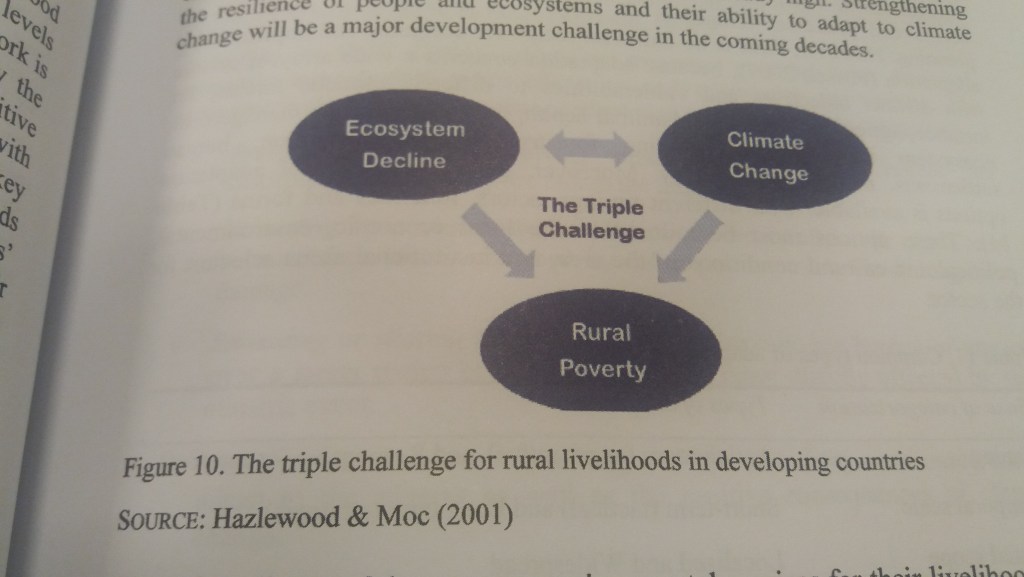
The second thread also touches on exclusion of poor communities in planning the future vis-à-vis the discourse of climate change. (Taylor, Castro, & Brokensha, 2012:198) infer that this disassociation of the voices of the global poor leads to helplessness/dependency, especially when the solutions implemented are not within the financial or technological capacity of rural poor farmers. In this sense, rural farming communities, in similar vein to the Coloured farmworkers in the Cederberg, are then made dependent on commercial interests to safeguard their economic interests (Ives, 2017:118).
Despite this exclusion, marginalised rural farming communities have persisted in ensuring their survival by adapting to the climate shifts using local knowledge. In Ethiopia specifically, there have been a range of adaptive measures; most of these tie very closely to Ives (2017) articulation of a theory of the bush, were most residents, particularly in the Coloured community, expressed by how they survive with the support of nature.
Resources and Coping Strategies
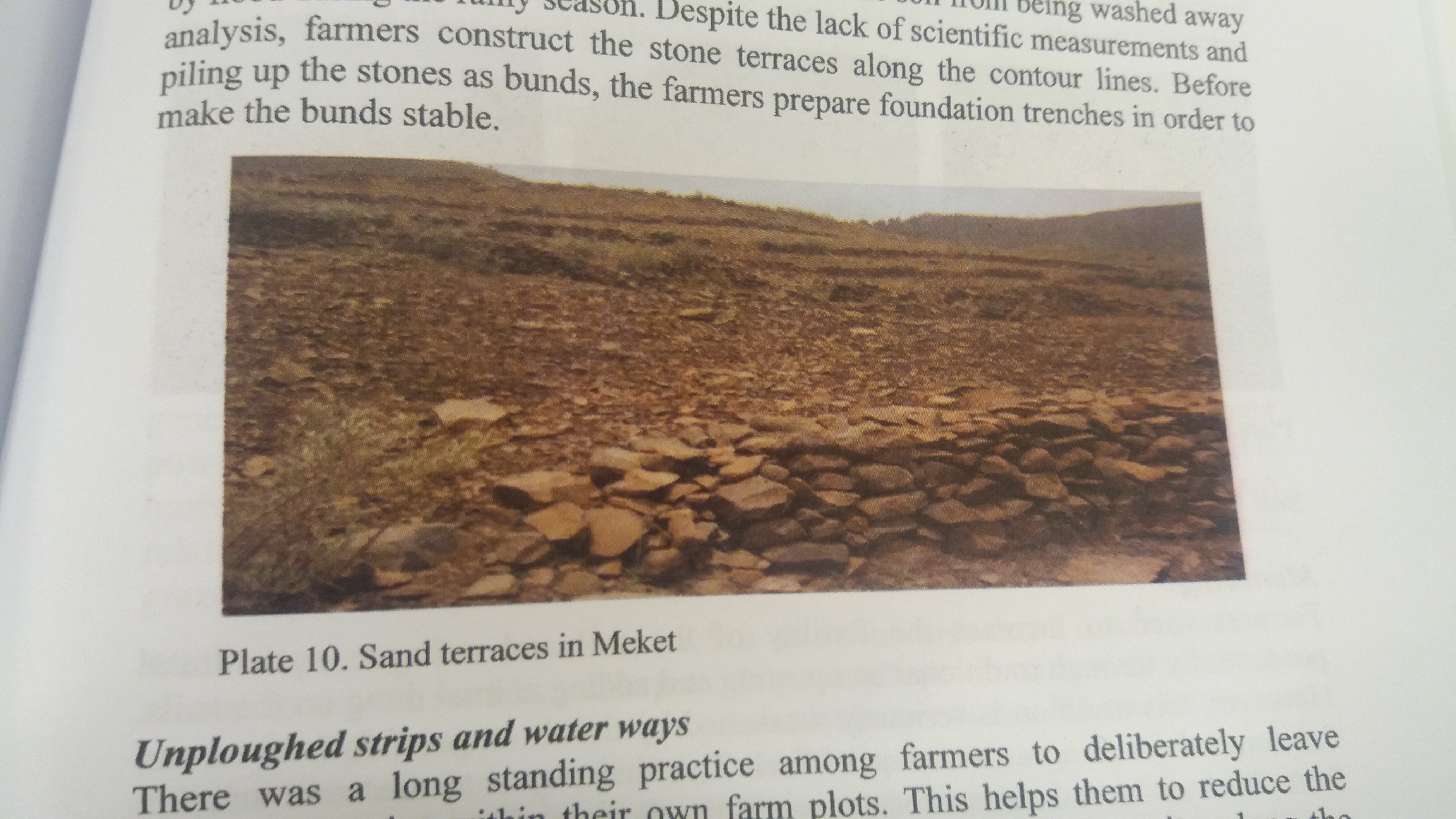
The adaption mechanisms mostly draw from the experiences of rural Ethiopia. Predominantly, analogous to Ives (2017:43) the responses draw from experiential knowledge and skills, practices and symbolic representations about their environment (Adem, 2011:105). This would include traditional practices in the areas of soil and water conversation, and indigenous agro-forestry. The latter option involves planting drought-tolerant and deep-rooted tree species such as acacia or zizphus, as opposed to the use of GMO resistant seed (Adem, 2011:112).
Despite the lack of scientific measurements (Adem:2011), farmers still use terraces for structural soil conversation to protect the soil from being washed away.
Finally, and similarly (Ives, 2017:118), the last adaptive method was socio-economic, making use of migrant wage labour (Adem, 2011:118). When small scale farming on its own was not sufficient, rural farmers turned to work on commercial farming lands. Across both contexts, this is particularly illustrated by the growing informalisation of labour through casual employment which is not permanent, thus in turn not guaranteeing job security (Ives, 2017; Adem, 2011).
Part 1 of this essay has thus established the operative discursive framework within which Ives’ theory of the bush is articulated, to illustrate how ecological factors – seeds primarily – become socially, culturally and politically active (Ives, 2017:24) in the wake of globalisation (de Sousa Santos, 2014; Amin, 1997:33). This part of the essay has shown how the different vulnerabilities that emerge through the interweaving of seeds and plants as commodities in relation to the language of globalisation (Ives, 2017:25), and how vulnerable communities adapt, cope and respond to these uncertainties.
The essay will now briefly turn to concretely illustrate the impact of globalisation and the simultaneous need to conserve ecosystems on notions of indigeneity and belonging (Ives, 2017).
Part II. Shifting Ecosystems, Biodiversity and Seed Saving
Enclosed protection laws for patented seeds: the Tanzanian experience
In 2016, the Tanzanian government passed into law the enclosed protection for patented seeds law, forcing indigenous and rural farmers to stop a tradition of seed exchange between themselves. Farmers who persist traditional seed exchange practises risking a prison sentence of at least 12 years or a fine of over €205 300[8].
The legal protection and enforcement of Monsanto’s seed as intellectual property serves as a useful point to reflect on how globalisation threatens markers of belonging and indigeneity. Ironically, the Tanzanian government had to pass this legislation as a precondition to receiving development aid from the G8’s New Alliance for Food Security and Nutrition (NASFN). The irony lies in the illustration as established in part 1: development aid from Monsanto tends to be counterproductive in the long run due to the loss of seed sovereignty, thus undermining food security. In addition, several studies have already shown the poor nutritional value of Monsanto’s hybrid and genetically modified seeds, with some of their products not permissible for use in the United Sates (Campesina, 2011).
By situating and reading this law as a prohibition of cultural and social practice, and by extension, as a reflection of the precarity of indigeneity and belonging, the essay argues that this denial of indigenous practice can be interpreted as threat to indigeneity rooted in a practice of peasant agri-culture. Extrapolating from Ives description of the interweaving of rooibos tea’s commodity history with the language of globalisation (Ives, 2017:177), the essay adopts the concept of precarious landscapes, as an entryway to establish the threat and precarious nature of indigeneity as articulated in a practice of seed saving.
Seed saving as it has been practiced across the continent (Ives, 2017; Adem, 2011; Frayne, Moser, & Ziervogel, 2012) is not only for the convenience which can come through exchanging seeds with other farmers when needed. Rather, it is also born out of a particular symbolic relationship to the land (Adem, 2011:105), and particularly with the plant being farmed (Ives, 2017). This in turn fosters the drive born out of a sense of duty to the land as the source of sustenance, to conserve this farming practice and the ecosystems around which crops are cultivated
Cultural Identity in Indigenous farming practices
In Steeped in Heritage, Ives (2017) repeatedly provides anecdotes of how residents in the Cederberg region would say “farming is in their blood”; “it is who they are” or “they belong on the farm” and these sentiments were shared across the racial divide. If we take this seriously, there is an articulated sense of belonging on the farm, but it is connected to the actual activity of being able to farm. The Monsanto seed enclosure act effectively prohibits Tanzanian rural peasants from farming in the event that they are unable to purchase Monsanto seed in the region.
Secondly, the lack of control in over seeds further extends to the type of crops that can be grown. To the degree that food is a part of culture – and indeed the extent to which some foods are indigenous and how it also serves as a marker of belonging and indigeneity, the lack of seed sovereignty undermines one such cultural identity as it were in the form of foods, especially if hybrid and genetically modified seeds are considered as invasive species alien to the local culture (Paull, 2018; Ives, 2017).
Upon reflection, one of the interesting insights, or questions rather, emerging from Steeped in Heritage, is the extent to which the language and claims to belong serve as masks for something perhaps slightly more perverse. Ives already illustrates that in the case of Afrikaner farmers, when they invoke the rhetoric of conservation, they are more concerned with their own lifestyles and standard of living, not necessarily with the shifting ecosystem. Yet, when one considers that this essay has repeatedly employed the concept of seed sovereignty, it might appear that claims to indigeneity and of belonging, are simultaneous laden with notions of ownership.
It is of course evident that commercial farmers and agribusiness have taken this approach, with the seed patenting as intellectual property serving as an indicator of having such ownership.
However, as a concluding comment, the essay offers this point of reflection to further prompt questions of how notions of seed sovereignty might potentially be restrictive vis-à-vis claiming cultural heritage for future possibilities. In this regard, embracing the uncertain in hopes for a better future might be the middle-ground to walk on.
Conclusion
The primary thrust of this essay was driven by an illustration of how ecological factors – seeds – become socially, culturally and politically active in the wake of globalisation as modelled by Monsanto. To that effect, the essay adopts Sarah Ives’s articulation of a theory of the Bush and of precarious landscapes to establish the two central aims of the essay. Part 1 established the operative discursive framework within which Ives’ theory of the bush is articulated, to illustrate how ecological factors – seeds primarily – become socially, culturally and politically active (Ives, 2017:24) in the wake of globalisation (de Sousa Santos, 2014; Amin, 1997:33). This part of the essay illustrated the different vulnerabilities that emerge through the interweaving of seeds and plants as commodities in relation to the language of globalisation (Ives, 2017:25), and how vulnerable communities adapt, cope and respond to these uncertainties.
Drawing from chapter 2, Farming the Bush in Ives (2017) Steeped in Heritage read together with chapter 4 Rumor, Conspiracy and the Politics of Narration, the essay situated Monsanto and its hegemonic globalisation viz seed imperialism by drawing to “emotive ideas of ecological belonging and the changing persistent structure of inequality” as made evident in Haiti (Campesina, 2011) and Mozambique, where Monsanto has donated seeds in the wake of globalisation and natural disasters reminiscent of Naomi Klein (2007) concept of disaster capitalism.
The second part of part 1 used the experiences of rural subsistence farmers drawing from Mobilising knowledge to build adaptive capacity: lessons from Southern Mozambique (Shaffer, 2012) and Oromo from Social Vulnerability, Climate Variability and Uncertainty in Rural Ethiopia: a study of South Wollo and Oromia zones of eastern Amhara Region (Castro, 2012) to illustrate how farmers have responded and adapted to threats, vulnerability and displacement that comes as a result of climate change (Adem, 2011) in conversation with Ives (2017:77) notion of precarious landscapes.
Part 2 of the essay aimed to illustrate the impact of globalisation and the simultaneous need to conserve ecosystems on notions of indigeneity and belonging (Ives, 2017). In this regard, the essay used the nexus of climate change and food security in Southern Africa (Frayne, Moser, & Ziervogel, 2012) from established the operative framework under which ecosystem conservation debates occur in the second section of part 1, and thus established food security as an ecological challenge (Frayne, Moser, & Ziervogel, 2012:28). Using the recent enclosed protection for patented seeds law in Tanzania forcing indigenous farmers to stop a tradition of seed exchange between themselves, the essay discussed how seed patents act as threats to biodiversity as an invasive species (Ives, 2017; Paull, 2018), undermining attempts to preserve ecosystems, and by extension threatening food security (Taylor, Castro, & Brokensha, 2012).
The essay’s concluding
comment located how globalisation threatens markers of belonging and
indigeneity as typified by seeds and food as markers of
cultural identity and situated the protection for patented seeds law in
Tanzania for Monsanto seeds, as a prohibition of cultural and social practice,
and by extension, as a reflection of the precarity of indigeneity and
belonging.
References
Adem, A. (2011). Climate Change and Rural Livelihoods in Northen Ethiopia: Impacts, Local Adaption Strategies and Implications for Institutional Interventions. Addis Ababa: Forum for Social Sciences Studies.
Alternative Energy Popular Education Programme. (2019, February 2). Eskom and the crisis of energy democracy: A case for safe, socially owned renewable energy. Retrieved from Phambazuka News, Voices for Freedom and Justice: https://www.pambazuka.org/land-environment/eskom-and-crisis-energy-democracy-case-safe-socially-owned-renewable-energy
Amin, S. (1997). Capitalism in the Age of Globalisation: The Management of Contemporary Society. London & New York: Zed Books.
Campesina, L. V. (2011, June 8). Haitian peasants march against Monsanto. Retrieved from Synthesis/Regeneration, Winter 2011, p. 16+. Academic OneFile: http://link.galegroup.com/apps/doc/A245473357/AONE?u=unict&sid=AONE&xid=46b1aa54
Castro, A. P. (2012). Social Vulnerability, Climate Variability and Uncertainty in Rural Ethiopia: a study of South Wollo and Oromia zones of eastern Amhara Region. In A. P. Castro, D. Taylor, & D. W. Btokensha, Climate Change and Threatened Communities: Vulnerability, Capacity and Action (pp. 29-41). Warwichshire: Practical Action Publishing.
Climate Vulnerable Forum. (2012). Climate Vulnerable monitor, 2nd edition: A guide to the cold calculus of a hot planet. Retrieved from Climate vulnerability Forum: http://daraint.orgclimate-vulnerability-monitor/climate-vulnerability-monitor-2012/report/
de Sousa Santos, B. (2014). Epistemologies of the South: Justice Against Epistemicide. 2014: Paradigm Publishers.
Ensor, J., Boyd, E., Juhda, S., & Broto, V. C. (2015). Building Adaptive Capacity in the Informal Settlements of Maputo . In T. H. Inderbeg, S. E. O’Brien, & L. Sygna, Climate Change Adaption and Development: Transforming Paradigms and Practices (pp. 19-39). New York: Routledge, Taylor and Francis.
Frayne, B., Moser, C., & Ziervogel, G. (2012). Understanding the Terrain: the climate change, assets and food security nexus in Southern African cities. In B. Frayne, C. Moser, & G. Ziervogel, Climate Change, Assets and Food Security in Southern African Cities (pp. 1-34). New York: Earthscan, Routlidge.
Guerrero, D. G. (2018). The Limits of Capitalist Solutions to the Climate Crisis. In V. Satgar, The Climate Crisis: South African and Global Democratic Eco-Socialist Alternatives (pp. 30-47). Johannesburg: Wits University Press.
Ives, S. (2017). Steeped in Heritage: The Racial Politics of South African Rooibos Tea. North Carolina: Duke University Press.
Kassa, H. (2016). Lessons for #FeesMustFall from Ethiopia’s #OromoRevolution and the quest for self-determination and land. Pathway to Free Edcuation: Volume II. Strategy and Tactics, 40-50.
Kotir, J. (2010). Climate change and variability in sub-Saharan Africa: A review of current trends and impacts on agriculture and food security. Environment Development and Sustainability, 587–605.
Mozambique News Agency. (2000, October 18). Mozambique: Monsanto seed for flood victims. Retrieved from Relief Web: https://reliefweb.int/report/mozambique/mozambique-monsanto-seed-flood-victims
Paull, J. (2018). Genetically Modified Organisms (GMOs) as Invasive Species. Journal of Environment Protection and Sustainable Development, IV(3), 31-37.
Shaffer, L. J. (2012). Mobilising knowledge to build adaptive capacity: lessons from Southern Mozambique. In A. P. Castro, D. Taylor, & D. W. Brokensha, Climate Change and Threatened Communities: Vulnerability, Capacity and Action (pp. 69-81). Warwichshire: Practical Action Publishing.
Taylor, D., Castro, A. P., & Brokensha, D. W.
(2012). Some reflections on indigenous knowledge and climate change. In A. P.
Castro, D. Taylor, & D. W. Brokensha, Climate Change and Threatened
Communities: Vulnerability, Capacity and Action (pp. 197-201).
Warwichshire: Practical Action Publishing.
[1] See example of Venezuela against Monsanto from the Globalization Research Centre: https://www.mondialisation.ca/venezuela-farmers-fight-monsanto-seed-imperialism-and-win/5551355
[2] See report from the Mozambique News Agency on natural disasters:
https://reliefweb.int/organization/aim
[3] Accounts from the Seed Freedom movement:
[4] https://www.mo.be/en/analysis/tanzanian-farmers-are-facing-heavy-prison-sentences-if-they-continue-their-traditional-seed
[5]Read South Africa’s President P.W. Botha location of Mozambique in the ‘total strategy’ to defend South Africa from Communist aggression in 1981. Page 91 of Rationalizing Gukurahundi: Cold War and South African Foreign Relations with Zimbabwe, 1981-1983. https://core.ac.uk/download/pdf/62634544.pdf
[6] An ambitious program of structural reforms was undertaken during the 1996-98 period. The trade regime was also liberalized through a reduction in tariff dispersion and a reduction in the average import tariff rate from 18 percent to 10 percent. Agricultural marketing was further liberalized with the removal of all minimum prices.
https://www.imf.org/external/np/pfp/1999/mozam/#VIB
[7]Five questions on Monsanto’s Haiti seed donation. Monsanto blog May 20, 2010. https://ajws.org/blog/five-questions-monsanto-needs-to-answer-about-its-seed-donation-to-haiti/
[8] https://www.mo.be/en/analysis/tanzanian-farmers-are-facing-heavy-prison-sentences-if-they-continue-their-traditional-seed
Discover more from Simon Rakei
Subscribe to get the latest posts sent to your email.
 Simon Rakei