Competitive Debating
I developed my passion for competitive debating in high school. As a junior speaker in the World Schools Style debating format, I was ranked 2nd in the GDL and GDE provincials, and I was a two-time top 10 nationally ranked speaker. As a senior speaker in my latter high school career — and leading as team captain of the debating squad — I was a three-time top 10 GSDB, SACEE, and senior academy speaker with triple SACEE eastern regional championship wins. I continued active speaking as university student for two years competing in the British Parliamentary format. I qualified to compete in the Pan African Universities Debating Championship in my first year, reaching the octo- finals, speaking at the World Universities Peace Invitational Debating Tournament, and reaching the semi-final of the South African National Universities Debating Championship.
I always sought to spread the transformative potential of competitive debating as far I could so that it may be of value to others. This passion for skills transfer, a desire to share knowledge and experiences, evidenced itself through the many privileges I’ve had to train and interact with a range of talented individuals as a debating coach. I served on the National Chief Adjudication panel for the South African National Schools Debating Board, National Selector for the SA Teams and as coach to the trialists for the SA Academy squad. The South African world schools debating teams rank among the best in the world, consistently breaking to the octo-finals or higher, and clinching the world championship in 2016. Locally, I served on the UCT Debating Union Committee as the Schools Coordinator, as Deputy Chief Adjudicator for the Western Cape, and on the Township Debating League Executive Committee as the Training Director. I was responsible for training close to 400 learners across 20 schools. TDL, now named Thethani Debating League, facilitates free training and coaching to debaters from underprivileged schools in Cape Town who would otherwise not be afforded guided practice, and runs the only debating league for township schools in the city. In addition, I coached more than 12 teams privately across four schools. Of those, at least 6 maintained top 10 provincial and national rankings with 18 speakers selected to compete in regional or provincial championships, nationally, or representing South Africa internationally. Through my passion for spreading the transformative potential of competitive debating, I’ve always sought to ensure that skills transfer occurred at the highest possible levels, and, in the areas where it’s most needed.
I subsequently retired from competitive debating and active speaking at tournaments to respond to pressing changes in the South African higher education landscape during my time as an undergrad.
Campaigns and Organising
In addition to competitive debating, my informal education was shaped by popular education and student activism. Some of the hashtag movements which characterised the 2010-2020 decade found their earliest expression at the University of Cape Town with #RhodesMustFall and #FeesMust Fall. The calls to remove the statue of Cecil John Rhodes at UCT were accompanied with an uproar of the word decolonisation. By the end of 2015, South African university campuses were sites of struggle. After retiring from competitive debating, I engaged in an effort to understand what the calls for “decolonisation” meant. At UCT, the Remember Marikana commemoration in 2015 served as a segue to demand a living wage for university workers. #RhodesMustFall produced a film of spoken word poetry filmed in Khayelitsha where 40 homes were donated to families after a shack fire. The film linked the Marikana Massacre to the outsourcing of labour at universities by tracing a line of cheap labour undergirded by the colonial migrant labour system, thus denying workers a living wage. This historical connection sharpened my grasp of the core impulses animating the movement. By August I was engaged in the Marikana commemoration efforts and fully working on coordinating various campaigns for fair work, decent wages and an end to outsourcing. Undertaking this work helped form the student-worker alliance in the run up of what would become the campaign for Free Education.
The October demonstrations of that year building on previous campaigns led to a historic agreement where the University of Cape Town insourced six outsourced services, including cleaning, residence catering, gardening, campus security, staff and student transport, thereby giving more than 1 000 workers direct security, protection and privileges of UCT employment.
Following the mass demobilisation and organising of nation-wide demonstrations which peaked in 2015/2016, I was subsequently deputed to guide various institutional engagements. At UCT, the #ShackvilleTRC campaign had attempted to consolidate some key gains which resulted from the direct action during 2015-2016. Therefore, the last two years of my undergraduate study were devoted to the strategic aims of the movement. Among these was my role on the Curriculum Change Working Group, and as the Chair of the Free Education Research and Planning Group. I was responsible for overseeing and guiding the implementation of an agreement reached between student activists and the university to commit to fee-free higher education for working class and “missing middle” students. Functioning with the office of the Deputy Vice Chancellor for Transformation, I supervised the investigation into the feasibility of various funding models for fee- free higher education. I was the Director and Lead-Coordinator of its Engagement Unit in 2017 directing efforts to mobilise and consolidate an institutional position committed to free education through public and civic engagements. In December of that year South Africa proclaimed free tertiary education for working class and missing middle students beginning in 2018.
I was also seconded to the Steering Committee of the UCT Institutional Reconciliation and Transformation Commission as a #ShackvilleTRC rep between 2016-2019 to oversee the delivery of recommendations related to restorative justice, decolonisation, institutional culture, discrimination, identity, transformation, and other issues raised by campus protests. Beyond institutional engagements, I helped to form and organise several popular education initiatives.
Popular Education
I served as an editor in the student issued popular education publication Pathways to Free Education. From 2016, I co-coordinated a knowledge generation project based on written submissions from scholars, activists, facilitated workshops with workers, students, community organisations, interviews with trade union members, and any other interested members of the public. The collective also hosted a number of summer and winter school sessions. This work culminated in co-published material spanning four volumes of pamphlets, booklets, and podcasts.
In 2017, co-founded the Alternative Energy Popular Education Programme. ALTEPEP was born as one of the three programmes under the “Student consciousness” project run under the Centre for Policy and Development (CEPD). At its minimum, the concept for the Alternative Energy Popular Education Programme aims to make use of critical pedagogy methodologies to facilitate transdisciplinary spaces between school going youth, university and TVET students along with community activists in dialogue on questions of energy as it relates to production, service provision, ownership and “work” with a focus on renewable energies.
I served as a Director and Associate Researcher between 2017-2021 where I led the research program on Profit Shifting and the Consequences of Illicit Financial Flows in Africa by exploring the relationship between extractives, illicit financial flows, and climate minerals for the transition to a low-carbon economy. I organised and coordinated a range of workshops, summer/winter schools, podcast series, and translating these to active interventions through community garden solar installation programmes and other co-operative based initiatives for self-reliance.
Professional Research, Lobbying, Academic Scholarship, and Advocacy
My research and advocacy interests revolve around a shared set of themes in my academic scholarship and professional work.
Lobbying and Advocacy: Economic Justice Campaign Work
Before my academic research, I was a researcher for a Cape Town based labour and social movement support organisation. I worked at the Alternative Information and Development Centre where I lobbied for measures to combat tax evasion, base erosion and profit shifting. Working on the Economic Justice program, I worked on the Stop the Bleed Campaign – a metaphor for illicit financial flows and money lost through tax avoidance schemes. I advocated efforts for legislative reform, drafted parliamentary submissions on anti-avoidance tax legislation, worked with unions on litigating action, and I began research and lobbying around mining taxation and corporate accountability. In 2019, I was part of a team supporting an investigation of transfer pricing leading up to the litigation of the second largest chrome producer in the world, Samancor, by the Association of Mineworkers and Construction Union. The mining company was being litigated for allegedly engaging in transactions outside the arms-length principle by using its subsidiary located in the British Virgin Islands as a front for Samancor’s directors and majority shareholders. These transactions dating from 2005 allegedly included illicitly shifting funds offshore through transfer pricing, marketing agreements involving secret consulting, commission and facilitation fees, unapproved debt write-offs, secret corporate restructuring arrangement through a range of share purchases and disposals, and spurious management fees. All told, $1,9 billion was alleged to have been lost through these arrangements.
Academic Interests: Extractives, Offshore Finance, Empire, and Non-Sovereign Tax Havens
I became intrigued by the relationship between the fact that more than half of the countries in the Caribbean did not attain political independence, and that a significant number of these went on to develop as tax havens. Britain, which was the dominant imperial power in the region, has close political ties to thirty of the sixty tax havens, accounting for 37% of global banking liabilities and assets. While there was research being done linking tax havens to corruption and the shifting of profits, I couldn’t find a lot about their developmental history as nation states and how these island territories came to assume their function in the global political economy. I wanted to reflect on the aspirations of an equitable international taxation regime by exploring the factors tracing the development of tax havens as non-sovereign nation states. How did non-sovereign states resolve the tension of pursuing autonomous development as colonial dependencies? This puzzle became the galvanising force of my MA thesis.
Behind this inquiry lay the promise of casting new light on a chronic problem: natural-resource rich countries with high levels of poverty and underdevelopment. Africa has been a net-creditor to the world: with an external debt of $258 billion in 2008, Africa recorded capital outflows of $579 billion to $1,4 trillion due to profit shifting and tax evasion between 1980 and 2009. To appreciate the relationship between extractives, profit shifting, and the challenge of curbing the use of tax haven jurisdictions, it is important to understand the developmental history of offshore centres and their particular paradox as non-sovereign states. This rationale built on the work of my Honours thesis where I looked at mineral rich countries with high underdevelopment using the DRC as a case study. I used one of the only two tax treaties internationally in force with the DRC to explore the source and residence conflict in international taxation by investigating if there is a link between reduced taxing rights and increased foreign direct investment anticipated to aid poverty reduction. I paired a legal doctrinal comparative analysis of the contradictions between the income Distributive Rules Articles of the United Nations Model Tax Convention and the South Africa-Democratic Republic of Congo Double Tax Treaty with a correlation study of the FDI inflows to the DRC after the tax treaty with South Africa came into force in 2013.
Thereafter I was set to begin my tax articles. I was a finalist and the regional runner-up of the 2018 Ernst and Young (EY) Young Tax Professional of the Year award. The same firm partly supported my undergrad studies after awarding me with a bursary in high school through a Talent Recruitment Program on the condition that I would serve my articles at EY after I completed my honours. So, I was contractually bound to begin my articles. However, I could not reconcile the bursary conditions with my core aspirations. Fortunately, with some leverage and a little luck, I wiggled out of that pickle.
Postcolonial Predicaments of Sovereignty
During my investigation into the transfer pricing of mining companies shifting profits to tax havens in the Caribbean, I wanted to understand how profit shifting impacted marginalised and precarious artisanal miners who unearth the minerals. Moreover, I wanted to approach the broader field of international taxation through an historical lens of empire, nation building, globalisation, sovereignty and decolonisation. I acknowledged the theoretical and methodological constraints of the Finance and Tax discipline for the work I wanted to do. Consequently, I enrolled for a newly launched interdisciplinary Master of Philosophy specialising in Theories of Justice and Inequality, a program housed in the UCT Sociology Department, and I was in the program’s first cohort of students.
My MA training enabled me to use innovative theoretical frameworks with historiographical research techniques. I took courses in Political Sociology and Global Political Thought to broaden my theoretical arsenal. I complemented these modules within a History and Anthropology based Centre for African Studies Department which offered a Problematising the Study of Africa course to sharpen my methodological tools. Before the covid-19 pandemic restricted international travel, I had planned to submerge myself in the world of artisanal and informal miners in the DRC for my MA research. With travel and fieldwork out of the question, I relied on archival document analysis and pivoted my master’s dissertation to historically situate non-sovereign tax havens in international taxation by using the minutes of the British Virgin Islands Legislative Council.
My Master’s dissertation on Reconstituting Empire in the Decolonisation Era used taxation sovereignty as a lens through which I constructed a critical review of the developmental history of the British Virgin Islands. Drawing on a combination of sociology and law scholarship alongside a review of the BVI Legislative Council minutes from 1950-1993, I used a sociolegal approach to chart the significance of ‘tax’ sovereignty – the “right” or jurisdiction of the state to impose tax. I traced the political-sociological developments of the 1950 independence decade which accompanied BVI’s version of decolonisation, followed by a phase of “neo-colonial imperialism” which tracked the socioeconomic and legislative developments corporatizing sovereignty from 1960 to 1984. This illustrated the conditions which generated reliance and external dependence on a reconstituted form of empire.
Toward the end of writing my master’s dissertation, which I completed just before the spring of 2021, I joined the Justice for Miners Campaign as the advocacy and lobbying impact leader. My role was to advocate legal reform of the compensation system by guiding the actions to lobby statutory bodies and mining companies. Before adjourning my position, I briefly helped mould these lobbying efforts to secure the campaign objectives. I coordinated JFM campaign actions and directed efforts to combine its forces at a regional level through initiating measures to strengthen the organisational and mobilising capacity of its six chapters across five countries in Southern Africa. This culminated in formulating a cohesive set of campaign tactics to ensure the just compensation for an estimated initial 500 000 potential claimants who contracted silicosis and tuberculosis working the gold mines of South Africa between 1965 and 2019.
Cultural and Literary Production
My recreation time is engaged in cultural and literary production. I compose music informed by African jazz lineages drawing on gwijo chorals and mbira melodies of the musical, cultural and spiritual traditions of Southern Africa. My literary interests are informed by my love of Russian literature, classics in African literature, Japanese literature of the Meiji period, and modern English literature. I was a winner of the See Studio Fellowship with The City (in partnership with Het Nieuwe Instituut, the Research Centre for Material Culture, and the Institute for Creative Arts). I also enjoy trail running and hiking. You can read more about my interests in my longer bio.*
* Please note that you have reached the end of the “about” section in the strict descriptive sense of the term. You are now entering the “my longer bio” blogosphere realm of my website. Expect to read essays from this point onward.
A Tale Foretold
Once upon a time, I reached the proverbial point where every “young adult” in their early 20s must attempt to chart his future-life in definite terms. I always thought I was the sort of person who routinely reflected and re-examined my core aspirations. However, I must confess a certain sense of deliberateness that came with pointedly answering the question “what do you want?” in precise and non-abstract terms. In the fashion advised by many-a-popular self-help cliches, I put pen to paper, and I made a list of things I wanted. I probably had eight or so items written down, some of them very abstract. One of the points on that list was something along the lines of “to write one of the greatest novels of the 21st century.”
I am both struck and humorously pleased with my ambition as I revisit this aspiration. It’s one thing to have some sort of talent if you will. For example, in describing his seminal Things Fall Apart in the African Trilogy series of his first three books, Chinua Achebe described the act of writing this novel and telling the story as a cart which was pulling itself. It was published when he was 28, and he had never written a novel before then. Chinua Achebe admits not knowing whether it was going to be a good or “successful” book, but, he also says, “something was pushing me, as it were – that was what I wanted to do – to produce a story about my people which was unique to them. It’s not, never, been done before.” This impulse may well be a force which goes beyond what may be called ‘talent’. I get the sense of a driving force which a fundamentalist may well be inclined to align with such terms as providence or destiny. In another interview after he had completed his second novel No Longer at Ease, Achebe describes how he actually didn’t spend a lot of time on polishing: “as a matter of fact” he recalls, “Things Fall Apart was written straight and without any kind of craft.” Be that as it may, Achebe also studied English literature. So, one may well have the force of the gods on their heels. But, to have the mastery of a craft which would make the attainment of a goal like writing one of the greatest novels of any era possible is a matter of skinning an entirely different cat.
It is difficult to read Things Fall Apart and the other two novels in the African Trilogy (repeatedly, that is at least four times in my case) without an appreciation of the fine artistry and precise workmanship of a sculptor in the crafting of the narrative. This is something I realised about the “greatest” pieces of art or literature of any period – be it the 1000+ pages of my favourite Russian novels, or the gripping short form novels which characterise the “classics” in African literature. The workmanship need not be directly evident in the ‘polishing.’ Rather, it is in the near obsessive quality and intense devotion required to hold and carry the vision of an idea for a sustained period until the moment when that idea can be completely and faithfully executed. Think Tolkien taking 12 years to write LOTR between 1937-1949, and another 5-6 years to get the series published from 1954-1955. To be sure, I do believe that if you are going to aim to do something, you might as well aim as high as you possibly can. However, it doesn’t hurt to have the practical skills required to sustain and reach your striving by having the means to faithfully execute your aims.
Of course, there are different ways to acquire the necessary skills of any craft, and there are many successful writers who were not university educated. However, while I do love literature, I never imagined being a writer as a full-time profession that I would singularly and intensely devote all my energy toward. Thus, while being a literature graduate may not be necessary, I think the time, energy and resources required to be “great” must be focussed on that craft. For myself, writing and literature aren’t the predominant or central occupations of my thoughts. When I was a kid, I always imagined people who wrote books as sort of idyllic people, people with a lot of time on their hands, perhaps in retirement, who no longer ‘did’ much in the real world, and for whom writing was a way to pass the time as a hobby of sorts. I think that has to do with the fact that in my high school years my favourite reading was much like watching popular action movies or legal thrillers with high stakes drama of modern warfare, spies, secret agents and espionage. I think of it now as popcorn reading – Robert Ludlum, Michael Connelly, John Grisham and the like, whose work is characterised by shadowy elements of corporate corruption, secret governments, and elements of the criminal underworld. I didn’t know it at the time, but, for example, Grisham studied accounting in undergrad and went on to law school to focus on tax law, was at some point a practicing attorney, and a politician. So, I don’t know exactly know how I got the impression that he was writing like some guy who has retired from a long time of working with a “real job” in the real world. In hindsight I can realise how this may have been evident in the style of writing or the tropes he frequently evoked. Or it’s something I might have read about his background on the cover of a book. If that’s the case, while funny, it would be a cruel irony.
Tangentially, I also find that creative writing is something of a temperamental exercise. I am someone who likes to have a routine and schedule for how I spend my days. While I am yet to perfectly meet the framework for my ideal day’s exact timeline, it serves as a blueprint to sequence what I need to get done and the order of how to do it. Academic writing usually fits neatly in this schema. However, when I feel the urge to write creatively, I’ve found that it cannot always be ‘accommodated,’ and sometimes, I am forced to abandon my schedule. The same thing happens when I receive a melody around which to arrange a musical composition. The problem is, I really like keeping my routine. In moments of real inspiration, one feels hard put to constrain the spirits. Discipline is set aside, and a ‘budgeted allocation’ of say a 1 hour block everyday to write could easily balloon to 4 days of consecutive writing, or a daily 40-minute jam session becomes a three-hour gig. Of course, it would be more sustainable if my regular ‘9 to 5’ was structured around my creative pursuits. This is why, I characterise writing as something of a temperamental activity. On the upside, it means I can stay up at and go to bed at all sorts of odd hours. On the downside, it’s hardly ideal to have breakfast at 4.30 p.m. and supper at 6 o’clock in the morning. I have found a way to make this flexibility work splendidly for my actual occupations.
Moreover, I find that I may be far too introspective (read code for self-absorbed) to meaningfully create an ensemble cast of interesting characters for a contemporary novel. Historically, the novel may in part have evolved as a form of psychoanalysis, so I’m not entirely in bad company. However, the stories I most feel compelled to write probably centre on biographical aspects of my life. I do not feel a particular compulsion to tell a grand narrative of sorts; where I have felt compelled to write, it’s usually been autobiographical in nature. For that type of writing, one needs to have lived an interesting, if not “inspiring” life. That remains to be seen. All this is to say I may not write the great novel I’d imagine liking, but I may yet down the line write a decent good book I’d be pleased with. Whether that will take the form of some fiction – biographical or otherwise – a strict non-fiction book, or based on my current path, a definite collection of scholarly work, remains too to be see. For the time being, I’m happy with pursuing my literary aims as something I do in my recreational time.
It is obvious that for writers like Dostoevsky or Achebe, their occupation is not a mere past-time that they engage in as a recreational hobby or activity. They are willing to put up with the whimsical spirits of the muses. All the time. It is their life’s work. As a sidenote, this is why I find poetry to be a useful substitute insofar as it can intensely capture a feeling a mood speedily. But for the standard I sought to attain in “writing one of the greatest novels of the 21st century,” it is difficult to imagine reaching that level, even without formal schooling, without an equivalent substitute providing similar training or at least intense devotion. have felt that my core impulses – like the cart pulling Achebe to tell his story – probably lie elsewhere. And so, my devotion – in the sense of what I obsessively think about for most of my time – is fixed in the realm of political economy concerns. I find it’s also suitable to some of my basic temperaments. That said, writing is a far more enjoyable and pleasant affair than the business of history and politics. I love engaging in my creative pursuits and I feel some passion towards my literary and musical interests. But, it’s not with the passion and zeal I have with that animating sense of purpose I feel toward my primary interests. A simple test is to ask: would I be willing to die for this? I believe a “true artist,” if they believe in their work, or feel it has a sense of purpose, would be willing to defend their work to death even if that work includes absurdity. I think that holds true for any occupation only if one takes up that occupation as a vocation or as a calling of sorts. So, it’s not a test I’d be willing to pass with writing as my occupation. However, it’s a bar I might be willing to reach with other endeavours.
Many a celebrated author do not typically set out with the intention of writing one of the greatest novels of their time. My theory is that there is an implicit connection that comes with a dedicated period of study, and an ability to locate yourself within, or beyond, a particular tradition; to find your contribution or blaze your own path. In this sense, it is an almost academic exercise. Think of Achebe saying he was doing something which hasn’t been done before. Or another author I admire, Ayi Kwei Armah, whose earlier work was informed by an implicit critique of Western existential philosophy. To have this ability of knowing what has come before and what can be added typically requires sustained study. It needs time. This brings me to my latest academic studies. I am a PhD student in a joint doctoral program which will prepare me to be a historian, an anthropologist, or both. Some of my historical research interests span at least three centuries. So, I figure that if I can straddle and weave complicated and sophisticated narratives into a cohesive and well-crafted body of work for my doctoral dissertation, the same skills which are useful as a scholar may well be handy if I decide to pursue my literary aims further. More than that, an American PhD program typically means at least five years of study. That’s five years of weekends, evenings after schoolwork, etc. In other words, that’s time, or at least additional time on my hands.
I was keeping this consideration in mind of how much time I might have to read when I was deciding on which doctoral admission to accept. I had offers from the London School of Economics and Political Science International History program, City University of New York Anthropology, the offer from the University of Michigan’s Anthropology and History joint program which I accepted, Princeton Anthropology, and University of California, Berkeley Geography. On a purely academic level, Michigan’s Anthro-History program was like a siren call. It felt like a chance to “have my cake and eat it.” But more than my vanity, or perhaps more of my vanity, I was excited by two things. To begin with, I had been initially excited by the prospect of doing my PhD in London because the music scene there is really happening. It’s hard to contend with the South African jazz scene now. But for a while, I really liked the prospect of meeting a talented swindler in London who would convince me to drop out of school because my destiny is to be an international music super star. However, two things I’ll mention here briefly from the Michigan program overshadowed this prospect.
First, the A-H joint-degree program at the University of Michigan is purpotedly the first of its kind and the only program (at least in the United States) to provide a formal institutional setting for doctoral training and professional certification in both disciplines. I felt like that Gromflomite who’d get ‘excited’ at the prospect of discovering what they were looking for in the szechuan sauce episode of Rick and Morty (S3E1) back when I still enjoyed watching the show. As someone with prior training outside the humanities in financial accounting and taxation, and with an interdisciplinary MA combing sociological and legal scholarship, I have an appreciation for the UM Anthro-History program’s unique rarity to the point where it feels almost magical for even existing. The second thing is Ann Arbor is apparently very cold, with freezing temperatures in winter. So, I thought, ah: here is an opportunity to take all my handwritten manuscripts lying in the hundreds of pages and finally have the chance to at least type them up. I’ll channel my inner Russian writer on those cold, hard winter nights, and, I’ll also have the experience with which to practice perfecting my Siberian metaphors. That way, when I am eventually ready to live in a grown-up city like Johannesburg or London, I’ll give a talented scam artist the opportunity to steal both my writing and music compositions. I also thought (putting on my anthropologist hat) it would be a good way to test my assumptions/hypothesis about what it is I am devoted to by seeing what I am willing to ‘endure.’ This method of testing my ideals and ambitions against the surface of reality through experimentation has usually proved to be very generative and productive in setting my long term aims.
On Devotion and Being Masters of Suffering: A Musical/Spiritual Composition
I was on something akin to a deliberative sabbatical from my school and organising work for the most part of 2022/23. I took some time out to do some thinking; to focus on thinking through some writing, critical reflections, and, to record some of my music compositions, and consolidate my creative projects. About seven years before this point, I was beginning my third year at the University of Cape Town reeling from what had been an explosive start to the academic year in 2016. Nearly a dozen students were suspended or interdicted from the university campuses just after the first day of the term following an installation of a shack and subsequent riots on the school’s grounds. I felt responsible not only chiefly in solidarity with comrades in the sense that it could have easily been anyone from the movement, but more so, because of the role I played in strategizing and organising the protest leading up to the demonstration.
The remainder of that year was spent ensuring that a restorative justice process would be availed so that rustications and other disciplinary measures would be overturned, reviewed, or open to amnesty and clemency pleas. Once this aim was secured, I began to revisit the initial events in the subsequent months and years. I had not anticipated how the politics and ideological tools deployed by the movement, sometimes only as a matter of strategy – or as a response to university management as part of an unending chess match – could manifest themselves in different ways than we thought about them. The way the protest intervention was so well and widely received, celebrated, and the gravity of the symbolism which would be attached to it, went beyond any of my expectations. I knew it would be bold and impactful if not for the fact that the students involved felt deep conviction and a spirit of possibility in pursuing purely heady and otherwise unrealistic aims. But I could never have imagined the outpouring fervour characterised by a communal force which seemed to both tap into an historical lineage of ancestral memory while transcending the present reality.
I began to attach something of a metaphysical and spiritual dimension to what I witnessed. My impulse was to explore this hypothesis through writers whose work embodied aspects of both the political and spiritual. Two authors stood out: Ben Okri, and Alice Walker. Incidentally, these two writers shared a connection to the University of Cape Town: both had delivered the annual Steve Biko commemoration lecture. I was watching the recorded proceedings on YouTube. The lectures they delivered, and the reception of the audience, are easily among the most noteworthy and remarkable from the entire commemoration series. But, of course, it was the imprint from reading their work which remained with me. I enjoyed Okri’s brand of writing. In particular, a few lines from Okri’s Astonishing the Gods would define my artistic venture in music.
I should flag something of a contradiction or double standard here. I believe that art serves a social function. So, politically, I don’t believe in art for art’s sake. However, I am inclined to suggest that if you are an artist, then I believe that the hill that you should be willing to die on is art for art’s sake. For myself, I suspect that one reason I decided to steer away from writing as a medium for the exploration I had in mind was to soften the edges of my political position on the ‘role’ of art, or at least mediate this contradiction. After all, you could say everything is political. However, not everything need be something akin to an activist’s lobbying. Therefore, in so far as art and activism are water and oil, I thought my writing was one medium where I’d invariably try to find a solution, whereas with music, I’d be more inclined to work with the insoluble. That is how I turned to music for its transcendental and almost magical quality. It was a way for me to do what Ben Okri can do with his penmanship. I felt that writing couldn’t reach that magical quality I had in mind, but with music, I would be able to open or create a whole new dimension of exploration, expression, and creation.
The inspiration which eventually led me to compose my own music was in a line from Astonishing the Gods. The book is a “fable of restoration” in which Okri explores and develops a new creation myth by drawing on the relationship between love, suffering, and the power of imagination to make the impossible possible. In less abstract terms, or to ground it in a history of political thought, Okri’s philosophical outlook and the argument brought to life in the book centres around the existential question of the meaning of suffering in defining what it means to be human. Like Biko in I write What I like or Fanon in Wretched of the Earth, Okri’s underrunning idea is that those who have known suffering and who have a particular history in relation to it can have a special contribution in reimaging what it means to be human, or to bring to the world a more human face. This is the central thread underpinning the novel which creates a world with an unending quest for the highest, near-perfection of justice. Such a world in the book’s terms presupposes a kind of suffering which “keeps renewing itself in the soul, which refuses to be forgotten, a suffering which demands to be continually turned into gold.”
As the existentialists might say, a continuously reinventing suffering is an absurd notion. Nonetheless, that line struck a powerful chord. It felt resonant at least from my life and what I know of it where there are different kinds of pain which, try as you might, you cannot simply do away with. Some things there’s no forgetting or “letting go.” It may never get better in time. To paraphrase a line from one of my favourite anime, you’re gonna carry that weight. When such suffering reaches far below the depths of your being, or keeps renewing itself in the soul, what can be done? If it’s not going anywhere, and you can’t let go or whatever, then it seemed to me that the next best alternative was the magic stuff. Lemons and lemonade. Still, a suffering which keeps renewing itself in the soul – I must admit, that’s pretty bleak – even if it’s turned into gold. It’s a terrible fate. But as the cool kids say, it is what it is. Therefore, the line inspired my musical venture. After I started performing a few of my compositions which received warm receptions, the idea emerged to develop a complete body of work around the concept of being masters of suffering.
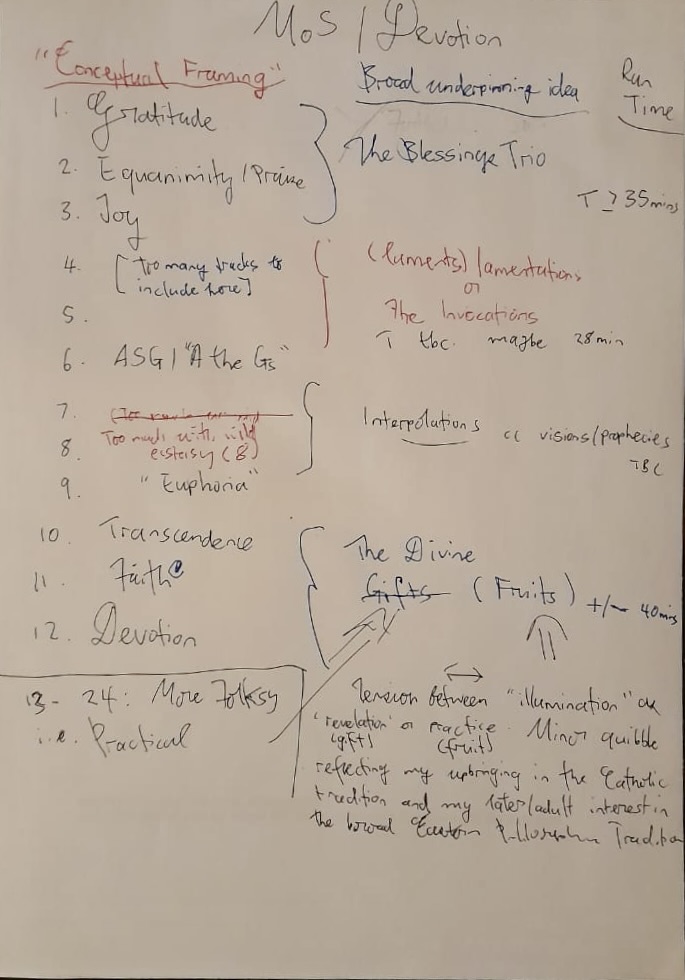
If you thought my literary aims were ambitious (to put it kindly), then I’m afraid you haven’t seen nothing yet. You can only imagine what I had in mind by embarking on a path inspired by such notions as a world with “the highest, near-perfection of justice.” Sure, there is a selfless aspect to that. But unlike a writer’s modesty, boisterous bravado and verging on cocky confidence are not alien in a musician’s territory, especially if, for example, you are a hip hop head like me. In the rap genre, each of your favourite artists will claim to be the greatest of all time in just about 3 out of every 5 of their songs. So, no, what I wanted to do as a musician was not even close to producing “one of the greatest” works of art. Instead, think visions of parting clouds and opening the gates of heaven, Moses and the promised land, nothing less than the second coming of Christ, etcetera, etcetera. I would be exaggerating if not for the fact that Southern African musical traditions are so closely connected to what I consider to be the divine. As an example, a distinctly South African jazz trait, also (paradoxically) typical of African music in general, is an ability to turn melancholy into joy and divinity, sorrow into bliss and beauty, and suffering into profound understanding and a depth of compassion. I especially love West African music and the singing which characterise the post-independence vocals of Guinean and Senegalese bands. I have half a mind to translate any of my lyrics just for that sound. Still, even then, in my mind I have always commented to myself that South African jazz music is the hill I will die on because its music is divinely inspired; it has a touch of the transcendental which can only be described as coming from direct contact with the divine, something heavenly and iridescently majestic.
One advantage of being a performing musician is you get to have a sense of your ability to execute your aims, however defined. In my case it was assessing a capacity to connect with an audience and “move a crowd.” I must confess a sense of gratification that comes with the ability to cast something of a spell or otherwise hypnotise a listener – those are words from reviews of the masses. It also helps when one or two producers who introduce themselves saying they’ve worked with so-and-so famous artist affirm the same or offer the opportunity to work with you. Moreover, I even began to wonder whether I found a way to sublimate my “preachy” inclinations by administering sermons or expressing lofty idealism through a guitar, as opposed to one of my childhood ideas of pursuing the life of the cloth as a priest in the catholic tradition in which I was raised, or my late teenage/early adult pursuits of politically oriented organising work. My vanity aside, this exercise fulfilled an important psychological function.
This is still a descriptive “about” section, and I am aware that this particular subsection on cultural production was prefaced with a specific injunction to expect to read essays. However, I must now respect you all and cut this short. Because wow. I imagine that for some people ‘essays’ are like maybe 2-3 pages max of writing. Now I’m about to really venture into long term paper “essay”. And so, I’m afraid I’m undoing the goodwill the minimalist cool kids might have felt toward this “about” section when I decided to hide massive reams of content under the drop-down headings. As an aspiring cool kid myself that won’t bode well for my influence/r ambitions.
Be on the lookout for upcoming posts with the titles “Devotion” or “To meat, or not to meat” where I will likely continue this thread. These posts will be in the Creative Writing or Non-Fiction tab of this webpage where I will continue this story. If at the time of reading these posts are not yet available, feel free to subscribe using your email address or “follow” the blog, and you will receive a notification once a new post is uploaded.
A few house rules and notices for website and blog content
I have decided to re-launch this webpage as a functional website for my work and scholarly interests, and only secondarily as a ‘blog.’ I am retaining the blog element because I still enjoy writing the occasional poem or reflexive essay. A poem is an expedient form to express otherwise intense emotion in a format which doesn’t strictly require the detailed reflection or disclosure of sensitive personal events which characterises non-fiction writing. On the other hand, I do write very regularly and there is a lot of ‘content’ I would still like to share. Unfortunately, I do not actually have enough time to publish and type up material. So, because as a matter of course I still enjoy writing, I am keeping the option open to publish the occasional reflexive essay or short story.
However, unlike with my ‘previous’ blog, I have classified old and new content as appropriate to protect sensitive information from being too widely available in the public domain. You may encounter posts with restricted access. Feel free to reach out if this occurs and if you have any questions.
Notice on Rules Governing Attribution, Citation and Distribution of Site Content
- You may share site content using any available online and digital links on other platforms. All site content may be used for any educational purposes, such as in workshops, classrooms, tutorials, seminars, or assigned course reading. However, you may not otherwise copy and paste, reproduce, and distribute the whole contents of posts without attributing the source directly to this website, or, without obtaining express permission.
- Note that for any works of poetry, you may not use any line, quote, verse or extract as an epigraph in any publication or published material without obtaining express permission directly from me. Moreover, for any substantial use or analysis of poetry in any publication where the poem extract exceeds 6 lines, a whole verse, or a stanza, you must seek permission to do so.
- Scholarly essays may be cited by referencing this website and the seminar for which they were written. Typically, these essays will include the seminar title with course information and class details such as the module number. For example, a response term paper from one of my seminars may be cited as:
- Rakei, S. (2019). “Writing on Water: The Haitian Revolution and Universal History.” POL5048S Global Political Thought. Political Studies Department, University of Cape Town.
Available at Simon Rakei: https://simonrakei.wordpress.com/2019/08/02/writing-on-water-the-haitian-revolution-and-universal-history/
- Rakei, S. (2019). “Writing on Water: The Haitian Revolution and Universal History.” POL5048S Global Political Thought. Political Studies Department, University of Cape Town.
- For scholarly publications, you may use any conventional citation method. You may refer to my Google Scholar profile for assistance with particular referencing methods.
- For short fiction, other creative writing, and non-fiction reflexive essays, directly attribute the source to this website.
- All popular education material, apart from single authored pieces or sole-conducted interviews, is directly attributable to the respective collective responsible for co-publishing any pamphlets, book volumes, or podcasts. Use your best judgement in determining the appropriate use of this material and consult the primary publication for guidance on re-use, reproduction, distribution and attribution guidelines. For instance, if you are reading a publication produced by people frequently throwing around words like imperialism and capitalism, then you probably may not want to use the same material in a coca cola advert. Of course, per collective fashion, I don’t speak for everyone.
 Simon Rakei