I imagine Five Hundred Legs of Distance would make for a good book or novel title if I were to write one. But alas, or rather; for the sake of what’s useful as at the time of writing, it will be the title of this piece.
The emotional need for human beings to express themselves, feel, connect with others, share ideas and thoughts, and have relationships is a double-edged sword; in the sense that it embodies both the nature and meaning (in part) of what it means to be human: to constantly strive and reach for experiences and expression which perhaps are only ever transcendental – that is to say by definition beyond the senses – including the mind.
Secondly, it is a double edged sword because paradoxically the things we strive towards, for fulfilment, security, attachment, happiness and comfort, are simultaneously the cause or, at least in part explain why we suffer and are miserable. Just as it is our nature to seek out expression and emotional connection, so too it is part of our nature to always grasp at something more ever elusive and seemingly beyond reach. Compound the transient nature of all things this adds to the anxiety and unease.
On expression
I recently learnt of the passing of the lead singer of the band Linkin Park who took his own life by hanging.
Whenever I hear of artists be they writers or musicians, who used their craft as a means by which to express how they feel, attempt to connect with others and reach for that transcendental experience, and who took their own lives, there’s a sadness I feel which isn’t unique to death or even the loss of life, but rather something more ill-fated which evokes a certain degree of fear and despondency.
For one, as someone who has taken to writing and recently the idea of playing music as tools or forms of expression, there’s a sense of familiarity in reading the writing of others or listening to music which undertakes this journey of expression. More than that, the content itself of the art resonates to varying degrees, sometimes offering watershed moments or bits of wisdom, encouragement etcetera. The act of suicide therefore in some sense signals a kind of futility and resignation both on the part of the artist and symbolises the futility of attempting to fulfil that one aspect of human nature or the human experience.
Ideally, we would perhaps all live in a world where people can freely express themselves and how they feel. But this begs the question – particularly in the case of individuals prominent enough to have had platforms where they can express themselves to and with wide and large audiences – what then happens after people have seen and heard you? What is the point?
That aside, however, I would also imagine that art forms in an ideal world would perhaps serve as functions to express higher ideas or notions beyond the grasp of what can be expressed in conventional forms. For example, notions of beauty, or to capture feelings of awe and splendour.
But we live in a broken world, and a lot of us are also broken people, so it is often that those who try to deal/handle or otherwise cope with the damaged parts of themselves – or the world for that matter, turn to art forms, commonly music and writing as instruments to heal.
I stumbled upon Linkin Park back in high school in the latter part of grade 11, and I liked the melodic blend of the piano and the vocals of the lead singer as soothing elements to the otherwise pouring rage and anger characterised by metal rock in the band. Although weird too (I don’t think I knew any other people I lived around or went to school with who listened to metallic rock) it helped me get through my angsty angry phase and deal with other things I won’t mention now.
And whilst it is easy to say people should not tuck away their emotions and rather find ways to express how they feel, this ignores the actual reality of pain, and to some extent inconvenient discomfort that one would need to go through. Moreover, for reasons I’m yet to understand fully, sometimes it’s simply not enough to do this in solitude, for example, I could simply write this in my journal and not share it elsewhere.
Yet there’s a pressing need to commune and share in a larger experience, and not necessarily to be seen or heard as I’d actually prefer the contrary; but rather, because metaphorically speaking there’s a desire to bring out of the darkness that which is felt inside and not seen or heard, out into the light symbolised as the larger collective. But I also think there’s value in ‘separating’ or drawing a line between that desire or craving (and even the actual feeling for that matter) from what one would consider to be the self, whilst simultaneously acknowledging the craving as only a constituent making the individual.
Many people would accept the above approach as a suitable method of ‘dealing’ with emotions as they need to be acknowledged as opposed to being repressed.
On communal healing
I was at a winter school session this past Saturday in Khayelitsha organised by Pathways to Free Education as part of a popular education program in the launching of the third volume of self-published booklets.
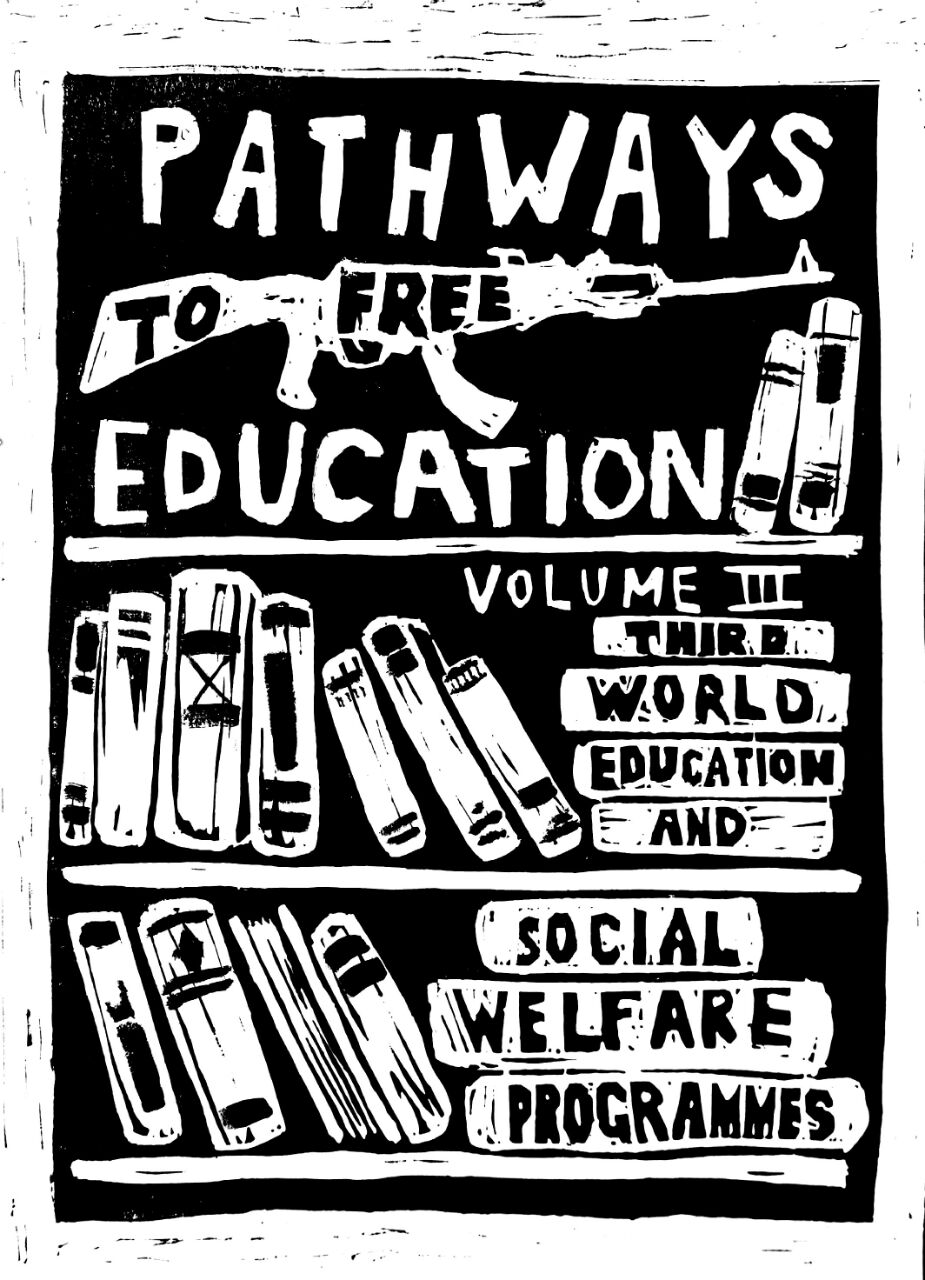
Cover Image of Pathways to Free Education Volume 3 booklet, graphic by Leila Khan
In the first of the winter school session which was a week before, the student participants responsible for crafting and facilitating the sessions were given very frank and blunt critique in how the way the space was set-up did not allow for people other than university-educated folk to express themselves freely. The language was too distant and divorced from their lived experiences, and people did not feel comfortable sharing their ideas or how they felt.
After taking the reflections to heart the second session was drastically improved and the feedback was positive. But beyond what was said, it was all round evident during the day how people were openly vulnerable to the point of feeling safe enough to share intimate encounters in a room of strangers.
I was thinking about one such moment from the session when I was reflecting on the idea of distance, particularly as it relates to relationships and connectedness between people and individuals.
And so to return to the title of this post: the initial idea was for me to explore my own distance in a sense from others, and why. I understand some significant aspects of this as having to do with experiences growing up and how that moulds certain personality traits whilst simultaneously otherwise using rationalisations as a priori understandings concerning the nature of things.
Popular education spaces have the capacity to be radical not only in how they have room to reinterpret what education and learning is, but also because they allow us to understand each other and ourselves in the process and centre what’s important for those present at that moment.
Learning, therefore, becomes a truly experiential process where knowledge is carried and brought forth via direct contact by participants in the room. By retelling experiences or forming your own thoughts about an idea or concept independently, it can then be applied in a manner that is relevant.
In this sense, the idea of learning is expanded to include aspects which allow for vulnerability and openness to create a meaningful connection not only with the content but with and to those around you.
As for communal healing: whilst the need is evident I can say for myself it is work I’d rather do personally whilst as far as possible participating to the extent to which it allows.
I am not sure this will ever feel the void we feel, but for the time being it seems sufficient to keep folks from the brink of utter despair, and there is hope to be found too.
This I will hopefully share on some day. Or rather, I should not feel the need to share it. For now I’ll say:
Between the world and me
Lies a great gulf
For the world carries my pain, but does not know it
And so a great gulf must always separate us
For I do not wish to be part of it
Yet it is of my own making, part of my nature
To turn away is to shun myself
This too I must do,
for I am but _
Discover more from Simon Rakei
Subscribe to get the latest posts sent to your email.
 Simon Rakei
After reciting (quite a few times) a potential response or comment to your inspirational and intriguing blog posts, I’ve settled for:
I’m a fan 🙂
LikeLiked by 1 person
Haha thank you and thanks for reading 🙂
LikeLike