A case study of the Azanian Liberation Tradition as a theory of liberation and practice of resistance
Long essay submitted in partial fulfilment of requirements for Module 1 SOC5059F: Theorising Justice from the South
Sociology Department, University of Cape Town
Abstract
African philosophy has necessarily come to be defined in relation to the consciousness of oppression and the struggle for freedom. This paper reflects on a tradition of black radicalism using the Azanian philosophical and liberation tradition in relation to contemporary South African historiography. Part 1 establishes African nationalism as a key theory and ideological formation of the Pan-Africanist Congress of Azania and locates confrontation as its main practice of resistance by tracing the historical contestations of African nationalism and its relationship to Marxism. The connective to contemporary South African historiography is briefly illustrated situating the late 2016 iteration of the student movement’s approach to the ‘National Question’. Questioning the nature of the black bourgeoisie betrayal of the revolution and the limits of their radicalism, Part 2 open the essay’s critique and situates the Azanian Liberation Tradition’s discourse of national liberation in Robinson’s rejection of universalist theory of political and social order through Robin D.G. Kelly’s reading of the Terms of Order. Theoretical anarchism is offered as a more humanitarian enterprise juxtaposed to the law and order alternatives of the sciences. This approach, the paper concludes, is perhaps most appropriate for African philosophy through a reading of Ramose’s African Philosophy Through Ubuntu.
Introduction
Background
The debate on nationalism and its role in Marxism – and by implied extension in revolutionary thought and action, was perhaps most notoriously popularised by Stalin’s pamphlet Marxism and the National Question. After shutting down the university campus for almost 6 weeks beginning in the week of 15 September 2016, with no progress from the talks with the university executive over repealing the rustication of student activists – summed up by the banner #BringBackOurCadres – the student movement had to decide if it would disrupt the final exam writing proceedings. The debate which unfolded in nightly plenary sessions gathered to reflect on strategy and reflect on tactics, specifically whether to continue the shutdown, was with some historical irony termed the National Question.
The national question in the student movement was a debate which was essentially strategic in nature. This means, it was a reflection on the objectives it aimed to reach located against the backdrop of a set of circumstances and constraints which would influence the decision to be taken: on the one hand, it was concerned with the appropriateness of using the shutdown tactic as a method of achieving the strategic objectives behind #BringBackOurCadres, namely the rescinding of expulsions of student activists; a prolonged shutdown risked not only a more repressive authoritarian clampdown from the university and the state[1], but it also meant losing the only bargaining leverage the movement had – the threat of not completing the academic year. The longer the shutdown continued, the more the university would resort to private security to guard exam premises[2]. Given the fear instituted by the clampdowns[3], this would militate the efficacy of attempting a disruption of exams[4], and by extension, risk not securing any gains or victories that could have been won[5].
On the other hand, and predominantly, the debate related to the broader strategic objective the movement had set out for itself at the start of 2016, declared as the Year of Free Education and the Return of stolen land (RhodesMustFall (RMF), 2016). In the very broadest sense in line with the ideological commitments of the movement, free education and the return of stolen land was inextricably linked to objective of the realisation of black liberation (RMF, 2016). This essay illustrates how this formulation was primarily, or perhaps first and foremost, a strategic necessity, whilst providing the broad ideological framework within which the debate occurred.
Rationale
To borrow from Neville Alexander (1979) writing on nationality in One Azania, One Nation: The National Question in South Africa, the existence of a strategy presupposes the existence of a theory (Alexander, 1979:167). For this essay, it is argued that a reading of the student protests and its strategic orienting in relation to invoking “the National Question” as a banner under which to guide strategic thinking and decisions of the student movement, is located within the Azanian liberation and philosophical tradition (Dladla N. , 2017). In that respect, the essay uses the relationship between theory and strategy (Alexander, 1979:1) as an entryway to map out the theoretical and conceptual framework underpinning black radicalism as it manifests in the Azanian Liberation Tradition (Ikwezi, 1978).
Scope, aims and outline
The essay has two central aims. First, to establish the theoretical underpinnings of black radicalism specifically through nationalism. The essay draws from Cedirc Robinson (1983) Black Marxism: The Making of the Black Radical Tradition. In conversation, part one of the essay will therefore establish what the essay refers to as the Azanian liberation tradition. This tradition is established through a historiographical reading of African philosophy as a philo-praxis of liberation (Ramose, 1999; Dladla, 2017) by primarily drawing on a reading of historiographical analyses of the Pan-Africanist Congress of Azania (PAC) during the period 1912-1963. In this respect, the essay draws from dissertations by Ranuga (1983) Marxism and Black Nationalism in South Africa: A comparative and critical analysis of the ideological conflict and consensus between Marxism and Nationalism in the ANC, the PAC and the BCM, 1920-1980, and Mahlangu (1990) From South Africa to Azania? A critical analysis of the Pan Africanist Congress in exile, 1962-1990.
As it specifically relates to African nationalism as a key theory and ideological formation of the Pan-Africanist Congress (PAC) of Azania, and with the PAC as its driver (PAC & Sobukwe, 2010): the essay connects three factors across part 1-3 of Black radicalism, to the unfolding which resulted in the Africanist theoretical and strategic outlook of the PAC of confrontation and mirroring the “emotions of the common man” (Mahlangu, 1990:33). From part 1 of Black Marxism, the limits of European radicalism and the resultant dismissal according to Robinson of the importance of nationalism in Marxist thinking (Robinson C. , 1983), is linked to the formation of the 1949 ANC Youth League as a response to lethargy and lack of action on the part of the old-guard associated with the founding of the congress movement in 1912 (Ranuga, 1983). It is worth noting, however, that seemingly contradicting Robinson, Alexander suggests that Marx was well aware of the historic force of nationalism, citing Marx’s acidic comments on his son-in law’s ridiculing of nationalities as nonsense (Alexander, 1979:10).
Second, as it relates to theoreticians of African nationalism, the essay relates Part 2 from Black Marxism, tracing the reformist and gradual approach of the intelligentsia from which a radical articulation would come to emerge (Robinson C. , 1983). Here the essay pays attention to the early Christian ethos approach of the early founders of the ANC (Ntloedibe, 1995:73), whose approach was largely non-confrontational gradual and reformist (Sobukwe, 1959:23), drawing striking parallels with the black intelligentsia outlined by Robinson in part 2 of Black Marxism on his discussion on W.E.B. Du Bois’ Black Reconstruction in America. Third, the primacy of nationalism is particularly illustrated in the Azanian tradition in the fact that the Communist Party of South Africa had come to play a decisive role in shaping ANC policy and ideological positions after its formation in 1921 (Pogrund, 1990:25), most notably the thesis of South Africa’s internal colonialism viz. colonialism of a special type (Alexander, 1979:106), and the multi-racial formulation of the 1955 Freedom Chapter document reifying the four nations thesis, contrary to the PAC’s non-racialism (Dladla N. , 2017). This formulation was critically important in determining which people constitute the nation of South Africa, and by extension, the resultant theory of national liberation. Lastly, Part 3 of Black Marxism on the relationship of the communist party to black nationalism in America, is linked to all three moments in the historiography of liberation movements from 1912-1949 in South Africa, with particular emphasis on the decision of the PAC to break from the ANC November 1959 (Mahlangu, 1990:30).
Therefore, in this first part, the essay hopes to illustrate that the invocation of the phrase ‘National Question’ was rooted in a tradition with a particular strategic orientation geared towards confrontation in how it both interpreted the student protests, and in its method in how it utilised and captured its radical potential and by extension the revolutionary instrumental value the student movement wielded. The essay locates how this strategic orientation favoured confrontation and pushing the limits of power (Mahlangu, 1990) as a practice of resisting colonial rule, and secondly, how is method sought to “mirror the emotions of the common man” (Mahlangu, 1990); in that respect, the essay draws the connective to the emotive appeal of nationalism as illustrated by Robinson (1983) through his interlocution with Richard Wright’s The Outsider (1965) and Black Boy (1945), with the larger aim of establishing the relationship between black radicalism, nationalism and Marxism and its limits. Using the historiographical account Alexander provides of the Communist Party of South Africa; its response to the Africanist oriented Industrial and Commercial Workers Union (ICU) led by Clements Kadalie in the early 1920s (Alexander, 1979:49) this coincides with Robinson’s overall assessment of the regard given to nationalism with a similar comparison of how the United States Communist Party disdainfully responded to the Universal Negro Improvement Association (UNIA) most notoriously associated with Marcus Garvey, and more specifically with Richard Wright’s decision to leave the Communist Party.
The second part of the essay adopts two questions posed by Robinson in his analysis of CL.R. James (1943) and his work, particularly in relation to The Black Jacobins and the figure of Toussaint L’Ouverture, and relates this to the 2016 iteration of the student movement. First: what is the nature of the black bourgeoisie betrayal? And secondly, what are the limits of the radicalism of the petty bourgeoisie? This question will foreground the brief, high level contextual overview from late 2015 and early 2016, leading to the student October-November 2016 movement debate on the “national question”. To help explore this, the essay borrows the concept of colour-caste used by Alexander (1979:158) to illustrate the co-option of black bourgeoisie strata of by the dominant class; a contradiction whereby their class interest tie them to the status quo whilst needing to appear to be tied to the fate of the masses whose struggles in turn elevate their access to privileges they are not able to presently enjoy. In so doing, the essay delineates radicalism in two senses: on an ideological level, and on the level of political action.
After analysing the two iterations on radicalism as explored through part 1 viz. the Azanian Liberation Tradition, its forms as observed in the student movement, and the betrayal therein, the debate on the national question is recast in a holistic assessment of its strategic advantages and its trapping. Therefore, on the level of theory, drawing from Robin. D.G. Kelly (2000) invocation of Robinson’s The Terms of Order in the foreword to the re-issued version of Black Marxism, the essay situates the discourse of national liberation in Robinson’s rejection of “universalist theory of political and social order (Kelly, 2000:xxvi). Therefore, the essay’s concluding comment offers, read together with Terms of Order (Robinson C. J., 1980:76,158-185) and Paul Feyerabend (1975) Against Method: Outline of an anarchistic theory of knowledge, theoretical anarchism, as a more humanitarian enterprise juxtaposed to the law and order alternatives of the sciences (Feyerabend, 1975:295). This approach, the paper also concludes, is perhaps most appropriate with a reading of African Philosophy Through Ubuntu (Ramose, 1999).
Broadly,
the paper is split into two parts revolving around the main aims as outlined
above.
Part I. The Philosophical and Theoretical Underpinnings of Black Radicalism
The Azanian Liberation Tradition, Nationalism and Marxism in South African Liberation Historiography
Approaching theory as historiography
Though hardly used in this paper, for clarity, the section of the paper begins by establishing conceptual clarity regarding the term Black Marxism, and its illuminating essence of the historiographical approach to theoretical work; if not for any other reason, then for the fact that Cedric Robinson’s (1983) book Black Marxism: The Making of the Black Radical Tradition is the centrepiece from which the unfolding conversation revolves. Briefly, Black Marxism is not a variant of Marxism whose proponents happen to be Black, nor is it a different kind of Marxism for black people (Robinson, 1983:70). In so far as the terms black radicalism and a black radical tradition are used in this paper in relation to African philosophy and the Azanian liberation tradition, and in as much as those terms are implicitly associated with the term Black Marxism, Black Marxism for the purpose of this paper is to be understood as the argument which posits that black radicalism and its epistemological framework of radical thought and theory has a relation with an African ontology and epistemological framework (Robinson C. , 1983:168) which exists in so far as Africans and people of African descent have historically resisted oppression and struggled for freedom. In other words, this radicalism though born of a common “cauldron” of capitalist slavery and imperialism (Robinson C. , 1983), has a deeper and underlying historical and ideological connective. Whilst not wholly adopting Robinson definition of the black radical tradition as an “essentially African response” to oppression (Robinson, 1983:78), the essay concurs with the analytical exposition Robinson undertakes in an attempt to both refute the idea that Black radical action had no coherent or shared ideological basis in the context of slave revolts, and specifically to illustrate that black radicalism did not have its epistemological roots in the Western critical tradition most pronounced in Marxism.
In this respect, Black Marxism can be understood as a historiographical account of Marxsim through the prism of race (Kelly, 2000).
It is precisely this fact of how the black radical tradition comes to find articulation through historiography which gives it status as theory (Robinson, 1983:195). The historiographical approach enables a theoretical illumination: to observe, map out and connect black radicalisms across different contexts, space and time i.e. to do theory and thereby establish both an intellectual/theoretical and radical tradition. Two historiographical accounts Robinson draws from in Black Marxism stand out: W.E.B. Du Bois (1966) Black Reconstruction in America: An essay toward a history of the part which black folk played in the attempt to reconstruct democracy in America, 1860-1880, and C.L.R. James The Black Jacobins: Toussaint L’Ouverture and the San Domingo Revolution. In both texs, Du Bois and James provide a historiographical reconstruction to illuminate radical practices which were erased by Western historiography (Trouillot, 1995) because they did not fit into the Western critical tradition’s conception of radicalism (Robinson C. J., 1980). Moreover, as in the case of Haiti, the historiography challenges the notion that black radicalism has its source within Western radical theory, establishes its uniqueness from European radicalism, and by extension, challenges the universalising theories of revolution and their unquestioned application (Robinson,1983:38).
Du Bois’ reconstruction of history is particularly exemplary and will be primarily related to historiography of the liberation movements in South Africa. For it is at once a political act (Robinson, 1983: 203):
- The terms of his analysis were quite important to Du Bois. They were a part of his beginning of the transformation of the historiography of American civilization-the naming of things. In the changing of the names of things, he sought to provide the basis for a new conceptualization of their relationship. In the first three chapters of his work, Du Bois established the rules of his analysis. The institution of American slave labor could not be effectively conceptualized as a thing in and of itself. Rather, it was a particular historical development for world capitalism that expropriated the labor of African workers as primitive accumulation.
It is political because it is a historical analyses “based on economic analysis and class struggle” (Robinson, 1983: 195). Here, Robinson invites us to pause and reflect on the importance of a theory of history – that is to say – history subjected to theory, by deliberate naming, the terms we use in theoretical work bring certain discussions, ideas and conversations into play, and how the term in itself changes the relation of things (Robinson, 1980:195). Furthermore, implied in the term, Du Bois reconstruction, precisely because it is historiographical, also seeks to give a historically accurate and just characterisation of historical events by reconfiguring which facts of history are graduated and qualified as a historical fact (Dladla N. , 2018:423) for the purpose of America historiography (Du Bois, 1966:711). Terming it the propaganda of history, Du Bois illustrates how the facts of American history have been falsified, because of the contradictions and shame therein. In this regard, in Du Bois’ reconstruction we find an emphasis on the Black worker introduced to America through the institution of slavery, hence offering a different fundamental contradiction divergent from Marxist analysis of primitive accumulation and economic development, to quote Du Bois (1966:3):
- How black men…, became a central thread in the history of the United States, at once a challenge to its democracy and always an important part of its economic history and social development
Having established the historiographical account as a form of doing theory, the essay now turns to the historiographical study of the PAC in relation to Marxism in order to establish the theoretical framework of the Azanian Liberation Tradition. In establishing the theoretical foundations of such a tradition, the essay takes African Philosophy as its departing point. Dladla (2018) in The liberation of history and the end of South Africa: some notes towards an Azanian historiography in South Africa, establishes what he considers to be the terms of an accurate and just South African historiography. To draw this connective, the essay turns to both Dladla’s and Azanian philosophical tradition’s interlocutor: African philosophy.
Similarly, to Black Marxism, African philosophy is not a variant of philosophy whose proponents happen to be African or identify as such (Dladla N. , 2017). However, its definition emerges from a sullied and dominated history because of the colonial encounter and racism which held Africans to be uncivilised and not having the ability to reason (Asad, 1973). Without the ability to reason, as per the Aristotelian construct of man as a “rational animals” (Ramose, 1999:15), Africans are not rational. And since rationality and reason are the basis of all valid knowledge as per the positivism that emerged post the Enlightenment era (Feyerabend, 1975), the experiences and ontology (being) and knowledge and truth of Africans were discounted because African philosophy was held to be impossible since the African by nature was incapable of producing any philosophy at all (Ramose, 1999:4).
According to Ramose’s conception, which this paper adopts, African philosophy must therefore adopt an “ineliminable liberative dimension” because an authentic liberation of Africa necessitates the re-affirmation of the right to reason and the rational demand for justice from its unjust conquest (Ramose, 1999:33); It is taken as a given that the term “African philosophy” necessarily, is used under protest, because inherent in the term is an idea that African philosophy is not ‘real’ philosophy – particularly within the academy whereby it is taught in such a way and kept on the margins it does not affect the mainstream, to quote Dladla (2017:33) code for “Eurocentric and dominant curriculum”. As such an authentic liberation of Africa must be underlined by the thesis that whoever holds the key to the construction of theory also holds the key to power (Ramose, 1999:33).
Consequently, this conceptual framing of African Philosophy readily lends towards the direction of a radical tradition embodied in the Azanian liberation and philosophical tradition.
African philosophy as philo-praxis of liberation: emergence of the Azanian Liberation Tradition
Azania was introduced into political discourse and liberatory ideology by the Pan-Africanist Congress of Azania (Dladla, 2018:417). Therefore, the theoretical exposition of the Azanian philosophy intellectual tradition, must necessarily go hand in hand with a historiography of the PAC and by part extension, the congress liberation historiography of South Africa.
As alluded to in the introduction, this essay does not provide a detailed overview of this historiography, but rather, draws on a specific reading i.e. selectively isolates focus areas of prior conducted studies on the PAC to establish the theoretical framework of the Azanian liberation tradition. By necessity, this is a function of the limited range of depth that can be covered within the scope of such a paper. Consequently, of the various defining features of the Azanian liberation tradition and philosophic thought[6], this section of the essay isolates and focuses on two, based on the historical reading of the PAC’s evolution viz. Mahlangu, B. D. (1990) From South Africa to Azania? A critical analysis of the Pan-Africanist Congress in exile in order to relate it to Robinson’s historiography viz. Ranuga, T. K. (1983) Marxism and Black Nationalism in South Africa: A comparative and critical analysis of the ideological conflict and consensus between Marxism and Nationalism in the ANC, the PAC and the BCM. 1920-1980, and finally also in order to make the connective with contemporary historiography vis-à-vis the student movement viz. Alexander, N. (1979) One Azania, One Nation: The National Question in South Africa.
The first feature is the confrontational nature in relation to political power, and willingness to push the bounds of what is considered possible within the realm of politics (Mahlangu, 1990:30). The second defining feature, Africanism (or African nationalism) (Mahlangu, 1990:70) warrants a separate discussion and is covered in the second section of this part (part 1) of the essay. The immediately following discussion can be considered a build-up to discussing African nationalism and Marxism.
The first defining feature of the Azanian liberation tradition is its relational attitude to direct action. By way of leading with the conclusion, as it relates to what radical and tradition means in this instance, it is submitted through a reading of the history that the conclusion to be drawn is as follows:
- First, that being radical and radicalism be defined necessarily in relation to action/activity, and; radical action must be assessed in relation to how it undermines an oppressive status quo;
- That this gravitation towards action is seen as constitutive of a sense of tradition – a tradition of positive action, nurtured by consistent commitment to the struggle;
Ten years prior to the 1959 decision of the PAC to split from the ANC, a group of young Africanists increasingly disillusioned with the lack of activity and progress in their congress organisation, the ANC, decided to form a block separate from the old guard (Mahlangu, 1990:32), and hence the ANC Youth League (ANCYL) was born in 1949. Interestingly, one observes a similar pattern in Robinson’s recounting of Du Bois’ Black Reconstruction. Much like the black intelligentsia in America (Robinson, 1983:179), the native elites in the ANC busied themselves with the project of operating newspapers, appealing for the right to vote, and generally seeking a gradualist reform which would not elicit antagonism but sought instead to find the favour of white South Africa (Ranuga, 1983:5). In that regard, the black elite had become dislocated and removed from the masses they were meant to lead (Robinson, 1983:203). This disillusionment with lack of action was so severe it was reflected in the name of the 1949 meeting adopted by the young Africanists, the 1949 Programme of Action (POA), and furthermore, the 1949 Programme of Action specifically committed members to mass mobilisation towards action: civil disobedience, strikes, boycotts and stay-at-homes (Mahlangu, 1990:30).
The PAC decided to break away once more on the basis that the ANC had abandoned to positions adopted in the 1949 programme. In that regard, the PAC at once established itself as the vanguard of the Africanist cause. Before we turn to uncover in more detail the assigned cause of the 1959 split – namely the role that Africanism would play vis-à-vis liberal whites and communists, the essay now turns to hone in the conclusion assigned earlier drawing from an interview conducted by Mahlangu (1990) with PAC student local executive official Malcolm Dyani, who was incarcerated at Robben Island from 1963-1978 for PAC activities as a student organiser.
Asked what it was about the Pan-Africanist Congress that he was attracted to, Dyani cited the willingness on the part of the leadership to sacrifice themselves and suffer personal cost, particularly with the PAC line of march which dictated ‘leaders in front’ in events whereby there would likely be arrests or physical confrontation with security forces (Dyani, 1990). This tradition of servant leadership is actually older than its practice by the PAC. It was first promulgated by Kwame Nkrumah in a meeting of “The Circle” – a student organisation formed during his studies in the England – and it provided what would letter serve as the template for Pan-Africanism’s vanguardism approach (Nkrumah, 1973:47). The Circle provided its motto as “the Three Ss”: Service, Sacrifice and Suffering. People in the township were wary of being sent to danger whilst their leaders stayed comfortably at home. The PAC’s approach was thus welcome and garnered the organisation respect by seeing the “leaders in front”.
When one reads Kwame Nkrumah’s full organisational policy document on The Circle, the expected level of commitment and sacrifice is immediately evident. This ranges from expectations to meditate daily on what The Circle stands for, and to fast once a month from sunrise to sunset (Nkrumah, 1973:48). This sense of discipline is evident in the PAC 1959 manifesto, paragraph 10(a) regarding the PAC disciplinary code requires that its members maintain good health habits. This sense of commitment to the cause is highly regarded.
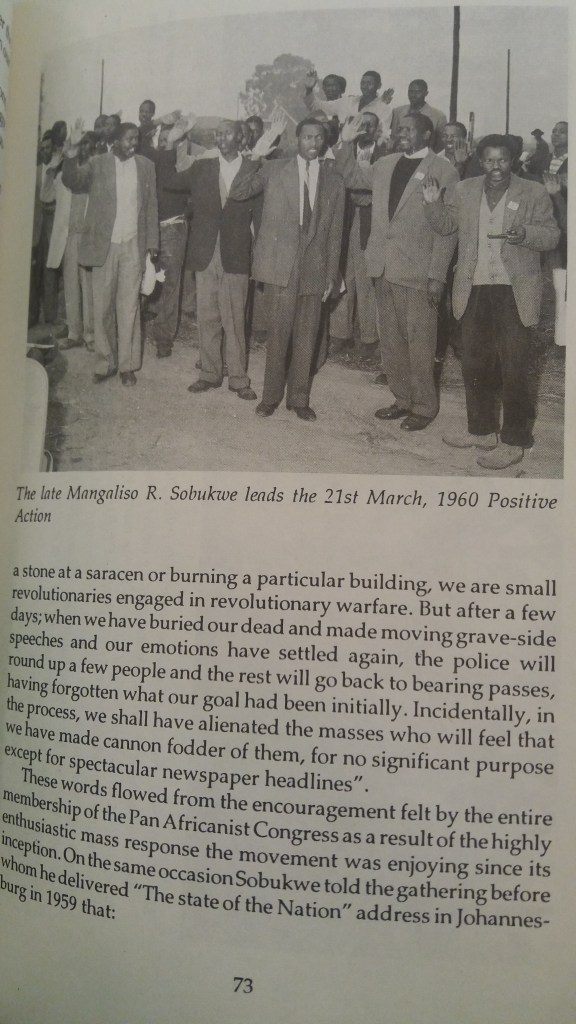
Second, Dyani (1990) flagged the willingness and readiness to act. The Positive Action Campaign which came to be fatally associated with the Sharpeville massacre and subsequently characterised as an anti-pass campaign (Pogrund, 1990). Here we also observe how different historiographical approaches have different implications for the theoretical framework of the Azanian Liberation Tradition (Dladla N. , 2018). The anti-pass campaign was deliberately termed the Positive Action Campaign by Sobukwe to signify its radicalism by establishing the political agency of people living under apartheid to change their condition.
On 21 March 1960, hundreds of members of the PAC left their pass books at home, and reported themselves to the nearest police station, demanding to be arrested for failing to carry their passbooks (PAC & Sobukwe, 2010). Such a simple act irreversibly changed the course of South African history (Pogrund, 1990). Yet, what is striking is the response it elicited from the apartheid power structure. As Dladla (2017) has suggested, the radicalism and threat posed by this symbolic gesture was enough to scare the regime into a frenzy to repress the protest. Unlike the framing of an anti-pass demonstration, the positive action campaign carries across the understanding that it is through the efforts and exertions of those who are oppressed that a change will come (Nkrumah, What I mean by Positive Action, 1949:93).
Through action, we simultaneously see the strength and power of ideas. In that regard, the Azanian liberation tradition, particularly that closely tied to its philosophical tradition, takes pride in its critical philosophy (Dladla N. , 2018:418)
Africanism and Marxism
For the PAC, Africanism is the basis of liberation (PAC & Sobukwe, 2010) and thus the primary motive force of the Azanian liberation tradition. As a consequence of what Sobukwe deemed historical necessity (Ranuga, 1983:41), partly as a result of Apartheid’s formulation of the four nation’s thesis (Alexander, 1979), the drive towards liberation occurred under the banner of national liberation since African nationalism was chosen “because of its deep human significance; its inevitability and necessity to world progress” (Sobukwe, Inaugral Address, 1959). Nationalism within the Azanian liberation tradition was a positive quality of patriotism, but above all, for love of Africa and the striving of human potential (Ranuga, 1983; Mahlangu, 1990). In that respect the PAC broadly adopted the definition of an African as anyone who owed their allegiance to Africa and acknowledged an African majority rule (PAC & Sobukwe, 2010). Therefore, this at once situated Africanism within a long debate in Marxist thought on the role of nationalism and self-determination in class struggle, colloquially referred to as “the national question”. For the purposes of this section, the essay historically situates the account Robinson provides vis-à-vis Marxism and Black Marxism, with an emphasis on the interactions between the Universal Negro Improvement Association (UNIA) and Richard Wright and the Communist party, in relation to a comparable moment when Clements Kadalie led the Industrial and Commercial Workers Union (ICU) between 1918-1924 (Alexander, 1979), at roundabout the same time as the UNIA was at its peak (Robinson C. , 1983).
In both cases, the response to nationalism by Marxist thinking is more or less the same. Instead of acknowledging the appeal nationalism had, in both instances, the Communist Party instead opted to infiltrate these movements and convert its members. Neville Alexander (1979) outlines how this influenced the ANC to the point the PAC had to break away. Therefore, historically, Africanism within the Azanian liberation in part is defined by this occurrence – or perhaps more precisely, in its relationship to communists and by extension at the time, white South Africa; that is to say, the perceived role of anyone who was not ‘African’ in the national liberation struggle in relation to the role of Africanism (Mahlangu, 1990). If we have thus far established that historiography and its reconstruction (Du Bois, 1966) is a form of theory (Robinson C. J., 1980), and that who holds the key to the construction of theory also holds the key to power (Ramose, 1999), it immediately becomes evident why the clash between Africanism and communism (and black nationalism in the United States) was of paramount importance; because, it was not just about a theory of radical change, but it also provided a theory of history, it was thus a historical contestation (Dladla N. , 2018) whose terms had fundamental contradictions differing with what Marxist thinking had set out. It changed the relations between blacks and white and placed emphasis on historical encounter.
Consequently, the point of departure for the PAC was that South Africa is part of Africa (Ranuga, 1983:19). This meant that Aficanism necessarily was defined in reaction against economic exploitation (Mahlangu, 1990:73). However, and perhaps primarily, this is superseded or is presupposed by the idea that Africa belongs to the African people who must fight back to regain their stolen land (Ranuga, 1983). In this respect, land and nationalism are thus interwoven. In One Azania, One Nation, Alexander (1979) discusses the political strategic implications of ideas about who constitutes the South African nation. The PAC had the broadest definition, stated simply “there is one race, the human race” (Sobukwe, The PAC case, 1959). Unlike the thesis by the communist party of South Africa, Sobukwe rejected multi-racialism and the four race groups because it implied a ‘democratic apartheid’ (Mahlangu, 1990:15). However, the terms of struggle were different. Whilst the definition of an African promulgated within the Azanian liberation tradition was broad enough to include white South Africans and welcomed them to stay in a liberated Azania (Ranuga, 1983), historically, they held that since the national liberation struggle was a fight by the African people to regain stolen land, by definition, the interweaving of land and nationalism meant whites could not be considered African nationalists for the purpose of waging struggle. This was more than anything else reverting back to the question of one owing their allegiance to Africa only; in this respect a similar class analysis concept of why the petit bourgeois isn’t wholly trusted can be deployed (Du Bois, 1966), since their current interests and wellbeing are ratified and protected by the status quo (Robinson C. , 1983; Alexander, 1979).
When Clements Kadalie took leadership of the Industrial and Workers Commercial Union (ICU) from 1918-24, the ICU eclipsed the ANC for more than a decade (Mahlangu, 1990:47). It is conjecture, but after the Communist Party of South Africa was formed in 1921, by the end of the decade when the ICU was in decline, the ANC was in an ascent: in a comparable analogy to the PAC – after the 1960 positive action campaign later known as the Sharpeville massacre, the ANC was considered a thing of the past (Dyani, 1990). In exile from the period 1963-1968, the PAC had a rough estimate of 6 000 cadres being trained for warfare juxtaposed to a figure of 2 000 for the ANC. In the countryside and townships of South Africa PAC numbers grew more than the ANC and stronger numerically. Mahlangu, based on his interview with Dyani (1990) partly attributes what became ANC’s stronghold politically and in South African historiography to the role and contributions of whites in the ANC. In contrast, the PAC, except for a single case, Patrick Duncan, did not allow for white membership.
The ICU in many ways can be linked to what became the ANC youth league formation in 1949 and by extension the PAC; it was what that the Christianised ANC of the 1912-1925 was not; breaking sharply with the docility of the ANC which opposed civil disobedience, the ICU had militant calls for defiance of pass laws (Mahlangu, 1990). Its base was largely “African” workers with a large “Coloured” base too. (Alexander, 1979). Therefore, given that you have a trade union synonymous with workers organisation in Marxist struggle i.e. a worker led and working class struggle: one must then ask why Marxism did not find a natural home in the ICU and why the Communist Party was sharply rejected even when the ICU was in decline, but instead, how it then came to find a place within the ANC which by all accounts was an elitist petit bourgeoisie movement (Ranuga, 1983), and to the point where it became influential enough to formulate what is the dominant South African historiography i.e. theory in relation to who constitutes the nation in South Africa, and by extension, the appropriate strategy of national liberation (Alexander, 1979).
To help explore this briefly the essay turns to Robinson’s analysis of the relationship between Marxism and the Universal Negro Improvement Association (UNIA) in the United States to explore the workings of the Communist Party. Under the leadership of Marcus Garvey, an influential figure in Pan-African philosophy, like the ICU, the UNIA eclipsed all movements for black liberation in America before its time, and after, well into the civil rights era (Robinson C. , 1983:211; Du Bois, 1966). To date, it remains the largest movement of organised blacks in American history. The UNIA’s outlook and strategic orientation was “revolutionary nationalism” (Robinson C. , 1983:214) whilst incorporating elements of socialism. Here too, with such revolutionary potential present, the communist party and the relationship between black radicalism and Marxist theory did not converge. The communist party had been unsuccessfully attempting to organise Black workers in the United States. From 1920/21 onwards, with a rival organisation to the UNIA, the Black Brotherhood, the Communist Party officials and the Black Brotherhood opted to infiltrate or subvert the UNIA (Robinson C. , 1983:217). A similar operandi was deployed by the Communist Party of South Africa in relation to the ICU and the ANC, and later, the PAC and the ANC (Mahlangu, 1990; Ranuga, 1983). In relation to the UNIA, the Communist Party went as far as attempting to force Garvey to join a communist united front. Failing that, they decidedly attacked Black nationalism until 1928 when the party pronounced its own variant: self-determination (Robinson C. , 1983).
Moving from this line of March, the Communist Party of South Africa promulgated self-determination in South Africa as an answer to the question of race in South Africa in relation to the right of self-determination for blacks. In other words, it was accepted that the blacks in South Africa could form their own nation as a national group (Alexander, 1979). However, the discourse of self-determination had devastating effects as it fell into a ready-made trap by the Apartheid government, who through its policy of separate development through the Bantustans, further expounded by the four nations theory (Alexander, 1979:148), was willing to accept the right of blacks to form their own nation. Racialism was thus ratified in this regard.
On the other hand, the Africanism that the PAC then articulated was premised on a theory of non-racialism (PAC & Sobukwe, 2010). What is important to recognise about the pluralist definition of nationhood which until today reifies four racial categories in South Africa as national or ethnic groups, is the fact that a pluralist position on the national question “carries the inevitable implication of a two stage revolution” (Alexander, 1979:106). Therefore, returning to the original question of strategy and the implications of ideas of the nation in regard to who would lead the national liberation struggle, the PAC’s insistence of Africanism was historically located in the strategic necessity to ensure the struggle, as as a result of the multi-nationalism supported by the Communist party in relation to aspirations of the ANC elite (Alexander, 1979) for gradual reforms, would not be led by the aspirant bourgeoisie.
Part II. The Nature of the Betrayal of the black bourgeoisie
Limits of the Radicalism of the petit bourgeoisie
Broad contextual overview
The demobilisation of the student movement after #FeesMustFall (FMF) in October 2015, began with the 2015 announcement by the then president Jacob Zuma of the 0% fee increase for the 2016 academic year[7] (as opposed to a commitment to phase in free education). Subsequently, there were instructions from the student political organisations South African Students Congress (SASCO) and the Progressive Youth Alliance (PYA) – both of whose mother body is the ruling party the African National Congress (ANC), telling students to stop protesting[8], as the victory of #FeesMustFall had been secured (Sikwebu, 2016). To illustrate the co-option of black bourgeoisie strata of by the dominant class; a contradiction whereby their class interest ties them to the status quo whilst, needing to appear to be tied to the fate of the masses whose struggles in turn elevate their access to privileges they are not able to presently enjoy, the essay borrows the concept of colour-caste used by Alexander (1979:158).
Indeed, in contemporary South Africa several of such characters are referred to by various terms, coconut being one such classification of colour-caste. In this regard, ANC Fees Must Fall leader Kgotsi Chikane, whose father is anti-apartheid activist and ANC struggle stalwart Frank Chikane, recently published a book precisely asking the question posed by Robinson on the nature of the betrayal of the bourgeoisie. The book Breaking a Rainbow, Building a Nation: The Politics Behind #mustfall Movements, attempts to answer whether coconuts can be trusted with the revolution (Chikane, 2018) and Kgotsi writes this book from the vantage point of having being part of the Black elite whilst being a leader during RhodesMustFall and FeesMustFall. Several of these students aligned to the PYA/ANC will soon be sworn into the national assembly of South Africa’s parliament after the recent ANC election victory, one of whose campaign taglines, was the fact that the government has pronounced free education in 2017[9].
2016 Iteration of the Student Movement and Locating the National Question Moment
A lot happened between October-November 2015 and the late October 2016 national question debate and though within the scope of the topic, for the point the essay hopes to draw in situating the Azanian Liberation Tradition within the discourse of radicalism vis-à-vis betrayal, the essay primarily focuses on the factors which were influencing the debate in terms of what constituted radical action. In so doing, the essay delineates radicalism in two senses: on an ideological level, and on the level of political action.
The 2016 iteration of the student movement was infamously tied to the Shackville protest at the university of Cape Town[10]. Because of the 2015 0% fee increase, students were broadly divided between those who wanted to continue protesting to secure free education, and those who opted to complete the academic year[11]. At the University of Cape Town, there remained a significant number of militant students who still wanted to pursue the logical conclusion of #FeesMustFall and the realisation of the call for Free Education. This group of militant activists effectively mirrored students who identified as members of RhodesMustFall, one of whose stated ideological pillars was Pan-Africanism (Ahmed, 2017). An unfortunate consequence of the response to the reactionary politics of SASCO and PYA, whom RMF regarded as having sold out the movement, was the collapsing of popular education spaces. In subsequent FMF years of 2016 and 2017, SASCO and PYA visibly lost popularity amongst the student population especially with the ground gained by the Economic Freedom Fighters Student Command (EFFSC) who won the student governing elections at 24/26 South African campuses.
For the purpose of situating the Azanian liberation Tradition, the essay locates what became Shackville within a broader context primarily aimed at mass conscientising through the installation of the shack as a symbol of land dispossession and squalor of Black people (RMF, 2016). This raising of consciousness was important given the lack of ideological cogency which was visible from the onset of FMF in 2015. Much of the descriptive analysis and formulations of strategies tended to lean towards the Rainbowist construct of South Africa, celebrating the success of black and white students uniting to fight for a common cause. This is as a result of the dominant historiography which reflects the interest of the ruling class (Du Bois, 1966; Alexander, 1979). Many students were slow to adopt the radical characterisation and the very idea of South Africa, as a settler-colonial project (Dladla N. , 2018). However, it is this characterisation which was critical in informing “radical action”.
The essay flags this to highlight a similar connective whereby initially non-violent radical protest action, as with the Positive Action Campaign, leads to violence, as with the 21 March 1960 Sharpeville massacre which prompted the PAC to adopt armed struggle in December 1960 at the graveside of non-violence (Mahlangu, 1990:45). Therefore, Shackville – the installation of the shack onto the university campus – its inception, orientation and purpose, must be understood as a deliberate action towards a consciousness raising project[12]. In turn, this would forge the background of the strategic objective the movement had set out for itself in 2016: the year of Free Decolonised Education and Return of Stolen Land (RMF, 2016).
The shack was installed on the very first day of the academic year on 15 February 2016 to set the tone in attempting to drive towards those strategic ends of free education and return of stolen land, and also to counter the demobilisation of the prior year. The installation of the shack itself was widely applauded and garnered wide mass support within a few hours after erection onto campus evoking similar occurrence at the university in 1984 protesting housing accommodation (Badat S. , 2002:384) Things turned violent after a directive from the university executive telling the students to move the shack or it will be moved by force[13]. Underpinned by a tradition of defiance (Badat S. , 2002) viz. Biko, the movement boldly responded by pronouncing that “there will be no forced removals today” and called for support, at once making an emotive appeal to a shared history of oppression and dispossession (On Black Pain/Black Liberation and the Rise of Fallism, 2019). Black students gathered in scores to defend the shack. And to defend in every sense of the word, is what they meant to do. As they say, the rest is history.
What I hope to have illustrated through this extremely brief exposition is the powerful nature of the radicalism embodied in the Positive Action Campaign or erecting a Shack on campus. At a first glance though seemingly simple, and indeed simple on the logistics of physical action concerned in walking yourself to a police station to demand arrest, the strategy was located and rooted in a broader theoretical tradition driving towards specific strategic ends. Second, as an interesting fact of history, that the response to such actions has been excessively forceful. And for the theoretician, one observes a re-writing of history (Dladla N. , 2018).
Recasting the national question
Confronted with whether to continue the university shutdown to rescind the expulsion of students because of the result of the Shackville protest, and to advance the overall strategic objective of realising free education, the movement once again returned to the Azanian Liberation Tradition in guiding its thinking (Alexander, 1979). However, the terms of the debate had changed. Students aligned with SASCO/PYA and the ruling party had been effectively expelled from the UCT plenary. Moreover, despite the devastating effects for the movement post-Shackville, public consciousness was elevated to the point to the point where now decolonisation has had to become re-appropriated. Consequently, the debate on the ‘national question’ quickly degenerated whereby the interrogation of how a campus shutdown would lead to black liberation, was quickly castigated and set aside as the sell-out position. Therefore, the contestation over the national question predominantly occurred in bad faith. This was done by conflating the ideological positions of the movement to the same level as positions that the movement was taking in relation to strategy.
Despite this, in one area, and presumably in good faith, one thing remained true to the tradition: the willingness to test the limits of power and to confront authority. Yet, as the essay attempts to show, this seems to be a question of strategic nature first and foremost, necessitated by the need to respond to otherwise reactionary non-revolutionary positions. In this respect, the late 2016 iteration of the student movement might have lost sight of that until it was almost too late[14].
Future of the discourse of national liberation in Robinson’s rejection of universalist theory of political and social order
As observed from the student movement, the discussion of the national question within a space whereby everyone in the room shared similar ideological persuasion, became a painfully alienating endeavour for those quickly branded sell-outs for focussing on the strategic efficacy of achieving national liberation through a campus based shut down especially when conceding to the already made evident and obvious ideological connections between the two. In this respect, the discourse of national liberation served to stifle debate not only in terms of strategy but concerning the very idea of liberation (Kassa, 2016). Whilst this essay has explored this via the lens of Africanism in relation to liberation, there might perhaps be other motive factors similarly powerful to nationalism as a source of inspiration.
Robinson outright rejects universalist theories of social order (Robinson C. J., 1980). For Sobukwe, Africanism was inevitable, a march of progress towards Africa’s rightful place in the world. When one reads Sobukwe, one readily accepts this as a declaration of faith. Indeed, citing a journalist of the Johannesburg Star in its publication of Sobukwe’s speeches, the bedrock of Sobukwe’s belief was not intellectually grounded; it was his faith in the “slow but inexorable advance of African Nationalism” (PAC & Sobukwe, 2010:3). How do we assess the validity of such a statement? And what then is the role of faith in theory? In arriving at the concluding comment of this essay, it is suggested that the dominance of scientific thinking in theoretical makes it difficult to think about theory differently given the ordered nature of science (Feyerabend, 1975). At the very least therefore, theoretical anarchism is offered as a mild suggestion as it does, at least in its approach, not supersede science above all knowledge in providing and outlining a theory of knowledge. This might then further be useful in de-marginalising African Philosophy.
Conclusion
The essay had two central aims, the main one concerning the illustration of the tradition within which the student movement’s invocation of the national question emerged. First, to establish the theoretical underpinnings of black radicalism specifically through nationalism. In conversation with Cedirc Robinson (1983) Black Marxism: The Making of the Black Radical Tradition part one established what the essay refers to as the Azanian liberation tradition. This tradition is established through a historiographical reading of African philosophy as a philo-praxis of liberation (Ramose, 1999; Dladla, 2017) by primarily drawing on a reading of historiographical analyses of the Pan-Africanist Congress of Azania (PAC) during the period 1912-1963. In this respect, theory is approached as historiography. Consequently the essay drew from dissertations by Ranuga (1983) Marxism and Black Nationalism in South Africa: A comparative and critical analysis of the ideological conflict and consensus between Marxism and Nationalism in the ANC, the PAC and the BCM, 1920-1980, and Mahlangu (1990) From South Africa to Azania? A critical analysis of the Pan Africanist Congress in exile, 1962-1990.
From part 1 of Black Marxism, the limits of European radicalism and the resultant dismissal according to Robinson of the importance of nationalism in Marxist thinking (Robinson C. , 1983), were linked to the formation of the 1949 ANC Youth League as a response to lethargy and lack of action on the part of the old-guard associated with the founding of the congress movement in 1912 (Ranuga, 1983). Second, as it relates to theoreticians of African nationalism, the essay related predominantly Part 2 from Black Marxism, tracing the reformist and gradual approach of the intelligentsia from which a radical articulation would come to emerge (Robinson C. , 1983). Third, the primacy of nationalism was particularly illustrated in the Azanian tradition in the fact that the Communist Party of South Africa had come to play a decisive role in shaping ANC policy and ideological positions after its formation in 1921 (Pogrund, 1990:25).
Therefore, part 1 illustrated that the invocation of the phrase ‘National Question’ was rooted in a tradition with a particular strategic orientation geared towards confrontation.
The second aim of the essay was a brief critique of the Azanian liberation tradition in relation to the student movemen’s invocation of the national question. Part 2 of the essay adopted two questions posed by Robinson in his analysis of CL.R. James (1943) and his work, particularly in relation to The Black Jacobins and the figure of Toussaint L’Ouverture to foreground the contextual overview as it relates to the 2016 iteration of the student movement leading to the national question debate. In establishing this context in relation to the betrayal of the black bourgeoisie, the essay borrowed the concept of colour-caste used by Alexander (1979:158) to illustrate the co-option of black bourgeioise strata of by the dominant class. Thereafter, the debate on the national question was recast in a holistic assessment of its strategic advantages and its trapping (Kassa, 2016). Therefore, on the level of theory, drawing from Robin. D.G. Kelly (2000) invocation of Robinson’s The Terms of Order in the foreword to the re-issued version of Black Marxism, the essay situates the discourse of national liberation in Robinson’s rejection of “universalist theory of political and social order (Kelly, 2000:xxvi). In that regard, the essay’s concluding comment offers, theoretical anarchism, as a more humanitarian enterprise juxtaposed to the law and order alternatives of the sciences. The paper also concludes, that this perhaps most appropriate with a reading of African Philosophy Through Ubuntu (Ramose, 1999).
References
Ahmed, K. (2017). #RhodesMustFall: Decolonization, Praxis and Disruption . Journal of Comperative International and Higher Education, 8-13.
Alexander, N. (1979). One Azania, One Nation: The National Question in South Africa. London: Zed Press.
Asad, T. (1973). Anthropology and the Colonial Encounter (1st ed.). London and Ithaca: Cornell University Press.
Badat, S. (2002). Black Student Politics. In P. G. Altbach, Studies in Higher Education: Dissertation Series (pp. 251-247). New York: RoutledgeFalmer.
Badat, S. (2002). Reform, Repression and Mass REsistance: South Africa, 1976-1977 to 1990. In S. Badat, Black Student Politics: Higher Education and Apartheid, from SASO to SANSCO, 1968-1990 (pp. 175-209). New York: RoutledgeFalmer.
Dladla, N. (2017). Here is Table: A Philosophical Essay on the History of Race in South Africa. Pretoria: Bantu Logic.
Dladla, N. (2018). The liberation of history and the end of South Africa: some notes towards an Azanian historiography in Africa, South. South African Journal on Human Rights, 34(3), 415-440.
Du Bois, W. (1966). Black Reconstruction in America: An essay toward a history of the part which black folk played in the attempt to reconstruct democracy in America, 1850-1880. New York: Frank Cass & Co. Ltd.
Dyani, M. (1990, October 18). Positive Action Campaign, local executive official; incarcerated for PAC activities on Robben Island, 1963-1978. (B. Mahlangu, Interviewer)
Feyerabend, P. (1975). Against Method: Outline of an anarchistic theory of knowledge. London: Verso.
Ikwezi. (1978). Azania is an African Country: Azanian class struggle and south african colonialism. Ikwezi, A Journal of South African and Southern African Political Analysis, 14-25.
Kassa, H. (2016). Lessons for #FeesMustFall from Ethiopia’s #OromoRevolution and the quest for self-determination and land. Pathway to Free Edcuation: Volume II. Strategy and Tactics, 40-50.
Kelly, R. D. (2000). Foreword. In C. Robinson, Black Marxism: The Making of the Black Radical Tradition (pp. xi-xxvi). Chapel Hill and London: University of North Carolina Press.
Mahlangu, B. D. (1990). From South Africa to Azania? A critical analysis of the Pan-Africanist Congress in exile (1962-1990). Cape Town: University of Cape Town.
Nkrumah, K. (1949). What I mean by Positive Action. In K. Nkrumah, Revolutionary Path (pp. 85-95). London: Panaf.
Nkrumah, K. (1973). The Document Known as the Circle. In K. Nkrumah, Revolutionary Path (pp. 47-51). London: Panaf.
Ntloedibe, E. L. (1995). Here is a Tree: Political Biography of Robert Mangaliso Sobukwe. Mogoditshane and Ga-Rankua: Century Turn Publishers.
On Black Pain/Black Liberation and the Rise of Fallism. (2019, March 19). Retrieved from Black Issues in Philosophy: https://blog.apaonline.org/2019/03/19/on-black-pain-black-liberation-and-the-rise-of-fallism/
PAC, & Sobukwe, R. (2010). Speeches of Robert Mangaliso Sobukwe,1949-1959 and Other Documents of the Pan Africanist Congress of Azania. Nkapese.
Pogrund, B. (1990). How Can Man Die Better: The Life of Robert Sobukwe. England: Jonathan Ball Publishers.
Ramose, M. B. (1999). African Philosophy Through Ubuntu. Harare: Mond Books Publishers.
Ranuga, T. K. (1983). Marxism and Black Nationalism in South Africa: A comparative and critical analysis of the ideological conflict and consensus between Marxism and Nationalism in the ANC, the PAC and the BCM. 1920-1980. Brandeis: Brandeis University.
Robinson, C. (1983). Black Marxism: The Making of the Black Radical Tradition. Chapel Hill and London: The University of North Carolina Press.
Robinson, C. J. (1980). The Terms of Order: Political Science and the Myth of Leadership. Albany, New York: State University of New York Press.
Sikwebu, D. (2016). Understanding the basics of the United Front Strategy. (B. Kamanzi, Interviewer)
Sobukwe, R. (1959). Inaugral Address. In R. Sobukwe, Speeches of Robert Mangaliso Sobukwe and Other PAC documents (pp. 13-20). Nkapase.
Sobukwe, R. (1959). The PAC case. In P. A. AzaniaThe, Speeches of Robert Managaliso Sobukwe (pp. 20-27). Nkapese.
Trouillot, M.-R. (1995). An Unthinkable History: The
Haition Revolution as a Non Event. In M.-R. Trouillot, Silencing the Past
(pp. 70-107). Boston: Beacon.
[1] See interim interdict granted by the High Court to the university of Cape Town against planned protest http://uct.ac.za/images/archive/dailynews/downloads/2016/Interim_Interdict_25_October_2016.pdf
[2] See University of Cape Town adopted senate motion and resolution on measures to be taken to successfully complete the academic year: https://www.news.uct.ac.za/images/archive/dailynews/downloads/2016/2016-10-24_Notice_SenateMotion.pdf
[3] On blended learning, private security and completion of the academic year: https://www.groundup.org.za/article/protesters-clash-private-security-uct/
[4]Campus announcement update on arrests of protestors by the South African Police Service https://www.news.uct.ac.za/article/-2016-10-25-update-on-senate-interim-interdicts-and-arrests-by-saps
[5]Lessons From The Agreement Signed Between UCT Executive And Fallists https://www.thedailyvox.co.za/lessons-agreement-signed-uct-executive-fallists/
[6] See the 1959 PAC Manifesto, paragraphs (G)-(O), in Speeches of Robert Mangaliso Sobukwe and Other PAC Documents, page 36-39 and “The PAC case”, page 20-27an article in the same collection authored by Sobukwe
[7] President announces no fee increase in 2016 https://www.news24.com/SouthAfrica/News/Zero-increase-in-fees-Zuma-20151023
[8] No further disruptions after 0% fee increase and students prepare for exams https://www.news24.com/SouthAfrica/News/Sasco-to-continue-university-fee-fight-on-go-slow-basis-20151027
[9] A number of faces that were at the forefront of the nationwide fight for free education will take on new roles as Members of Parliament https://citizen.co.za/news/south-africa/politics/2131161/young-people-celebrate-as-fallists-head-to-parliament/
[10] Icarus and the Student Movement. Encouraged reading for a brief contextual overview of the moments leading to Shackville which this essay does not go into This essay offers my reading of the events in relation to the topic. https://www.thedailyvox.co.za/icarus-and-the-student-movement-brian-kamanzi/
[11] https://constructingsolidarities.wordpress.com/the-movements/pathways-to-free-education/
[12] Popular education https://africasacountry.com/2017/07/fallism-as-public-pedagogy
[13] https://www.politicsweb.co.za/news-and-analysis/rmf-lay-criminal-charges-against-max-price–co
[14] https://simonrakei.wordpress.com/2016/11/23/on-being-and-becoming-radical-turning-points-and-tipping-points-a-journey-into-fallism/
Discover more from Simon Rakei
Subscribe to get the latest posts sent to your email.
 Simon Rakei
Hi Simon, Thanks for sharing this great essay. If possible, do you have an easily shareable PDF of Mahlangu’s 1990 UCT thesis? I’d be interested in his particular take on Kadalie and the ICU. Many thanks, Henry
LikeLike
Hi Henry, thanks! Unfortunately, I do not have a PDF copy of Mahlangu’s thesis. I read it in the Jagger Reading room where it was housed in the Special Collections of the African Studies Library at UCT. That’s the part of the building which was recently destroyed by a fire. I did a quick search on our libraries site and it seems that the dissertation was lost in the fire.
I don’t know if you know of Khwezi Mkhize, he was once in the English Department at UCT but I think he moved to Wits. Anyway, I remember he too was interested in Kadalie as well, so he might be able to help.
LikeLike
Thanks Simon – this is helpful, although it’s tragic to hear Mahlangu’s work may be among the contents lost. There was also a lot of contents relating to the ICU in the Special Collections and I’m not sure what the status of this is.
Yes, I know Khwezi Mkhize. He’s been really helpful and generous with his support.
Thanks again!
LikeLiked by 1 person
Hi again. I remembered something which might be of interest and you may have already come across it. Shortly after the fire a research fellow from Copenhagen, Maha Rafi Atal, started compiling a registry of sorts for the Special Collections materials. Basically she was asking people to share and upload copies of research materials they might have using this link: https://docs.google.com/forms/d/e/1FAIpQLSe5xp7JCEu8bFliwzIl3lBdESKqd5agb9Ngat-O-zsN1WQVOg/viewform
If you are able to get in contact with her you might have some luck finding out about the status of the other ICU contents or if anyone shared copies of work relating to that. I understand that the database she was compiling was/will be shared with UCT. However, as far as I’m aware the people from Special Collections have not shared that with the public. The only update we’ve received was on the extent of damage of the African Studies Published Print Collection (approximately 70 000 items were lost). And the official channel to query about the status of particular collections from Jagger room is this address: lib-jagger@uct.ac.za. I also found this link from the Public Culture archive to have a useful synopsis of what I just outlined above http://www.apc.uct.ac.za/apc/2021/fire-update
LikeLike